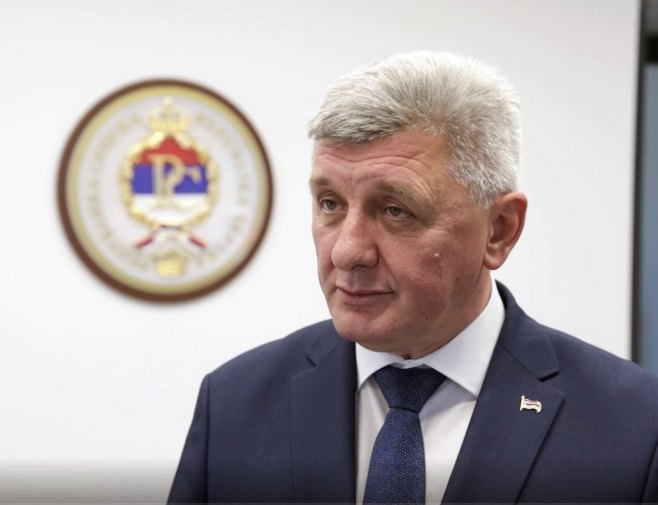

Political and geopolitical circumstances are now favorable for the National Assembly of Republika Srpska to adopt a new constitution that would firmly safeguard the rights granted to the Serb people under the Dayton Peace Agreement, Republika Srpska Minister of Scientific and Technological Development and Higher Education Draga Mastilović told SRNA.
Mastilović argued that Republika Srpska has the constitutional right to adopt its own fundamental legal document and that the current political environment provides an opportunity to strengthen its institutional position.
“We know that the Constitution of Republika Srpska has been amended several times, largely through what I consider legal coercion by the High Representatives in BiH. However, we must bear in mind the clear fact that Republika Srpska has the right to adopt its own constitution,” Mastilović said.
New constitution to safeguard rights under the Dayton Agreement
According to Mastilović, the conditions for adopting a new constitution have matured, much as they did in 1992, when Serb political leaders adopted the first Constitution of the Republika of the Serb People in BiH.
He emphasized that Republika Srpska’s constitutional position was subsequently recognized through the Dayton Peace Agreement.
“Everything that part of the international community, particularly the High Representatives, has done over the past 30 years has been to the detriment of the Serb people, as they have sought to undermine the institutions and even the Constitution of Republika Srpska,” he claimed.
Mastilović said that a new constitution should primarily safeguard the rights of the Serb people while also respecting the rights of the other constituent peoples.
He expressed confidence that Republika Srpska possesses the institutional and political capacity to continue strengthening its constitutional status.
Mastilović criticizes political rhetoric in Sarajevo
The minister described Republika Srpska as a democratic society that guarantees peace and stability to all its citizens.
He contrasted this with the Federation of BiH, where, he claimed, incidents and provocations targeting Serbs occur frequently.
“I have not seen anyone in Republika Srpska being attacked because they were carrying a particular flag or wearing a football club jersey. Unfortunately, such incidents have become an everyday occurrence in Sarajevo,” Mastilović said.
He attributed these tensions to what he described as negative political propaganda coming from Sarajevo.
According to Mastilović, political leaders in Sarajevo have become increasingly frustrated because their expectations that Republika Srpska would be weakened have not materialized.
He argued that political representatives in Sarajevo must abandon what he characterized as wartime political objectives if they want Republika Srpska to remain within BiH.
“BiH can exist only if Republika Srpska exists within it,” Mastilović emphasized.
He also called for changes in political rhetoric and attitudes toward the Serb people.
“They must change their wartime rhetoric and mythology, which, unfortunately, have shaped entire generations of young people. They have raised them to hate their closest neighbors,” he claimed.
Warning over the rise of neo-Nazism and neo-fascism in Europe
Mastilović also expressed concern about what he described as the resurgence of Nazism, neo-Nazism and neo-fascism across Europe, as well as the growing visibility of Ustaša ideology in the region.
He argued that Serbs were among the first European peoples to confront these ideologies during the conflicts of the 1990s.
“In the 1990s, Serbs were the first to confront neo-Nazism and neo-fascism in Europe. Many people did not understand this at the time. Once again in history, Serbs stood in the way of that evil,” Mastilović stated.
He also pointed to what he described as a contradiction in Sarajevo, where some streets still bear the names of individuals he identified as Nazi ideologues, while political representatives publicly emphasize anti-fascist traditions.
Concerns over Ustaša ideology in Croatia
Mastilović expressed particular concern about developments in Croatia, claiming that the resurgence of Ustaša ideology has become increasingly visible.
He also criticized what he described as Europe’s passive response to these developments.
The minister alleged that Germany and several other Western countries supported Croatian and Muslim forms of neo-Nazism during the 1990s, referring to the glorification of the Handschar Division and Muslim military formations associated with the Second World War.
“What is particularly concerning is that so many young people in Croatia today have been influenced by Ustaša ideology. There are now more followers of Nazi ideology than there were in 1941,” Mastilović claimed.
He warned that European institutions should take the issue seriously.
“If this does not concern Europe, then we truly have a major problem,” he said.
Call for a stronger response to extremist ideologies
Mastilović concluded that Republika Srpska and other countries should take a clear position against the resurgence of extremist ideologies.
“Republika Srpska must take a clear stand on this issue, and not only Republika Srpska, but all free countries,” he emphasized.
“We must confront the evils of the 20th century, such as Nazism and fascism. Otherwise, they will destroy us,” Mastilović warned.
Source: RTRS