

Republika Srpska authorities are preparing amendments to existing legislation in order to implement conclusions adopted under a resolution banning the glorification of the ideology and symbols of the Independent State of Croatia (NDH), as well as Ustasha, Nazi and Fascist ideologies and symbols.
Republika Srpska is preparing amendments to its Criminal Code that will classify the public promotion and glorification of Ustashism and the ideology of the NDH as a criminal offense.
These activities stem from the Resolution on the prohibition of the glorification of the NDH and Ustasha, Nazi and Fascist ideology, adopted by the National Assembly of Republika Srpska in March this year.
In addition to changes to the Criminal Code, amendments to the Law on Cemeteries and Funeral Activities are also being prepared in order to enable the removal of monuments and symbols that glorify these ideologies.
The Government of Republika Srpska has confirmed that a draft law has already been prepared and is currently undergoing the legislative procedure, while work is simultaneously underway to establish a working group tasked with drafting additional legal solutions.
According to officials, the goal is to create an institutional response to the revival of NDH symbols and ideology in public spaces.
The resolution condemning and prohibiting the promotion and glorification of the ideology and symbols of the NDH, as well as Ustasha, Nazi and Fascist ideologies and symbols, which sparked considerable political debate, was adopted by the National Assembly of Republika Srpska on March 17.
It entered into force after the Constitutional Court of Republika Srpska, ruling on a veto submitted by Bosniak and Croat delegates in the Council of Peoples, determined that the resolution represented a political act expressing Republika Srpska’s position toward the ideology and symbols of the notorious NDH.
Two conclusions were adopted alongside the resolution.
The first conclusion instructed the Government to prepare amendments to the Law on Cemeteries and Funeral Activities within 60 days and submit them to the National Assembly. The amendments are intended to regulate the removal of monuments and symbols that promote and glorify the ideology of the NDH and Ustasha, Nazi and Fascist ideologies, and which offend the religious, moral and national sentiments of the Serb people.
Under the second conclusion, the Government was tasked with proposing amendments to the Criminal Code within the same timeframe and introducing a criminal offense targeting individuals who publicly promote, glorify, support or encourage the positive evaluation or acceptance of Ustashism and the Ustasha ideology of the NDH through public communication channels, public gatherings or other means.
The Government of Republika Srpska stated that the National Assembly delivered the resolution and accompanying conclusions on May 27.
“The Ministry of Justice of Republika Srpska, as the authority responsible for the Criminal Code, has prepared a draft law introducing a new criminal offense – public promotion and glorification of Ustashism and the Ustasha ideology of the Independent State of Croatia. The draft law is currently in procedure,” the Government confirmed.
Officials also noted that relevant ministries are working on amendments to the Law on Cemeteries and Funeral Activities and that an interdepartmental working group will be established to prepare the draft legislation before it is submitted to the National Assembly.
“The objective of the new law will be to regulate the removal of monuments and symbols that promote and glorify the ideology of the NDH and Ustasha, Nazi and Fascist ideologies,” the Government stated.
Srđan Mazalica, head of the SNSD parliamentary group and chairman of the National Assembly Committee for Donja Gradina, the largest execution site of the Jasenovac concentration camp during the NDH era, said that Republika Srpska remains determined to carry out the adopted measures.
Mazalica stated that additional activities are underway, including communication with international institutions, translation of the resolution into English and its distribution to relevant international addresses in order to coordinate efforts against the ideology of the NDH.
He previously said that the resolution was not adopted merely for symbolic purposes, but as a concrete step toward confronting the legacy of the ideologies listed in the document.
According to unofficial information, however, there is a strong possibility that the proposed legislative amendments could also face a veto once they enter the adoption process.
Within Republika Srpska, public attention has largely focused on a monument located in the Catholic cemetery in Modran near Derventa, notable for its “U” shape and a checkerboard design featuring a white first field. No other potentially controversial symbols have been publicly discussed.
In late May, Ustasha insignia were removed from the monument in Modran. The disputed elements were voluntarily removed by representatives of the Croat community and families of the deceased.
The move was described in Derventa as a reasonable and responsible act demonstrating that respect for victims and remembrance of one’s own dead should not become a source of division. Local media reported that the removal was necessary to prevent tensions and preserve good relations in the community despite the difficult wartime legacy.
The Museum of Genocide Victims in Belgrade is also actively involved in efforts to remove controversial symbols. Following initiatives launched by the institution, the Spanish government decided on April 14 to remove Ustasha insignia from the grave of Vjekoslav Maks Luburić, one of the most notorious war criminals of the 20th century, who was responsible for the deaths of hundreds of thousands of Serbs during the Second World War.
The museum stated that it has identified several hundred Ustasha symbols displayed in public spaces across Europe and around the world and is actively working on creating a database that could facilitate their removal.
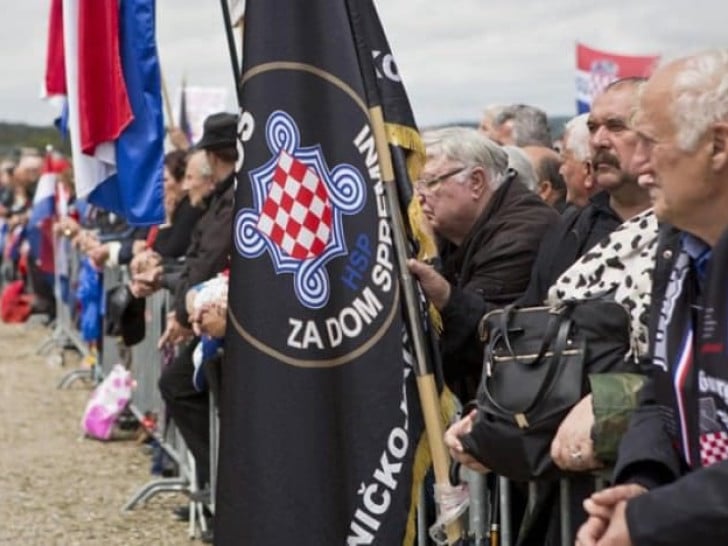
“Za dom spremni”
The resolution states that the NDH was established following the occupation and partition of the Kingdom of Yugoslavia under the patronage and with the full participation of the Axis powers. During the Second World War, it committed genocide against Serbs, carried out the Holocaust against Jews and perpetrated genocide against the Roma people, known as Samudaripen.
The resolution also expresses concern over what it describes as the revival of NDH ideology, symbols and slogans in the region, including the NDH flag featuring a white first field in the checkerboard design, the Ustasha symbol “U”, the slogan “Za dom spremni” and the insignia of the Handžar Division.
Source: Glas Srpske