


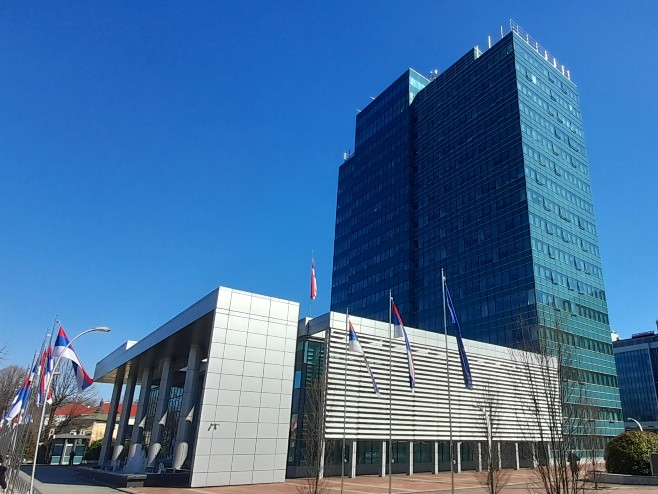
The Government of Republika Srpska has accused the Office of the High Representative (OHR) of grossly misrepresenting the political situation in BiH, undermining the Dayton Peace Agreement and obstructing the restoration of democratic institutions, sovereignty and the rule of law.
In its 36th report to the United Nations Security Council, the Government emphasizes that all parties in BiH, as well as international actors operating in the region, must respect the Dayton Peace Agreement and work toward restoring functional democratic processes, full sovereignty and the rule of law.
The report argues that the OHR continues to engage in destructive activities while submitting repetitive reports that distort the actual situation in BiH and misrepresent the causes of the country’s institutional dysfunction.
“This is hardly surprising, given that the OHR has always been the principal cause of that dysfunction rather than a source of solutions,” the report states.
According to the Government, BiH has become an example of a failed state-building experiment conducted by foreign diplomats through persistent interference, with limited understanding of the region’s culture and history and insufficient respect for the Constitution of BiH established at Dayton.
Government accuses OHR of undermining constitutional order
The report argues that international interventionism has weakened the rule of law, seriously damaged BiH’s constitutional framework and deepened mistrust among its constituent peoples.
It further claims that foreign involvement continues to encourage centralization in violation of the Dayton Peace Agreement, the Constitution of BiH and the Constitution of Republika Srpska.
The Government particularly criticizes successive high representatives, including Christian Schmidt, whose legitimacy it disputes.
According to the report, high representatives have disregarded constitutional provisions requiring legislation to be adopted by domestic legislative institutions through established democratic procedures.
The Government argues that their interventions have distorted BiH’s political culture and decision-making processes to such an extent that describing the country as a colony would be an understatement.
It maintains that even colonial administrators are accountable to some authority, while high representatives have exercised powers without meaningful oversight.
UN Security Council urged to support annulment of imposed legislation
The report accuses foreign officials of exercising arbitrary authority without accepting supervision from legitimate international institutions.
It claims that international interference has transformed BiH’s judiciary into an instrument of political confrontation, criminalized freedom of expression, contributed to the removal of democratically elected leaders and facilitated attempts by state-level institutions to assume control over public property.
The Government maintains that such actions violate constitutional provisions which, in its interpretation, assign ownership of public property to the entities.
According to the report, restoring the rule of law requires removing from BiH’s legal system all acts imposed by high representatives, including Christian Schmidt, that conflict with the Dayton Peace Agreement and the Constitution of BiH.
“The UN Security Council should fully support the annulment of these unlawful acts. This would create the conditions for BiH’s domestic institutions to focus on resolving the country’s problems,” the report states.
The Government emphasizes that Republika Srpska has consistently demanded respect for the Constitution of BiH agreed at Dayton, both domestically and internationally.
It rejects allegations that insisting on constitutional rights represents obstruction, political intransigence or separatism.
Instead, the report describes this position as a principled commitment to the rule of law.
October elections demonstrate support for Republika Srpska’s policies
The report also addresses the elections held on October 4, which it describes as widely recognized as free and fair.
According to the Government, voters in Republika Srpska delivered an unequivocal message by giving the governing coalition a convincing victory.
The report interprets the result as a clear democratic mandate to continue existing policies, including defending Republika Srpska’s rights under the Dayton Peace Agreement and opposing what it describes as unlawful and authoritarian actions by the high representative.
The Government emphasizes that the coalition achieved its victory despite Schmidt’s decision prohibiting its two largest parties from receiving public funding to which they were otherwise legally entitled.
It argues that the election results confirm strong support among Serbs, as a constituent people, for preserving entity competencies and the power-sharing mechanisms guaranteed by Dayton.
The report particularly highlights the issue of public property, which Republika Srpska considers an inseparable element of its territorial and constitutional integrity.
Minić pledges to represent all citizens of Republika Srpska
Following his victory in the election for President of Republika Srpska, outgoing Prime Minister Savo Minić delivered a message of unity, according to the report.
Minić pledged to serve as president of all citizens of Republika Srpska, regardless of their religion or ethnicity.
The Government emphasizes that Republika Srpska and its leadership remain firmly committed to the Dayton Peace Agreement and are prepared to cooperate with Bosniak and Croat political parties that share this commitment.
Despite continuing political and ethnic divisions, the report identifies numerous areas in which agreement could be reached.
These include measures supporting BiH’s progress toward European Union membership while preserving the constitutional competencies of its entities.
The Government expresses its willingness to cooperate with Bosniak and Croat representatives to build a more peaceful and prosperous future for all citizens of BiH.
It also calls for an end to political obstruction that, according to the report, has delayed the implementation of numerous development projects.
Election results strengthen calls for constitutional sovereignty
The report highlights the election of Željka Cvijanović and Darijana Filipović as the Serb and Croat members of the Presidency of BiH, respectively.
According to the Government, both represent political parties advocating the restoration of BiH’s sovereignty and democratic constitutional order through ending what the report describes as the high representative’s unlawful assumption of unlimited powers.
“The peaceful and orderly conduct of the elections demonstrates the strong democratic capacity of our citizens and leaves no doubt about the legitimacy of the support enjoyed by Republika Srpska’s governing institutions,” the report states.
However, the Government argues that the successful conduct of the elections cannot erase what it considers serious and unlawful abuses of authority during the pre-election period.
It maintains that these actions undermined the constitutional order established by the Dayton Peace Agreement.
Government raises concerns over Schmidt’s involvement in electoral system
The report expresses deep concern over what the Government describes as Christian Schmidt’s illegitimate interference in BiH’s electoral system.
It reiterates Republika Srpska’s position that Schmidt was not appointed with the necessary approval of the UN Security Council and lacks the support of the parties to the Dayton Peace Agreement.
According to the Government, Schmidt imposed decisions that resulted in millions of convertible marks being allocated from Central Bank of BiH funds for electoral technologies that had not been adequately verified.
The report alleges that these decisions violated constitutional procedures.
It also criticizes Bosniak political representatives, including officials within the Ministry of Finance and Treasury of BiH.
According to the report, a Bosniak deputy minister bypassed the minister appointed from Republika Srpska and signed payment orders connected to the procurement.
Central Election Commission accused of promoting centralization
The Government also challenges the composition and activities of the Central Election Commission of BiH (CEC).
The report alleges that the Commission’s membership is legally invalid because mandatory public competition procedures and candidate selection through the relevant parliamentary committees were bypassed.
It further claims that the CEC has become a partisan instrument of centralization.
According to the Government, former advisers to opposition politicians were appointed to positions designated for Serb representatives, while certain Bosniak members maintain close connections with Sarajevo-based political structures.
The report also alleges that some Commission members remained in office after reaching the legally prescribed retirement age.
The Government argues that the CEC’s objective is to deprive Republika Srpska of what it considers its constitutional right to independently organize and conduct elections at the entity level.
Smartmatic technology raises data security concerns
The report raises additional concerns about the introduction of electronic voter identification and ballot scanners supplied by Smartmatic.
According to the Government, these technologies were introduced without sufficient agreement among domestic political actors or transparent testing.
It argues that their implementation creates potential risks to digital sovereignty and data security.
The report states that concerns about Smartmatic systems have also been raised in the European Union and the United States.
It refers to US indictments against senior Smartmatic executives involving allegations of bribery and financial misconduct connected to obtaining election contracts.
The Government cites these cases as justification for its reluctance to place unconditional trust in electronic electoral systems managed by foreign entities.
It expresses particular concern about the possibility of access to public databases, including citizens’ biometric information.
The report argues that the introduction of such technologies requires greater transparency, oversight and guarantees concerning the protection of sensitive data.
Republika Srpska calls for legal and political response
In its concluding assessment, the Government maintains that the election results clearly demonstrate public support for Republika Srpska’s leadership.
Nevertheless, it argues that alleged systemic violations involving international intervention
Source: RTRS