


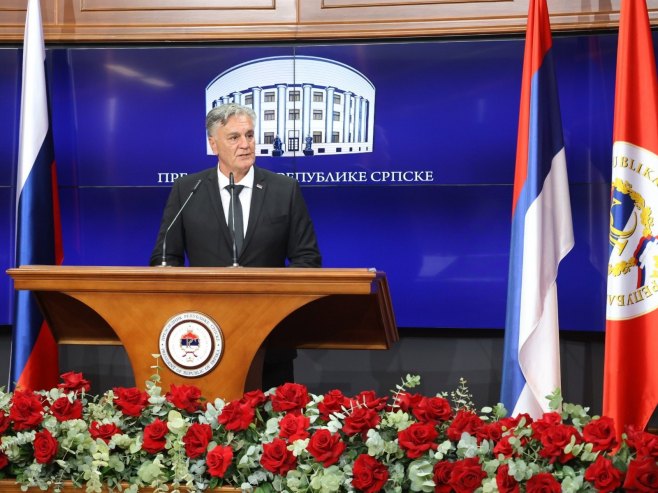
Republika Srpska President Siniša Karan said that historical memory and a culture of remembrance are important for preserving national identity, Republika Srpska and its institutions, emphasizing the significance of Serbia and Republika Srpska jointly commemorating major historical events.
He said that preserving identity and history, together with the full legitimacy of the people’s will, provides the foundation for strong institutions and the preservation of Republika Srpska.
Karan recalled that he recently had the honor of attending the commemoration in Greece marking 110 years since the Serbian army landed on Corfu.
He described joint commemorations as one of the key expressions of the shared identity of the Serb people, linking them to the Declaration adopted at the All-Serb Assembly on the protection of the national and political identity and common future of the Serb people.
“Every one of our children, every citizen, should spend at least one day visiting the Blue Tomb, Corfu and the island of Vido, where our heroes are buried,” Karan told ATV.
He said that joint school excursions for students from Republika Srpska and Serbia, including visits to Donja Gradina and other sites of suffering, are among the points included in the declaration.
“A people that does not value its past and does not know how to honor all the sacrifices made throughout its history can hardly build the right values in the present and the future,” Karan said.
Speaking about the significance of January 9, Karan said the date should be viewed in the context of the establishment of Republika Srpska.
He said Republika Srpska was established before the outbreak of armed conflict in BiH, following the outvoting of Serb representatives in the then Assembly of the Socialist Republic of BiH. He described its establishment as both a political response and one shaped by historical memory and the desire to prevent a repetition of the suffering of the Serb people.
“Had Republika Srpska not been created, I have no doubt that there would be no Serb people in BiH today, or they would have been reduced to a national minority,” Karan said.
Preserving Republika Srpska’s constitutional position is key to its stability
Karan said that the will of the people, strong institutions, economic self-sustainability and respect for the Constitution and the Dayton Peace Agreement are essential to preserving Republika Srpska.
He said Republika Srpska had faced numerous pressures over the past three decades, but argued that its institutions and popular support had enabled it to endure.
“The will of the people is crucial. Republika Srpska was created by its people,” Karan said.
He said various Republika Srpska institutions had come under pressure, including the office of the president, the National Assembly and the Government, but maintained that strong public support had consistently stood behind those institutions.
Karan emphasized the importance of the BiH Constitution, contained in Annex 4 of the Dayton Peace Agreement, saying that it provided international legal recognition of Republika Srpska.
“Internally, Republika Srpska, as a separate federal unit, has full sovereignty,” Karan said.
He argued that decisions by successive high representatives had altered competencies and BiH’s constitutional structure outside the constitutional amendment procedure.
“Only what is changed through the Constitution can be legitimate, legal and permanent, and the Constitution can only be changed in matters to which Republika Srpska gives its consent,” Karan said.
He also said Republika Srpska was economically self-sustaining, which he described as an important foundation for political autonomy.
“There can be no political independence without economic independence, especially today in this multipolar world, where it has become clear that without economic stability you are very easily exposed to political influence,” Karan said.
He added that economic stability was essential to the overall stability of Republika Srpska.
“Republika Srpska is also a secure environment, and security is our priority,” he said.
Speaking about the BiH Constitutional Court, Karan criticized its current composition and claimed that it had issued numerous decisions affecting Republika Srpska without adequate constitutional grounds.
“They have certainly caused greater harm than all the high representatives in BiH. High representatives represent sheer tyranny and force, but it is very difficult to explain how the Constitutional Court can make decisions that have no constitutional basis,” Karan said.
He argued that such decisions were part of what he described as continuing efforts to centralize BiH.
“The essence of those decisions was centralization. In a unitary BiH, the Serb people would no longer be equal,” Karan concluded.
Source: RTRS