


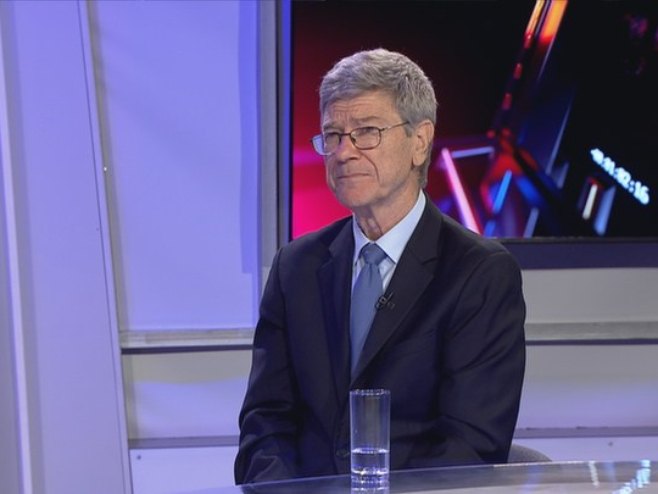
Republika Srpska is pursuing the right policy by developing relations with a broad range of international partners, renowned American economist and geopolitical analyst Professor Jeffrey Sachs said in an interview with RTRS program “Drugi ugao.”
Commenting on Republika Srpska’s relations with Serbia, Russia, China, Israel and, increasingly, the United States under the current administration, Sachs said he viewed such an approach positively, although he noted the limitations facing small economies.
“That policy is right, but there is a limitation because this is a very small country. The right policy would be for Europe to say the same thing that you said BiH wants to do: ‘We want good relations with Russia. We want good relations with China. We want good relations with the Arab world. We want good relations with Iran. We want good relations with Israel. We want good relations with the United States.’ That is what they should be saying,” Sachs said.
He criticized what he described as Brussels’ tendency to divide the world into allies and adversaries, arguing that such an approach was counterproductive.
According to Sachs, Europe had economically harmed itself through sanctions against Russia without achieving its stated objectives.
“It did not end the war because the war is based on something else. The war is based on Russia’s national security concerns. It did not force Russia to back down or declare defeat or anything of the sort. All it achieved was higher electricity, gasoline and diesel prices. That is completely counterproductive,” Sachs argued.
As an economist, Sachs said BiH should remain open to international trade, promote its export sectors and strengthen competitiveness.
“For a country of around three million people in total, it is a small economy, whether you look at the two parts or the economy as a whole. It has to be an open economy,” he said.
Sachs argued that geopolitical tensions were making such an approach more difficult, particularly when it came to relations with China.
“Economically, you want good relations with China. It is an incredible economy, highly competitive. You want Chinese investment here. If Europe says, ‘No, no, no, you want to become part of Europe, you cannot have Chinese investment,’ that is a major problem, but also a major mistake by Europe,” Sachs said.
He argued that Europe should stop viewing international economic relations as a zero-sum game and move away from what he described as increasing militarization.
“We can have peace, we can have good relations with China. Then, when BiH says, ‘We are receiving good Chinese investment,’ Europe should say, ‘Great, that is good for us.’ But we are not there yet. This is partly a mindset that needs to change in Brussels,” Sachs said.
Sachs: Europe needs a different approach to Russia and China
Sachs said Europe had yet to fully understand its place in the changing international system.
“That is why joining Europe is not such a joy right now, because Europe is so confused about what it should do with Russia and what it should do with China. I want BiH to join a successful Europe, not an unsuccessful Europe,” he said.
Sachs said he expected to visit Brussels in the coming weeks and would once again advocate a change in European foreign policy.
“I tell them: ‘Change your foreign policy in order to succeed. Stop waging war with Russia. Stop this war in Ukraine. Stop antagonizing China,’” Sachs said.
He said he would like to see the Western Balkans more closely integrated into European planning, financing, infrastructure development and European Investment Bank programs without further delays.
At the same time, he argued that Europe should pursue more pragmatic relations with Russia and China.
“That would actually provide an enormous boost to this region,” Sachs said.
Speaking about the Western Balkans, Sachs said the region’s geographic position between different cultures, economies and geopolitical centers could be a major advantage in peaceful conditions.
“This is an excellent connecting region between Europe and Asia, for example. That is precisely what has made this region so complex for perhaps one or two thousand years, because it is a kind of frontier between many cultures and many civilizations,” he said.
“In a properly functioning, peaceful world, being at the crossroads of many cultures is a great advantage. You become a hub connecting with Russia, a hub connecting with Türkiye, a hub connecting with the European Union and a hub connecting with the Middle East,” Sachs added.
He warned, however, that the same geographic position becomes a serious challenge during periods of confrontation between major powers.
“If the major powers are fighting, it is very difficult for a country like BiH to find its way when there is a struggle between the European Union and Russia and this country is somehow in the middle in every sense — physical geography, culture, history and trade ties,” Sachs said.
He argued that negotiations, rather than continued military confrontation, were necessary to end the war in Ukraine.
“You have to end this militaristic approach. You have to end the idea that you or Ukraine are going to defeat Russia. That is not going to happen. You have to negotiate, resolve this issue, stop NATO enlargement, reach Ukrainian neutrality and peace, and then the Western Balkans will do much better,” Sachs said.
Sachs: Countries should be responsible for their own future
Asked whether a country could fully develop democratic institutions while a foreign official has the authority to impose laws and remove elected officials, Sachs said it could not.
“Countries should be responsible for their own future,” Sachs said.
He argued that without outside intervention, different parts of BiH that disagree with one another could find it easier to reach solutions directly.
“When an outside power is present, you say, ‘Oh, we will get favoritism for this side, we will maneuver for this side.’ You do not get the direct contact that you need,” he said.
Sachs said his broader view was that neighboring countries and communities should work out their differences directly, while distant powers should avoid unnecessary interference.
“Generally, in any region of the world, neighbors should get along with one another, and countries on the other side of the world should stay out. That is my personal view,” he said.
He added that problems in BiH should primarily be resolved within the region, while the European Union should seek normal relations with other major powers, including Russia.
Geography and geopolitics shape BiH’s economic prospects
Sachs said BiH could not escape the economic realities created by its geography.
“Geography tells you: ‘Here is how I can trade best. Here are the resources I have.’ What determines whether that works or not is the surrounding geopolitics,” he said.
He argued that conflicts in Ukraine, Gaza and Iran were creating negative economic and security consequences for the region, including higher energy costs and greater uncertainty.
“Everyone needs to be a little more practical, a little more peaceful and a little less belligerent, and we will get much further,” Sachs said.
Asked about the possibility of another energy crisis, Sachs said recent years had been discouraging because of a succession of wars that he believed could have been avoided.
“The war in Ukraine should never have happened. It should have been stopped. It could have been stopped. The war in Gaza was terrible. In my view, Israel’s violence was terrible. The war in Iran was the most absurd, tragic war, so detached from reality that it certainly should never have happened,” Sachs said.
Despite this, he said he remained optimistic that governments could learn from what he considers the mistakes of recent years.
“On the one hand, it is easy to be pessimistic because so many mistakes have been made. On the other hand, I remain optimistic because I keep thinking that once all these mistakes have been demonstrated to be mistakes, now is the time to do the right thing,” Sachs said.
He pointed to recent diplomatic contacts between major powers as potential signs of a shift toward greater stability.
“Maybe the summit that has just taken place between the United States and China is a good signal that we are returning to some peace and stability. So, if you ask me, I am optimistic because I think we cannot continue making the same mistakes over and over again,” Sachs concluded.
Source: RTRS