

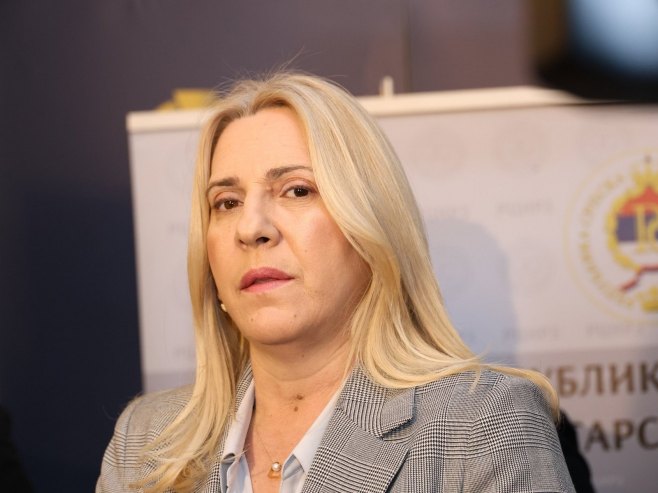
Serb member of the BiH Presidency Željka Cvijanović said Republika Srpska would not remain captive to the political agendas of Bosniak politicians, arguing that such narratives were increasingly failing to gain traction internationally.
She said that efforts aimed at further centralizing BiH and reducing the competencies of Republika Srpska had reached their limits.
Cvijanović said she received an invitation to a reception in New York hosted by U.S. President Donald Trump because of what she described as the good contacts Republika Srpska has developed with the Trump administration.
She described the invitation as significant recognition for Republika Srpska and said it marked the first time that a Serb member of the BiH Presidency had attended the reception.
Cvijanović rejected claims from political figures in Sarajevo that the invitation had been paid for, describing such allegations as insulting and unfounded.
“They can say whatever they want. However, everyone making claims that something like this was paid for is recorded in the system. You cannot imply that an administration is corrupt and does something because it received money,” Cvijanović said.
She criticized Bosniak member of the BiH Presidency Denis Bećirović over his appearance at the United Nations, claiming that he had gone there primarily to criticize Republika Srpska and Serbia.
According to Cvijanović, representatives of other countries have grown tired of such narratives.
“They say that Bosniak politicians talk about the past, that they are prisoners of their political agendas and are unable to move forward, and then we are expected to respond to that. We are not the same, and we cannot be prisoners of their political issues because those issues no longer find fertile ground internationally,” she said.
Cvijanović said it had been necessary for Republika Srpska to improve its relations with the West, particularly the United States. She said Republika Srpska had anticipated Trump’s return to the presidency and had worked on developing contacts during the four years he was out of office.
“We found our place there,” Cvijanović said, adding that this had eased pressure on Republika Srpska.
She said that in previous years it had been difficult to imagine representatives of Republika Srpska entering the White House and holding talks with U.S. officials.
“Today, the doors are opening. Today, we are going in,” she said.
Cvijanović also argued that what she described as political overreach in BiH must end, noting that the imposition of laws had already stopped.
She criticized Bosniak political leaders for focusing on reducing Republika Srpska’s competencies rather than economic and social issues such as salaries and pensions.
“I say they will not reduce them anymore. We know what we need to do, and that is to continuously strengthen Republika Srpska through the development of local communities, overall development and greater support for individuals, families and different groups in society,” Cvijanović told K3.
She said the Trump administration had sent clear messages that it did not intend to act as a tutor in BiH and that domestic political actors should reach solutions themselves.
According to Cvijanović, the absence of references to the Bonn Powers represents a change in Washington’s approach toward BiH.
She said that in the coming years she intended to return to major international political centers, arguing that further diplomatic work was necessary to ensure Republika Srpska remained peaceful, stable and secure.
“There are several countries and governments in Europe that are very hostile, but I am encouraged that there are more of those who understand the situation here,” Cvijanović concluded.
Cvijanović: Republika Srpska must actively represent its interests in BiH institutions
Cvijanović also said Republika Srpska must actively represent its interests within BiH-level institutions and should not allow any individual political actor to speak on behalf of the entire country when there is no agreement among its constituent elements.
She said one of BiH’s main challenges remained establishing more stable internal relations and reducing political tensions while preserving peace and stability.
Political disputes, she argued, should be resolved within institutions rather than through outside intervention.
Cvijanović said BiH lacked a coherent internal policy, making it difficult to pursue a coherent foreign policy. She also criticized the way the country’s diplomatic and consular network operates.
“It is no longer primarily a question of individual appointments, but rather of this renegade diplomatic activity being conducted under Sarajevo’s direction,” Cvijanović said.
Speaking about political relations within BiH, she claimed that interventions by high representatives had contributed to tensions and crises.
“The tensions and crises were caused by interventions by high representatives, in coordination, of course, with the Bosniak political bloc,” Cvijanović said, adding that she believed this was no longer the case.
She said that when acting within BiH’s joint institutions, her priority was to protect the interests of Republika Srpska.
Cvijanović added that she viewed this obligation as a responsibility toward the people living in Republika Srpska.
Reflecting on her mandate in the BiH Presidency, she described it as intensive and turbulent, marked by numerous international activities and contacts, while trust and dialogue among political actors at the BiH level remained limited.
Source: RTRS