
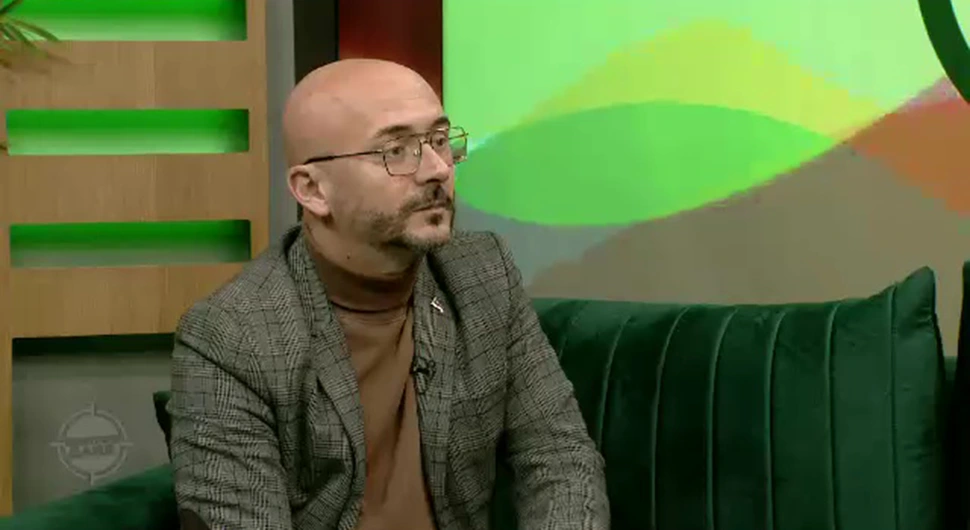
This year’s marking of Republika Srpska Day passed without pressure or open threats from international circles, which represents a significant shift compared to previous practice, said economic diplomacy expert Siniša Pepić while appearing on the RTRS morning program.
He assessed this as a clear indication of changing attitudes toward Republika Srpska and a weakening of narratives that for years came from Brussels and political Sarajevo.
“Republika Srpska was created by the will of the Serb people in peacetime, and it is the people who decide how their holidays will be celebrated. The international factor remained silent on this issue, unlike in previous years when there were threats and strong pressures to abolish Republika Srpska, relying on the narrative of political Sarajevo together with U.S. Ambassador Murphy and, I can freely say, the outgoing usurper of the office, Christian Schmidt,” Pepić said.
He emphasized that this shows Republika Srpska is entering a phase in which it has more friends in international relations.
“Essentially, the only remaining adversary is the current usurper of the position of high representative, Schmidt. This tells us that everything we have done over the past years—from the standpoint of both the Constitution and international law defining the position of Republika Srpska—has borne fruit,” Pepić said.
He added that in recent days he had the opportunity to speak with Eduard Husson, who said he could not understand how people in Brussels are so deaf to reality and to the obvious facts presented by Republika Srpska.
“This is a professor who is apolitical and speaks from a scholarly perspective. He approaches the issue as a scientist should—by analyzing and stating that the arguments put forward by Republika Srpska are so evident that the professional and political public must provide an appropriate response to everything happening in Bosnia and Herzegovina, in order to ensure stability, but not at the expense of the Serb people,” Pepić said.
He also spoke about the key problems of the European Union and how those processes have been reflected in Bosnia and Herzegovina.
“In Bosnia and Herzegovina, they found fertile ground because Bosniak political elites recognized in this their hidden agenda—the desire to take control of the country and of our lives. They would decide which holidays we may or may not celebrate. Imagine what life would be like in a unitary Bosnia and Herzegovina—it would resemble the life of an average Christian in the EU, where political and radical Islam have devastated society. Those who most loudly swear allegiance to Bosnia and Herzegovina would, in fact, destroy it by realizing their hidden agenda,” Pepić said.
He recalled that just last night several calls could be heard for abolishing the entities, noting that this is all part of a Brussels agenda, political Sarajevo, and political Islam.
“Radical political Islam has taken root on 23 percent of the territory of Bosnia and Herzegovina and has infiltrated the EU. This has been recognized as a global problem that will be addressed in the coming years. Republika Srpska and the Serb people are, once again, standing on the ramparts of Europe in defense of Christian values. Current geopolitical circumstances show that this problem is being recognized globally and that Republika Srpska is on the right side of the geopolitical relations unfolding today,” Pepić said.
He stressed that the key problem no longer lies with the leading global powers—Russia, China, and the United States—with whom Republika Srpska has found common ground. The problem, he said, lies in Brussels.
“The problem with Brussels was best defined by Péter Szijjártó, who during his first visit to Republika Srpska made a statement that opened many channels and forced others to start listening. He said that Serbs should not be talked about, but talked with. That is precisely what Brussels lacks. Brussels’ ‘woke’ ideology is opposed to the ideologies of Budapest, Slovakia, and many other countries that are rebelling against official Brussels policy, which over the past ten years has nullified everything upon which Europe was founded,” Pepić noted.
He added that over the past decade Brussels has tried to negate faith, nation, state, and family—values that form the core of every Serb and of Serb identity.
“All of this has been trampled upon, and we see that Brussels has gone deep into ‘woke’ ideology and neoliberal positions that are now in direct opposition to the ideologies of the three key powers—the United States, Russia, and China. We only became fully aware of the scale of this imposition of ‘woke’ ideology when Trump released information about projects carried out by certain governmental and non-governmental organizations in other countries, with a focus on our region, aimed at imposing an ideology that negates everything we have been for centuries and upon which we have survived as a nation in this area,” Pepić said.
He concluded that it is evident, when looking at the map and global developments, that political and economic relations are being reshuffled and that a new world order is emerging—one that will be neither multipolar as envisioned by BRICS nor unipolar as envisioned by the Biden administration, but rather the result of an agreement among three major powers: the United States, Russia, and China. Current circumstances, he said, confirm this.
“Because of its positions and its schizophrenic policies, Europe has shot itself in the foot, undermining its social system and everything on which it was built. It was once the heart of the Christian world and culture, as well as a major industrial power. Today, those industries are on the brink of collapse, all as a result of undermining state sovereignty and the right of nations to decide their own fate,” Pepić said.
He believes that the only country capable of bringing change to Europe and returning it to a path of recovery is Hungary.
“The EU will not quickly return to its former paths of glory, because European society was built on diversity, not on creating an artificial European nation. It seems to me that certain structures in Brussels are attempting to form a European faith and religion opposed to Christianity, which shaped social circumstances for centuries,” Pepić concluded.
Source: RTRS