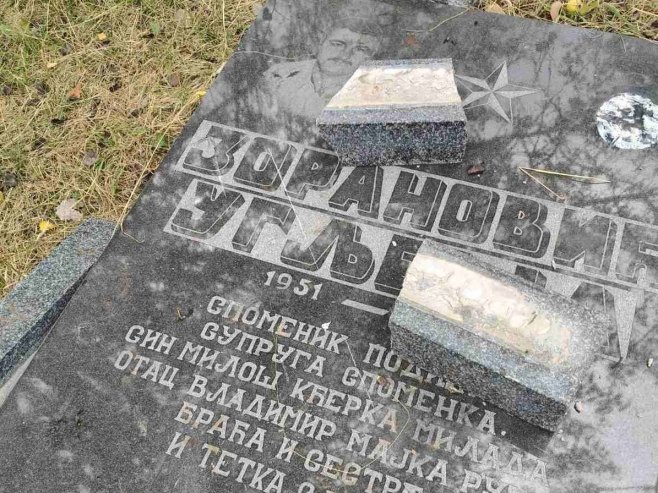

Gravestones at a Serb cemetery in the village of Vučinići, near Kladanj, were vandalized last week, raising renewed concerns among displaced Serb residents about the protection of their property and cultural heritage. Similar incidents have been reported at other Serb cemeteries in the municipality. Before the war, more than 4,000 Serbs lived in the Kladanj area, while today only a small number remain.
Mile Zoranović was just four years old when his family was forced to leave the municipality of Kladanj because of the war.
Returning to the cemetery in Vučinići, his native village, he pointed out damage to his grandmother’s gravestone and several other burial monuments.
“My grandfather and grandmother share a gravestone, although my grandfather died in 1995 and was buried in Vlasenica. Thirty years after the war, I cannot believe that something like this is still happening,” said Zoranović, a former resident of Vučinići.
Gravestones have been knocked down, while photographs of the deceased have been deliberately damaged. According to former residents, such acts of vandalism have occurred repeatedly in recent years.
“I feel sorry for all the deceased whose gravestones have been destroyed. I simply do not understand why anyone would be bothered by people who are no longer alive,” said Rodoljub Stanišić, another former resident of the village.
Repeated attacks on gravestones force families to relocate remains
Zoranović described how photographs attached to gravestones had been smashed with hard objects.
“The photographs on the monuments were broken and struck with hard objects. Milan Gavrilović had his father buried here, and his gravestone was damaged three times. Eventually, he was forced to relocate his father’s remains to Han Pijesak,” Zoranović explained.
Before the war, approximately 200 Serbs lived in Vučinići, with most employed in factories in nearby Kladanj.
According to Stanišić, the village was attacked and burned in May 1992.
“The entire village was attacked and set on fire in May 1992. We still have property there, including our house. It is in a very sad condition. The house was not burned, but it is partially destroyed,” he said.
Serb population in Kladanj declines dramatically
According to the 1991 population census, more than 4,000 Serbs lived in the municipality of Kladanj, accounting for approximately 26 percent of its population.
Before the war, there were 19 Serb settlements in the municipality. Today, according to representatives of the displaced community, only around ten Serb returnees live in three settlements.
Đorđe Radanović, President of the Committee for the Protection of Serb Rights in the Federation of BiH, criticized the lack of basic infrastructure in areas where Serbs might return.
“There is no electricity, no water and no road, and nobody is planning to build them,” Radanović said.
He also raised concerns about offers made to Serb property owners.
“If a Serb owns 200 dunums of land, someone offers him 200,000 KM. One man responded that even a square meter of plastic sheeting costs more, while they were offering him just one mark per square meter of land,” Radanović stated.
Calls for protection of Serb property and cemeteries
Former Serb residents of Kladanj are now scattered throughout Republika Srpska, with the largest number living in Vlasenica.
Vlasenica Mayor Miroslav Kraljević called for urgent measures to protect cemeteries and private property belonging to displaced families.
“The images coming from Kladanj in recent days are deeply disturbing. We appeal to the authorities to take every necessary measure to protect the cemeteries and all property belonging to our people there,” Kraljević said.
“These people want to preserve what belongs to them. They do not want to sell their property,” he added.
Republika Srpska Prime Minister Savo Minić also appealed to the authorities in the Federation of BiH to ensure normal living conditions for Serb returnees and protect their property and cultural heritage.
Minić emphasized that repeated acts of vandalism targeting Serb cemeteries in the Federation of BiH were unacceptable and called for stronger measures to prevent further incidents.
Source: RTRS