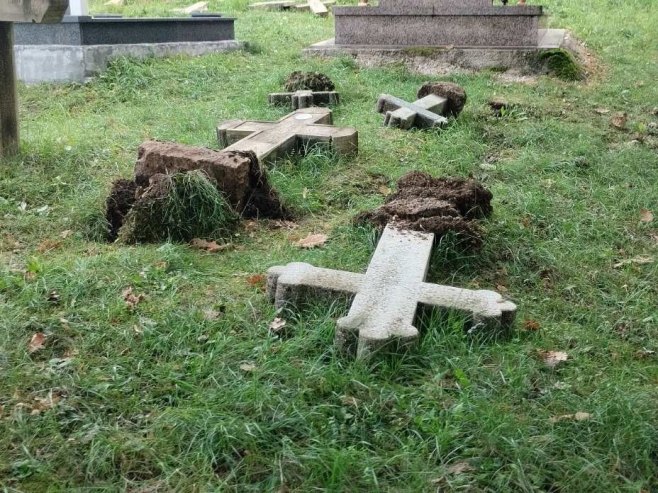


Theologian Nebojša Lazić has warned that attacks on Serbian Orthodox cemeteries in the Federation of BiH represent what he describes as a campaign of cultural erasure aimed at eliminating historical evidence of the Serb population’s presence in the region.
According to Lazić, Orthodox cemeteries have increasingly become targets because they serve as lasting reminders of Serb communities that once lived in areas where their population has since dramatically declined.
“Graves are being targeted because they prove that a people once lived there, created, fought and, as Petar Kočić said, suffered both on Turkish stakes and under Austro-Hungarian ropes. Historically speaking, those people helped create BiH as it exists today,” Lazić stated.
Recent attacks on Orthodox cemeteries near Banovići
Commenting on the recent destruction of wooden shelters at Orthodox cemeteries near Banovići, Lazić expressed concern that those responsible have not been identified.
He claimed that previous similar incidents had also gone unpunished, creating an environment in which perpetrators feel encouraged to repeat such acts.
“Perpetrators continue these attacks because of the lack of public engagement and the failure to treat this issue seriously. Media outlets in the Federation also fail to report adequately on these incidents. In a way, attacking Serb cemeteries, religious sites and monasteries has even become socially acceptable,” Lazić said.
He emphasized that attacks on cemeteries carry particular significance because burial grounds often represent the last remaining evidence of the historical continuity of Serb communities in areas where they no longer live.
According to Lazić, the Serb population in many parts of the Federation of BiH has declined to extremely low levels.
Lazić: Destruction of monuments threatens historical and cultural identity
Lazić argued that the attacks form part of a broader effort to reinterpret history and weaken the cultural and national identity of Serbs.
He accused certain Bosniak political and social circles of promoting a historical narrative that excludes the Serb contribution to the region’s heritage.
“Everything is being done with the aim of cultural erasure, or cultural ethnic cleansing, through the destruction of monuments and evidence of a people’s historical existence,” Lazić stated.
He maintained that Orthodox cemeteries, monasteries and religious monuments are particularly vulnerable because they preserve the memory of communities that have largely disappeared from certain areas.
Criticism of institutional responses and lack of prosecutions
Lazić also referred to reported attacks on minors from Serbia and restrictions on Jewish gatherings in Sarajevo, arguing that these incidents reflect broader problems of intolerance and inadequate institutional responses.
He claimed that existing legal mechanisms have failed to provide effective protection or accountability.
“As a rule, the perpetrators are never found, cases are left in drawers and nothing is done, even though these incidents involve incitement to religious and ethnic hatred and violations of fundamental human rights conventions,” he said.
Lazić criticized the responses of police and other institutions in the Federation of BiH, describing their public statements as largely procedural and lacking meaningful action.
“This is a farce. They try to demonstrate that they are taking action, but they rarely respond or provide information of public importance. Everything is reduced to bureaucratic formulations without substance,” Lazić stated.
He added that some institutional representatives allegedly fail to answer public inquiries despite legal obligations to provide information.
Lazić warns of a recurring pattern of attacks
According to Lazić, the handling of these incidents follows a recurring pattern that contributes to further attacks on Serb communities, property and religious heritage.
“First, the authorities issue statements lacking substance. Then those dry reports appear in the media, and everyone waits for the issue to fade away until the next attack. Unfortunately, these incidents have become a kind of everyday occurrence,” he said.
He argued that the absence of effective investigations and prosecutions encourages further acts of vandalism.
Wooden shelters destroyed at two Orthodox cemeteries
At the beginning of November, a wooden shelter at the Gradina Orthodox cemetery in the village of Lozna near Banovići was cut down and demolished.
The shelter had been built by displaced Serbs originally from the area to provide a gathering place during village religious celebrations and Orthodox memorial services for the deceased.
Several days later, another wooden shelter was destroyed at the Orthodox cemetery in the village of Borovci, approximately three kilometers from Lozna.
Lazić called for greater public attention, stronger institutional accountability and effective protection of Orthodox cemeteries and religious heritage in the Federation of BiH.
Source: RTRS