


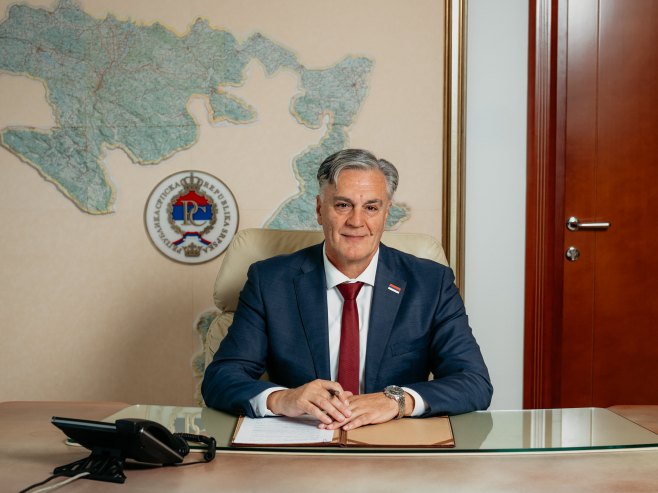
President of Republika Srpska Siniša Karan said that the Day of Serb Unity, Freedom and the National Flag is one of the most important holidays jointly celebrated by Serbia and Republika Srpska, as well as by the Serb people as a whole.
“The powerful symbolism that should be expressed through this joint celebration is, above all, unity. That unity can be understood in several ways, but above all we want to send a strong message that the Serb people, their national and political identity, regardless of where they live, constitute one united people,” Karan said.
He emphasized that this is the central message of the holiday.
Karan recalled that the Declaration of the All-Serb Assembly, which addresses the joint protection of the national and political rights of the Serb people and their common future, was also a response to those who, he said, had opposed the Serb people throughout history.
“The key method of acting against the Serb people is to create disunity among them. I do not mean only political or some other form of disunity, but national and political fragmentation. That is why, throughout history, there have been references to Bosnian Serbs, Croatian Serbs, other Serbs and so on,” Karan told ATV.
According to him, anyone who has targeted the Serb people has sought to undermine their unity and integrity.
“The moment the Serb people lose their integrity, regardless of where they live, they enter a process of assimilation, whether partial or complete. At that point, Serbs practically cease to exist as such, even though they were once constituent peoples, for example, in Slovenia and Croatia,” Karan said.
He added that the holiday symbolically reflects the history of the Serb people wherever they have lived.
“Unity is what preserved the Serb people, above all through all the wars, including World War I and World War II. Although not a particularly large nation in terms of population, the Serb people suffered enormous losses relative to their numbers, particularly in World War I, but also in World War II,” Karan said.
He noted that the holiday is commemorated on a symbolic date marking the breakthrough of the Salonica Front.
Karan said the joint celebration of the most important holidays of Republika Srpska and Serbia is the result of what he described as the best relations between the two, crediting Aleksandar Vučić and Milorad Dodik with building those ties.
Speaking about the national flag, Karan said it represents the unity and freedom of the state.
“Together with Serbia, on February 15, Sretenje, we celebrate Statehood Day and Constitution Day. Through this joint commemoration, we want to bear witness to the shared history and collective historical memory of the Serb people, wherever they may live,” Karan said.
He recalled that the January 9 Declaration on the establishment of Republika Srpska envisaged it as a federal unit within the Federal Republic of Yugoslavia.
“The Serb national body was divided following the breakup of Yugoslavia. That is why unity, freedom and the national flag carry such powerful significance,” Karan emphasized.
Karan also said that the March 1 decision was, in his view, intended to politically marginalize the Serb people and turn BiH into “a state of only one people.”
“That is precisely the point of this strong unity. Therefore, all attacks on the special relations between Republika Srpska and Serbia are anti-Dayton and unconstitutional. They are, above all, a direct negation of the BiH Constitution, which explicitly provides for the right to establish special parallel relationships with neighboring states,” Karan said.
He concluded that denying the special relations between Republika Srpska and Serbia would amount to denying the Serb people, their state-building status and their position as a constituent people.
Source: RTRS