

The most beautiful handball fairytale in Banja Luka was written in 1991, when RK Borac Banja Luka won its second European trophy — the IHF Cup. The triumph came with a team largely made up of players who had grown up in the city on the Vrbas River.
Facts
- Borac won the IHF Cup with a squad averaging just 20 years of age
- The backbone of the team consisted of local players from Banja Luka
- After lifting the trophy, the team jokingly attempted a “changing of the guard” at Red Square in Moscow
The system built in those years, based on a strong local foundation combined with talented young players from across Yugoslavia eager to prove themselves, was producing results. Still, few expected the Yugoslav vice-champions to go all the way and lift the trophy, especially after losing Iztok Puc and Patrik Ćavar following the defeat to Proleter at the end of the domestic season.
Yet the “Banja Luka kindergarten,” as many called the youthful squad, grew stronger with every game. The team’s average age was only 20, while the bench was led by then 35-year-old coach Velimir Petković.
One of the key figures in the title-winning campaign was Samir Nezirević, a local Banja Luka talent who played fearlessly throughout the competition.
“At the beginning nobody believed we could go all the way and win the trophy. We were a young team without European experience. Our first goal was simply to improve and gain experience through the IHF Cup. But as the victories started coming, our confidence kept growing. Borac had a well-organized system, excellent working conditions, and a winning mentality. You have to believe in what you do, because that’s the only way to succeed — and we believed,” Nezirević recalled.
From kayaking and football to handball
Friends from childhood say Nezirević was gifted in every sport he tried — football, basketball, kayaking, or handball.
“It’s true. Some people were good at school, some in sports. I trained kayaking first and even finished seventh in Yugoslavia. I grew up by the river and loved being there. I also trained football, but at that age you just want to score goals. Then we had a month of handball at school. I fell in love with the sport — scoring goals, the emotions, everything.”
Borac’s youth system was extensive. Teachers across schools identified talented children and worked with them. The best would move to feeder club RK Rade Ličina before eventually reaching the first team. Nezirević followed that same path.
An early sign of success came when Borac’s juniors won the Yugoslav championship.
“That trophy was our springboard. Borac had already won trophies at senior level, but not much in youth categories. We became the generation that won the Yugoslav title. Coach Momir Golić led us brilliantly, and we beat Celje in the final. We were already playing against older and stronger teams in the Republic League, and that hardened us.”
The road to the trophy
Borac first eliminated Belgian side Herstal Liège before defeating German team Empor Rostock in both matches.
Then came the semifinal against powerful German club TUSEM Essen, considered the main favorite for the title.
Borac lost the first match in Germany 24:17.
“They surprised us with rough play. The arena was packed with around 10,000 fans, and we weren’t used to that kind of atmosphere. After the match they acted as if qualification was already secured.”
Those comments only motivated the young team further.
“That gave us extra motivation. Coach Petković prepared the return leg perfectly. We flew across the court, driven by our fans. We played unbelievable defense. They didn’t know what hit them.”
Borac stunned the Germans in the return leg and advanced to the final.
The final against CSKA Moscow
Waiting in the final was mighty CSKA Moscow, featuring several Soviet national team players and rising superstar Talant Dujshebaev.
CSKA had already been European champions in 1988 and Cup Winners’ Cup holders in 1987.
Borac won the first leg in Banja Luka by five goals.
“Once we reached the final, we wanted to win it. Dujshebaev was already one of Europe’s biggest talents, but we played brilliantly and earned a five-goal advantage.”
The return match in Moscow confirmed the quality and maturity of the young team.
“There was no relaxation. We went to Moscow to beat them again. Goalkeeper Zlatan Arnautović was incredible, saving penalties and giving us confidence. They won the second leg, but we controlled the match overall and lifted the trophy.”
Celebrations from Moscow to Banja Luka
After the final whistle, celebrations erupted.
“We were like a volcano that had exploded. Everything we had worked for finally paid off. We celebrated from Moscow to Banja Luka.”
The celebrations in Moscow included an unforgettable moment at Red Square.
“We even went to Red Square and jokingly tried to perform a changing of the guard near Lenin’s Mausoleum,” Nezirević laughed.
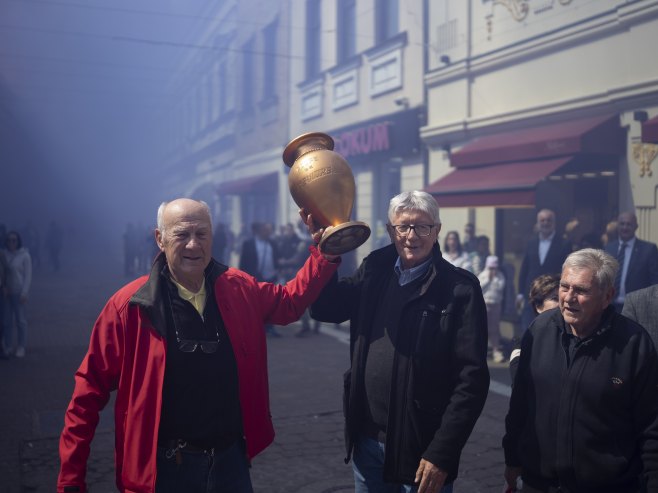
When the team returned home, thousands welcomed them in Banja Luka despite a delay of several hours.
“The city knew how to celebrate trophies. For days people treated us wherever we went. Eventually we had to hide just to get some rest.”
A generation interrupted by war
The triumph was soon overshadowed by the outbreak of war in the former Yugoslavia.
“That IHF Cup was the crown of our generation, but people forget that a year earlier we had already played an excellent Yugoslav championship final against Proleter. We truly believed we could challenge for the European Champions Cup as well.”
Nezirević described the war period as the hardest time of his life.
“I left through the corridor to Belgrade with a seven-month-old child. My entire world collapsed. I never thought I would have to leave my Banja Luka.”
Instead of Switzerland, he eventually continued his career in Italy, where he became one of the league’s top players and later a coach focused on developing young talents.
Lifelong friendships
The members of Borac’s golden generation remain close to this day.
“Even if we don’t see each other for a long time, when we meet again it’s the same true friendship and respect. The core of the team were kids from the streets of Banja Luka, but every player who arrived from outside fit in immediately.”
Despite decades abroad, Nezirević says Banja Luka still feels like home.
“Every visit brings back the most beautiful memories of childhood. There’s nothing better than meeting friends, riding a traditional dajak boat on the Vrbas, and returning to the places we loved growing up.”
Source: Glas Srpske