

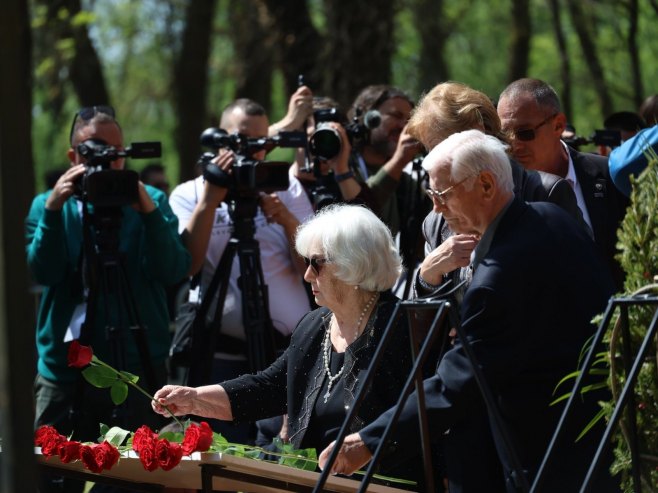
The monstrous crimes committed in the Jasenovac camp system are still vividly remembered by the few surviving former inmates. Every memory of the killings and torture of innocent people still causes them pain today. Alongside Orthodox prayers, Jewish and Roma prayers were also heard. Numerous citizens attended the commemoration in Donja Gradina, including primary and secondary school students. The Ministry of Interior of Republika Srpska confirmed that the commemorative gathering passed peacefully and with dignity.
Among those attending the Day of Remembrance in Donja Gradina was Milutin Vukmirović, who survived the horrors of Jasenovac as a six-year-old boy. During the Kozara offensive, and later in the camp, he lost 30 members of his immediate family. He says inmates were taken daily to Donja Gradina, from where they never returned.
“They were digging holes here, graves, and in the evening they would kill those they had taken from us. Then the next day others would come to dig and bury them. It was constant. That was how they destroyed people,” said Jasenovac survivor Milutin Vukmirović.
Rade Radivojac from Prijedor was deported to Jasenovac as an 11-year-old boy and managed to escape during a storm. He witnessed the cruelty of the Ustasha executioners. The images of horror, he says, are still before his eyes today.
“We lost our father, mother, brother — we lost everything. I was the only one left,” said Radivojac.
According to historians’ estimates, the Ustasha killed 700,000 people in the Jasenovac camp system, including 500,000 Serbs. Among the victims were also 40,000 Roma and 33,000 Jews. For that reason, Jewish and Roma prayers were held today in Donja Gradina as well. The shared message was clear — the memory of the Holocaust and the victims of genocide must be preserved.
“If, God forbid, Republika Srpska ever forgets this place, it will lose its identity. Because all identity is contained in this place. That is the essence of remembrance. A hole in memory creates a volcano of misfortune,” said Chief Rabbi of Serbia Isak Asiel.
Representative of the Roma community Miloš Acković added that for the Roma people, this is not merely a historical site.
“This is an open wound of our being, a symbol of our Samudaripen, our extermination. The silence of Donja Gradina is best understood through prayer. We will pray for the innocent, for the children, and for the future,” he said.
It is a sacred duty to be here today, because Donja Gradina is the site of one of the greatest crimes of the Second World War, said lawyer and former adviser to the Israeli prime minister Ariel Bulshtein.
“It is our duty to be here every year, not to allow others to forget, and of course to prevent such a tragedy from ever happening again,” he added.
Columns of buses also arrived in Donja Gradina today, carrying students along with their teachers and professors.
“The culture of remembrance is important. Our school also takes part in art and literary competitions. Today we came here to pay tribute to the fallen and murdered Serbs, Jews and Roma. I believe this is an ideal opportunity to pay our respects and remember all the victims who lost their lives here,” said Jana Kalabić, a student of the Technical School in Gradiška.
Borislav Marić, a Russian language professor at the Secondary School Centre in Prnjavor, added that the culture of remembrance is very important not only as a reminder of history, but also as a warning for the future.
From Donja Gradina came a clear message about how important it is to understand history and learn from it. Responsibility for that now also rests with the generations to come. That is precisely why gatherings like this remain part of the fight against forgetting and indifference.
Source: RTRS