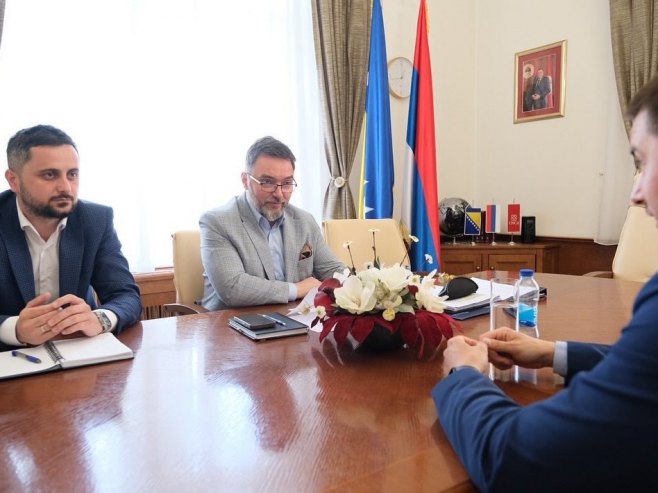


“Our goal has always been dialogue based on the Dayton Agreement and equality, and we have reiterated this to all our partners—from Tel Aviv, through Belgrade and Budapest, to Washington,” Zlatan Klokić, Minister for European Integration and International Cooperation of Republika Srpska, said in an interview with Glas Srpske.
He emphasized that cooperation with the diaspora is one of the key priorities of the ministry he leads.
“Our people around the world are the best ambassadors of Republika Srpska. Through institutional support, networking, and joint projects, we are strengthening economic, cultural, and business ties. Our goal is for the diaspora to be a strong partner in the development and promotion of Republika Srpska,” Klokić said.
We also discussed strengthening cooperation with investors from the United Arab Emirates (UAE), the return of citizens from the diaspora, and the work of Republika Srpska’s representative offices abroad.
GLAS: The establishment of a Fund to support projects implemented with European Union backing is planned. What does this specifically mean?
KLOKIĆ: Republika Srpska should receive a fund whose mandate will focus on supporting the drafting of projects financed by the European Union. In principle, a new department will be formed within the Ministry to provide assistance in project preparation.
The idea emerged from a very practical need—to make it easier for our institutions, municipalities, and public bodies to participate in EU-funded projects. We often have good project ideas, but lack the initial funding to launch activities.
The Fund will serve for pre-financing projects. This means we will help beneficiaries start projects on time, with funds later reimbursed once EU financing is received. It is important to us that as few good ideas as possible fail due to administrative barriers and initial costs, and that Republika Srpska makes the best possible use of the funds available.
The Fund will be financed from our budget and is envisioned as a revolving fund. Applicants would return certain funds as a form of guarantee, allowing the budget allocated for this purpose to expand year by year.
GLAS: Investors from the UAE recently visited Republika Srpska. What was agreed and in which sectors can cooperation be expected?
KLOKIĆ: Juma Madani, owner of the company “Al Matija Investment Group” from Dubai, spent four days in Banja Luka. As one of the largest investors in the UAE, we presented everything Republika Srpska can offer as an attractive investment destination.
The next step is organizing a business forum between Republika Srpska and the UAE in Banja Luka. It should take place this year, with several companies from Dubai and the Emirates expected to attend. It may also provide an opportunity for a member of the royal family, close to Mr. Madani, to visit the largest city of Republika Srpska.
At the forum, we will present projects in infrastructure, agriculture, energy, and tourism—areas in which Emirati investors have already expressed interest. In June last year, during a business forum in Dubai organized with the support of the Government of Dubai, Republika Srpska signed a Memorandum of Understanding with “Al Matija Investment.” Republika Srpska was the honorary guest at that event.
GLAS: How would you assess cooperation with the diaspora?
KLOKIĆ: Cooperation with the diaspora is one of our priorities. Our people abroad are the best ambassadors of Republika Srpska. Through institutional support, networking, and joint initiatives, we are strengthening economic and cultural ties.
We have adopted a strategic document dedicated to this topic—the first serious framework in which Republika Srpska clearly states that the diaspora matters and that cooperation should be genuine, not merely declarative. It is a seven-year plan outlining how to better connect with our people worldwide.
GLAS: What do the figures show regarding returns?
KLOKIĆ: Data show that more than 250 newly enrolled students in schools in Republika Srpska previously attended schools abroad. We are therefore talking about between 750 and 1,000 people who have returned from abroad, though the real number is certainly higher.
We also launched a podcast hosted by our celebrated Olympian Saša Čađo, focusing on positive stories of people who returned to Republika Srpska.
GLAS: There is also mention of establishing a contact point for return to Republika Srpska. What is that about?
KLOKIĆ: We have been working for some time on the idea of creating a single contact point available not only to youth and students, but to the entire diaspora—a place where people can receive clear and reliable information about their rights, procedures, and concrete support if they are considering returning.
At the end of last year, we organized the conference “Back to Srpska,” which marked the launch of the “Nazad u Srpsku – Back to Srpska” program. We are implementing it following the model of “Tačka povratka,” with their direct assistance and expertise, as we believe it is important to learn from those with experience.
This issue will be a key focus of the Government’s work. Our aim is to remove administrative, legal, and procedural barriers and thus facilitate the return of our people.
GLAS: You have also attended Republic Day celebrations abroad this year. What messages were conveyed?
KLOKIĆ: Our people abroad say that we must preserve Republika Srpska and resist all pressures. They carry Republika Srpska in their hearts and nurture its culture, history, and tradition.
The message was one of unity and solidarity. In early February we were in Stuttgart, last weekend in Belgrade, and in early March we will be in Vienna. It is important that Republic Day is marked wherever Serbs live, as it preserves identity, language, culture, and ties with the homeland.
Our diaspora is a strong pillar of Republika Srpska—people who, although living far away, have never forgotten who they are or where they come from.
GLAS: What are the most significant activities of Republika Srpska’s representative offices abroad?
KLOKIĆ: Our representative offices promote Republika Srpska, its potential, and opportunities for cooperation. Activities range from meetings with investors to cultural and social events.
Among the most important events were the marking of 30 years since the signing of the Dayton Agreement, the opening of the “House of Republika Srpska” in Vienna, and a business forum in Stuttgart.
It is important that results are visible and that the voice of Republika Srpska is heard more strongly worldwide.
GLAS: The two newest representative offices are in France and China. How are they functioning?
KLOKIĆ: The Representative Office of Republika Srpska in China has not yet become operational, but the office in France has been active since the end of last year. Bojana Kondić Panić, appointed as its head, organized a Republic Day celebration in Paris.
In the next two to three months, Republika Srpska is expected to participate in one of the most significant economic fairs in France. There will also be opportunities to promote documentary films by our acclaimed director Denis Bojić.
GLAS: How much has the diplomatic outreach of Republika Srpska’s representatives improved its global positioning?
KLOKIĆ: Recent visits by delegations of Republika Srpska represent a successful diplomatic outreach and a clear indication that Srpska has its own international voice.
These activities—particularly meetings in the United States—open new doors on the global stage and enable direct communication with states that play key roles in international politics.
It is important that issues concerning the constitutional position of Republika Srpska are internationalized and discussed where key decisions are made. Our goal has always been dialogue based on the Dayton Agreement and equality—and we have reiterated this to all our partners, from Tel Aviv, through Belgrade and Budapest, to Washington.
Civil sector
GLAS: Projects and cooperation with civil society organizations have also been initiated within your ministry. What is the focus?
KLOKIĆ: Cooperation with civil society is important, especially in the context of the European integration process. The Ministry engages both independently and through joint participation in EU-funded projects, such as EU4PAR.
We have worked with numerous civil society organizations—from youth councils and youth associations to organizations dealing with social, educational, and inclusion issues across Republika Srpska.
I would particularly highlight that since 2013 we have implemented an internship program for students of the Faculty of Philology at the University of Banja Luka. More than one hundred students have completed the program, gaining practical knowledge through translating and processing documents related to European integration and international cooperation.
Source: Glas Srpske