

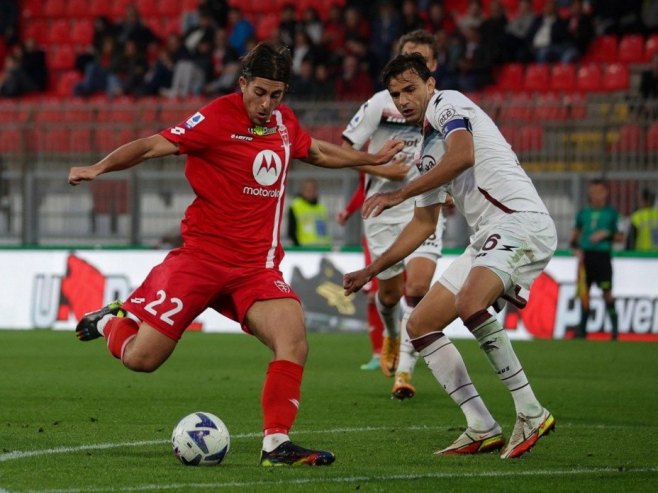
Can Borac surprise Atalanta on Thursday? Former Serbia international Ivan Radovanović believes the Banja Luka club has a genuine opportunity against the Italian side, whose squad is valued at approximately €500 million, particularly given the difficulties the Bergamo team has experienced this season.
Speaking to RTRS, Radovanović, who began his Italian football career at Atalanta, shared his assessment of the upcoming encounter, the transformation of Italian football and the future of Serbian football.
Radovanović spent 15 years in Italy, playing for seven clubs and making nearly 400 Serie A appearances. He joined Atalanta in 2008 as a young player, spending three seasons with the Bergamo club.
He made his greatest impact at Chievo, is fondly remembered in Bologna and enjoyed a particularly memorable spell at Salernitana.
Borac can exploit Atalanta’s transitional period
“I think Borac have a great chance. If I were their coach, I would not be afraid of anyone. Borac are a major club in our region. They have been playing well in recent years, winning titles and making progress in Europe. Playing in front of their own supporters is an additional advantage,” Radovanović said.
“Atalanta are going through a transitional period this season. They are not playing well, and Borac could take advantage of that.”
Atalanta currently occupy 12th place in Serie A, far from the positions that guarantee qualification for European competitions.
The departure of Gian Piero Gasperini, who led the club for nearly a decade, appears to have left a significant void. The current team is struggling to replicate the performances that once made Atalanta one of the most formidable sides in Italian and European football.
“They tried over the past two or three seasons to restore the system established by Gasperini through his protégés, Ivan Jurić and Raffaele Palladino. However, they were unsuccessful. They have now opted for a completely different football philosophy,” Radovanović explained.
“Under Gasperini, training sessions were extremely demanding, with man-to-man marking across the entire pitch, to put it simply. Maurizio Sarri has arrived with a completely different approach to football. I believe that is why Atalanta are struggling, and I repeat, this is a great opportunity for Borac.”
Atalanta’s success is built on a strong football system
Despite their current results, Atalanta remain among Italy’s leading clubs, benefiting from a football structure developed over the past two decades under the leadership of club president Antonio Percassi.
“I know the Percassi family, who arrived at the club shortly after I moved to Bergamo. Antonio and his son Luca played for Atalanta as youngsters and have a deep love for the club,” Radovanović said.
“I know how much effort they invested, particularly in the youth academy and training centre, raising everything to the highest level. They also made the right choice with Gasperini.”
Radovanović singled out former sporting director Giovanni Sartori, who now works at Bologna, as another key figure behind Atalanta’s development.
“Sartori brought me to Chievo from Atalanta in 2014. Just look at how many young players have come through Atalanta over the past decade and where those players have ended up. The system established by Percassi, Sartori and, of course, Gasperini was extremely important. They deserve the greatest credit for the club’s recent successes.”
Italian football is losing its traditional identity
Reflecting on changes in Italian football ownership, Radovanović expressed regret over the growing influence of international investment funds.
“During the final two or three years of my career, club owners in Italy began to change. A financial crisis emerged, and numerous investment funds, particularly American ones, started buying clubs,” he said.
He revealed that these developments were among the reasons he decided to retire earlier than he might otherwise have done.
“The people coming in look at everything through statistics, age and salaries, something similar to the American system. In my opinion, football has lost some of its charm.”
Radovanović highlighted traditional Italian football figures such as Maurizio Zamparini at Palermo, Aurelio De Laurentiis at Napoli, the Pozzo family at Udinese, the Percassi family at Atalanta and Urbano Cairo at Torino.
“It is wonderful to see families that genuinely care about their clubs. When things are going well, they are extremely happy, but when the team is losing, they are still there. That romantic side of Italian football has been lost somewhere along the way.”
Players from the former Yugoslavia bring character to Atalanta
Atalanta’s squad features several players from the former Yugoslavia, including Serbia’s Lazar Samardžić, Montenegro’s Nikola Krstović, BiH’s Sead Kolašinac, Croatia’s Mario Pašalić, Slovenia’s Relja Obrić and North Macedonia’s Eljif Elmas.
Radovanović believes their presence contributes significantly to the atmosphere within the team.
“I honestly cannot remember a single club having so many players from across our former country. I know the dressing-room atmosphere is excellent precisely because our players bring a special character and spirit. It is like one big family,” he said.
He nevertheless warned that Atalanta possess exceptional individual quality and considerable squad depth.
“You saw it against Inter on Sunday. Krstović came off and Gianluca Scamacca, whom I played alongside, came on. Éderson, another former teammate of mine at Salernitana, was replaced by Pašalić. Samardžić was on the bench, and there is also Kolašinac, who is playing very well, as well as Kessié. It is an excellent team.”
Krstović has the potential to join one of Italy’s biggest clubs
Radovanović also praised Montenegro international Nikola Krstović, who has attracted considerable attention this season.
“I remember him from Red Star, where he did not receive a proper opportunity, and later from Dunajská Streda. When he moved to Italy, he chose the right club in Lecce,” Radovanović said.
“It is no coincidence that he is playing ahead of Scamacca, whom I know very well. What I particularly like is his hunger for every ball and every challenge. He is certainly one of the best strikers from our region and is on the right path towards joining one of Italy’s top clubs.”
Developing the next generation at Partizan
After working under numerous leading coaches throughout his playing career, Radovanović turned to coaching following his retirement.
He previously served as head coach of Jedinstvo Ub and currently works with the youth teams of Partizan, the club where he never received an opportunity as a senior player.
“I returned to Serbia after 15 years. Partizan contacted me, and I accepted their offer. For two years now, I have been developing as a coach, making mistakes and correcting them,” he explained.
“Results are not the priority. My goal is to pass on my experience to these children, guide them in the right direction and show them what it means to be a professional.”
Radovanović believes that football intelligence and decision-making have become essential elements of modern football talent.
“Children must live for football,” he stressed.
Commenting on Partizan’s current difficulties, he acknowledged that the club is undergoing a major transitional period.
“It is genuinely difficult, and not only in terms of results. We hope to overcome these difficulties because a club like Partizan does not deserve to be in its current position in the standings.”
Serbian football needs a complete reset
Having represented Serbia at every youth international level and earned 10 senior caps, Radovanović also offered his assessment of the national team under Veljko Paunović and the broader state of Serbian football.
“I think we need to start from scratch and reset everything in Serbian football. We must openly acknowledge that we have been absent from major competitions for four or five years. We need to work and appoint the right, properly educated people who will establish clear standards,” he said.
Radovanović expressed concern about Serbia’s performances at both club and international levels, particularly in the Nations League.
“I understand that we are facing much stronger national teams, but failing to register a shot on goal is unacceptable.”
He believes Serbia should prioritize developing a new generation of international players rather than focusing exclusively on immediate results.
“If I were the national team coach, I would say: forget about the Nations League and these qualifiers. I would bring in young players aged 22 or 23 and under, so that in four or five years they could become the backbone of the national team. Of course, it is easy to say that from my current position, but that is what I would do,” Radovanović concluded.
Source: RTRS