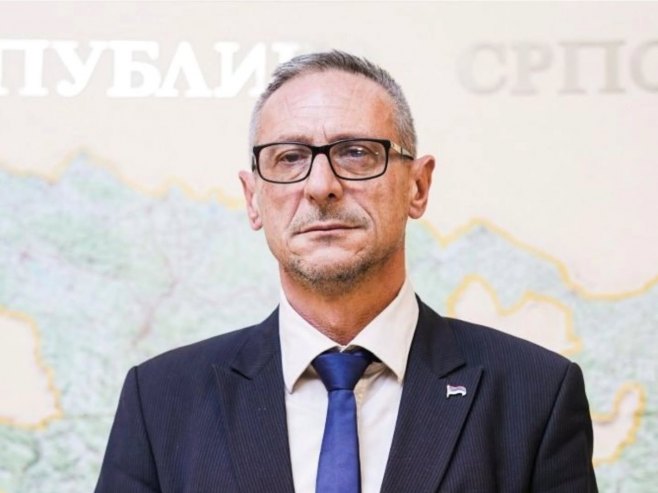

If there is no agreement even on the date when peace was established, it is legitimate to question the foundations of a shared future for BiH, Republika Srpska Minister of Labour and Veterans’ and Disability Protection Radan Ostojić told SRNA.
“Serbs in Republika Srpska respect and commemorate significant dates from both world wars. When we speak about a date that should serve as a common symbol of peace in BiH, that date is November 21,” Ostojić said.
He recalled that the General Framework Agreement for Peace in BiH was initialled in Dayton on that date, bringing the war to an end and paving the way for the establishment of peace.
November 21 should be a common symbol of peace
Ostojić described it as disheartening that the Federation of BiH does not commemorate November 21, the date that brought peace to all peoples living in BiH, but instead marks November 25, the anniversary of the first session of the State Anti-Fascist Council for the National Liberation of BiH (ZAVNOBiH).
He emphasized that the Serb people suffered the greatest losses during World War II while also serving as a pillar of the anti-fascist struggle.
“The fact that there is still no agreement in BiH on important historical dates after more than three decades best illustrates the depth of these divisions,” Ostojić stated.
He questioned how a shared future could be discussed if there was no equal respect for the peace that ended the war.
“The Dayton Peace Agreement is not merely a document that ended the war, but also the foundation of BiH’s current constitutional order and a guarantor of peace and equality among its constituent peoples,” Ostojić stressed.
Historical truth without selective remembrance
Ostojić emphasized that the Serb people were a pillar of the anti-fascist struggle while simultaneously being subjected to mass atrocities and genocide, particularly within the territory of the Independent State of Croatia (NDH).
He argued that a responsible approach to history requires acknowledging all historical events without selective remembrance or politically motivated reinterpretations of facts.
In this context, he said that the participation of some members of the Muslim population in the armed formations of the NDH and crimes against Serbs must not be overlooked.
“We must examine history in its entirety, without concealing or relativizing crimes,” Ostojić said.
Peace must transcend political and national divisions
As a war veteran and former member of the Army of Republika Srpska, Ostojić said he understands the meaning of peace and freedom and the importance of preserving them.
“That is why November 21 should not be a matter of political or national affiliation, but a common reminder of the value of peace and the suffering endured by all peoples in BiH,” he stated.
November 25, formerly commemorated as ZAVNOBiH Day, is observed as Statehood Day in predominantly Bosniak areas of the Federation of BiH, while Croats generally do not observe it as a holiday.
Republika Srpska does not recognize November 25 as a public holiday, maintaining that its designation as BiH Statehood Day is not based on an agreement among all three constituent peoples.
Source: RTRS