
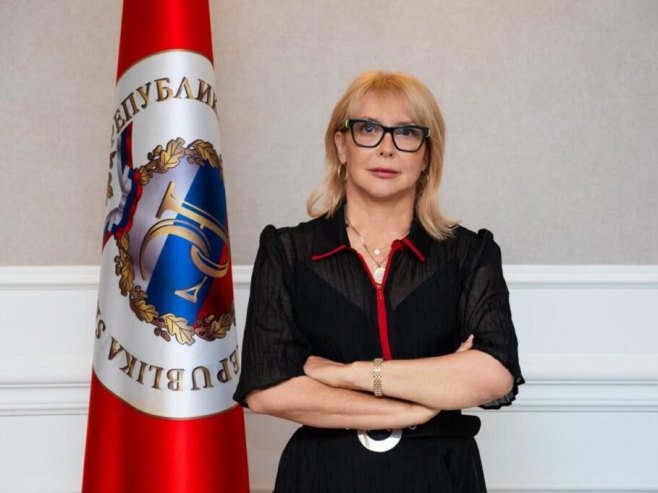
There are moments in political life when establishing an institution is not an administrative act, but a response to a situation that has become politically unsustainable. The establishment of the Republika Srpska Office for International Cooperation is precisely such a decision, Acting Director of the Office Ana Trišić Babić said in her column “Republika Srpska’s right to speak with its own voice.”
There are moments in political life when establishing an institution is not an administrative act, but a response to a situation that has become politically unsustainable. The establishment of the Republika Srpska Office for International Cooperation is precisely such a decision.
It stems from a simple fact that no longer makes sense to conceal behind diplomatic formulas: BiH’s international position has long ceased to reflect a balance between the interests of its constituent parts, nor can Republika Srpska accept having its interests represented internationally without any real influence over the substance of that representation.
Relations within BiH are deeply disrupted. This is not the consequence of a single political conflict, one mandate or one decision. It is a long-term structural problem in which what is supposed to be shared has gradually ceased to be shared, while institutions that should reflect the complex constitutional nature of BiH have increasingly been used as instruments of a single political vision of the state.
Foreign policy is perhaps the clearest example of this problem.
There is no such thing as neutral representation in international relations. Whoever defines the problem, chooses interlocutors, sets priorities, formulates messages and interprets political developments holds political power. That is why the question of who speaks on behalf of BiH has never been merely a technical matter of diplomacy. It is a question of political subjectivity.
In international politics, you do not lose only when you run out of arguments. You lose the moment you agree to let someone else interpret your arguments on your behalf.
For too long, Republika Srpska has been presented internationally almost exclusively through a negative framework. It has been portrayed as a problem to be solved, an obstacle to be removed and a political phenomenon to be disciplined. Its positions have often been interpreted not from the perspective of its legitimate interests, but through predetermined political categories.
This created a situation in which others spoke about Republika Srpska, while the space in which Republika Srpska could speak for itself remained disproportionately narrow.
This is not a matter of communication. It is a matter of power.
Peoples do not first disappear from maps. They disappear when they accept that others can tell them who they are, what they are allowed to want and where the boundaries of their interests lie.
The right of a political community to explain its own interests is one of the fundamental characteristics of political subjectivity. Those who cannot provide their own interpretation become the subject of someone else’s interpretation. Those who cannot articulate their own interests sooner or later become the object of the interests of others.
Republika Srpska can no longer accept such a position.
The problem runs deeper because behind many institutional disputes in BiH lies a political project that should be called by its proper name. It is a unitarist and centralist concept under which BiH would gradually move away from its Dayton structure, while the actual political influence of Republika Srpska would continuously diminish.
Such a policy is rarely pursued openly. It is implemented gradually. One competency today, a new interpretation tomorrow, a new institutional practice the day after. What is initially presented as an exception becomes a precedent and then a rule.
Foreign policy is particularly important in this process because international representation also produces political realities within the country. If one political concept succeeds in monopolizing BiH’s representation before the world, it gains the ability to present its own interpretation of the state as its only legitimate interpretation.
This is precisely why equality cannot exist only on paper.
If Republika Srpska bears the consequences of international decisions, economic processes, European integration, regional relations and geopolitical changes, then it must have a genuine opportunity to articulate its interests to the actors making decisions on these issues. Anything else creates a structural imbalance. Equality without a voice is not equality.
Contemporary political practice demonstrates that the international presence of federal or decentralized units is not an exception, but a standard feature of seriously organized systems. In the Federal Republic of Germany, one of Europe’s most stable federations, Article 32 of the Constitution provides that the Länder, insofar as they have legislative powers, may conclude treaties with foreign states with the consent of the federal government. Germany’s Länder have their own representative offices and actively protect their economic, educational and cultural interests internationally.
Belgium’s experience goes even further: within their areas of competence, its regions and communities have developed strong international capacities, including direct foreign contacts and certain forms of independent action toward other states.
Swiss cantons, for their part, participate in shaping positions when international decisions directly affect their competencies, because a serious federation understands that responsibility for consequences cannot be separated from the right to participate in decision-making.
Even in the United States, where individual states do not conduct foreign policy in the classical sense, they vigorously develop international trade, investment and educational representation, because it has long been understood that protecting a specific interest is not the same as competing with the central government.
The question, therefore, is not whether a political community has the right to develop international contacts in areas concerning its constitutional and developmental interests, but whether it is prepared to exercise that right responsibly, professionally and continuously.
The establishment of the Office for International Cooperation is therefore, above all, a decision for Republika Srpska to end the practice of accepting the role of an object.
We are not seeking the right to speak on behalf of others. We are assuming responsibility for speaking in our own name. That is the essential difference.
The Office is not an administrative decoration, a protocol addition or an institution established to create new positions. It should serve as an instrument for serious, professional and continuous international engagement by Republika Srpska.
Its task is not to create parallel diplomacy outside the existing constitutional order, but to build complementary diplomacy that, within that framework, will protect the interests of Republika Srpska where they are currently insufficiently represented.
This is not escalation. It is an institutional response to an existing imbalance.
The Office for International Cooperation is not a luxury. It is a long-overdue form of institutional self-defense. Our priorities must therefore be concrete.
The first is defending the constitutional position of Republika Srpska and consistently explaining the Dayton structure of BiH internationally. Dayton is not a historical footnote or a temporary arrangement that applies only as long as it suits someone politically. It is the foundation of BiH’s current constitutional order and the framework within which its political life is possible.
The second priority is developing direct relations with governments, parliaments, political parties, academic institutions, business associations, research centers and other relevant international actors. Republika Srpska must be present where positions are shaped, not merely where already adopted assessments are subsequently announced.
The third priority is monitoring political processes that could have direct consequences for Republika Srpska, ranging from European integration and security policies to energy, trade, migration and changes in the international economic order.
A small political community cannot determine the rules of the global system, but it can understand where changes are emerging, assess their consequences in a timely manner and protect its own interests. This is precisely what distinguishes serious policy from reactive politics.
Republika Srpska’s international engagement, however, must not be reduced solely to institutional and status-related issues.
Investment diplomacy must become one of the pillars of the Office’s work. Capital does not arrive on the basis of political declarations. It goes where there is information, contacts, legal predictability and people capable of connecting a specific project with a specific investor.
Republika Srpska must systematically identify markets and sectors in which it has comparative advantages, from energy, agriculture and the food industry to tourism, infrastructure, the wood industry and new technologies. Our international engagement must produce measurable economic results.
Capital does not follow political slogans, but seriousness. And in international relations, seriousness is measured by presence, knowledge, reputation and the ability to explain your own interests before someone else translates them to serve their own.
Cultural diplomacy is equally important. A people that allows others to permanently define it gradually loses the ability to determine its own place in the world.
Republika Srpska has its own cultural, historical and institutional reality that should be presented without complexes and without any need to explain its existence to anyone as a political anomaly. Universities, cultural institutions, artists, scientists, historical heritage and contemporary creativity are as much a part of Republika Srpska’s international identity as its political institutions.
Culture is often a quieter form of politics, but its effects last longer than many official statements. Those who surrender the story about themselves to others eventually surrender the place that belongs to them in the world.
A special place belongs to the diaspora. For decades, we have viewed the diaspora primarily through a sentimental lens. It is time to begin viewing it strategically.
People originating from Republika Srpska who live in Europe, North America, Australia and other parts of the world are not merely guardians of family ties. Among them are entrepreneurs, professors, doctors, engineers, experts and people with political and social connections.
A serious state does not leave such potential to chance. We need a network of knowledge, capital, contacts and trust that will connect the diaspora with the institutions of Republika Srpska — not occasionally and ceremonially, but permanently and systematically.
All of this requires a change in the way we understand international politics. The world is not a place where those with the best arguments survive if no one hears them. International relations are not a political theory seminar.
Interests are articulated, alliances are built, reputations are created, contacts are maintained, and political space that you fail to occupy yourself is very quickly occupied by someone else. The person who is right is not always the one who is heard in the world. The one who is heard is the one who is present, prepared and capable of turning a right into a political argument.
Republika Srpska must act with full awareness of this reality. The Office for International Cooperation is therefore not an institution against anyone. It is an institution for Republika Srpska.
Its existence stems from responsibility toward our institutions, our citizens, our economy and our constitutional position.
The task before us is not to produce yet another interpretation of Republika Srpska among many others. Our task is to ensure that the voice of Republika Srpska is heard where decisions are made, policies are shaped and perceptions are created that later have very concrete political consequences.
The era in which others held an almost complete monopoly over explaining Republika Srpska must come to an end. Not because we expect everyone to agree with us, but because we no longer accept others determining what we are, what we are allowed to want and where our legitimate interests end.
From Germany and Belgium to Switzerland and the United States, seriously organized systems are not based on the assumption that their federal or decentralized units should remain silent on matters that directly affect them. On the contrary, stability is built when the internal constitutional reality is also given responsible external representation.
I therefore consider the establishment of the Office a responsible and necessary statesmanlike step. Republika Srpska is assuming greater responsibility for its own international positioning, its economic ties, its political contacts, its culture and its relationship with its diaspora.
We have the right to our own voice. We have an obligation to make that voice serious, competent and present. Those who do not invest in their own voice finance someone else’s interpretation of their own interests.
Republika Srpska will no longer merely be a subject of international politics.
Source: RTRS