
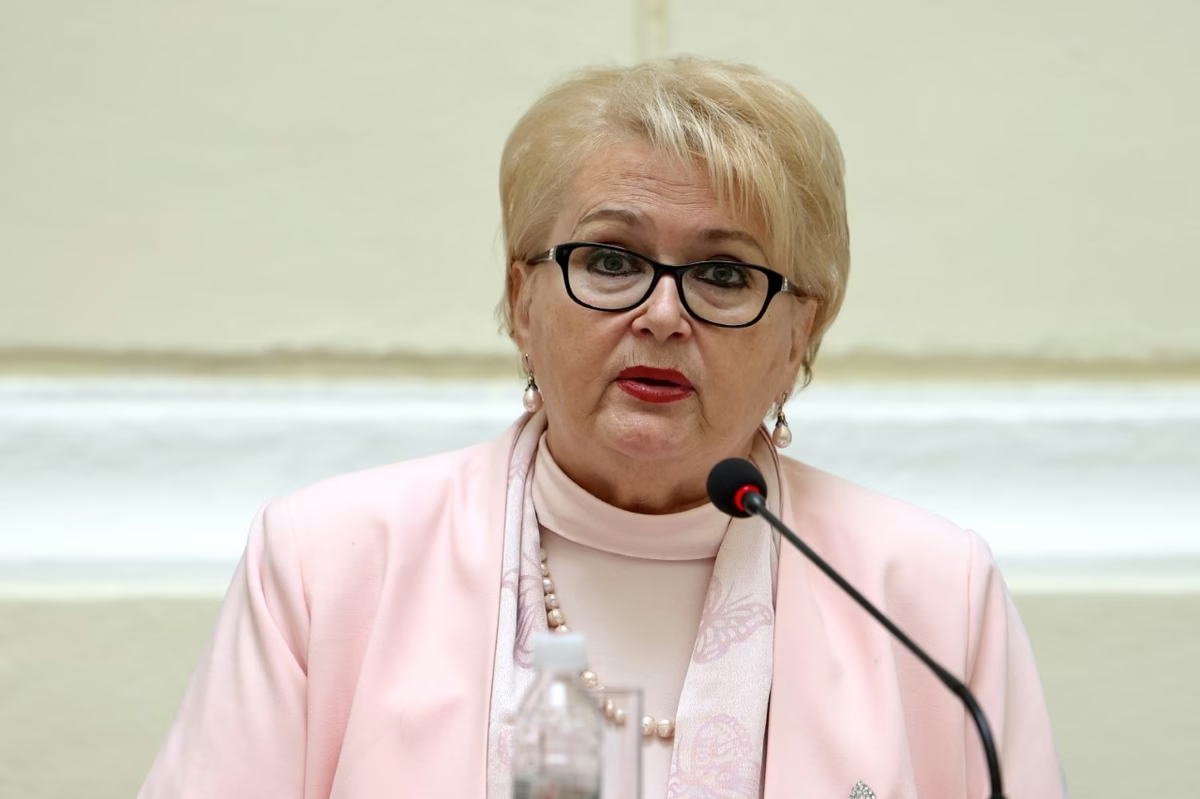
Former Bosnia and Herzegovina Foreign Minister Bisera Turković sharply criticized the current authorities, above all Denis Bećirović, the Bosniak member of the BiH Presidency, because Bosnia and Herzegovina did not send a representative to the ceremony and farewell for former Iranian Supreme Leader Ayatollah Ali Khamenei.
In her statement, Turković recalled the historical foundations of Bosnia and Herzegovina’s diplomacy and key moments in the country’s defense.
“Alija Izetbegović knew how to build relations with both the East and the West. Bosnia and Herzegovina defended itself thanks to the courage of its people, but also thanks to the help that came from different parts of the world. In the most difficult moments, we were not alone. The United States, Iran, Pakistan, Malaysia and many other countries helped us. Thanks to that support, along with the determination of our fighters, Bosnia and Herzegovina survived,” Turković said.

She then raised the question of the country’s current geopolitical position under the present authorities.
“Today, one serious question imposes itself: if Bosnia and Herzegovina were once again faced with an existential threat, who would extend a hand to us? Apart from NATO, who could we count on? Who would stand with Bosnia and Herzegovina today? The answer is not at all encouraging. The current authorities are conducting foreign policy without a clear strategy, without continuity and, perhaps most dangerously, without political courage,” the former minister said.
Direct accusations against Bećirović
In the continuation of her reaction, Turković made direct and serious accusations against Denis Bećirović.
“The Bosniak member of the Presidency, Denis Bećirović, lacks the courage to advocate an independent and principled foreign policy, to make decisions in the interest of Bosnia and Herzegovina even when they are not to the liking of more powerful states or current political trends. Instead of statesmanlike decisiveness, we are witnessing a policy of calculation, avoidance of responsibility and waiting for others to decide instead of him. Instead of preserving and developing friendships built over decades, he is carelessly neglecting them. Instead of principled diplomacy, he is pursuing a policy of improvisation, short-term interests and ideological divisions. The result is that Bosnia and Herzegovina today has fewer friends than ever, while not gaining a single new ally who could replace the lost relationships,” Turković wrote.
Iran’s role in the Srebrenica resolution and during the war in BiH
As key evidence for her claims, Turković pointed to diplomatic processes at the United Nations, but also recalled the funeral and official ceremonies in Tehran that the BiH leadership ignored.
“When the Srebrenica Resolution was voted on, Iran supported its adoption and, according to available reports, influenced around ten other states to vote in favor. That support was crucial for its adoption. At the funeral of President Ebrahim Raisi and Foreign Minister Hossein Amir-Abdollahian, there were no representatives of Bosnia and Herzegovina among the official delegations. Representatives of Serbia and many other countries were present. Now, when more than one hundred countries are sending delegations to Tehran to express condolences over the death of Iran’s Supreme Leader, Ayatollah Ali Khamenei, Bosnia and Herzegovina once again has no official representative. This is a man who, during the war, did everything to help Bosnia and Herzegovina. Richard Holbrooke stated on several occasions that Iranian arms shipments were of crucial importance for the survival of Bosnia and Herzegovina during the war,” she stressed.
“Political courage is needed even for a diplomatic minimum”
The former head of BiH diplomacy explained that the issue has nothing to do with Iran’s internal order, but rather with basic state respect.
“This is not about whether someone agrees or disagrees with Iran’s internal policy. It is about the diplomatic minimum and a state’s ability to show respect to those who helped it when times were hardest. That does not require the consent of great powers. It requires political courage. Unfortunately, that is precisely the courage Bećirović lacks. It is easier to remain silent than to take responsibility. It is easier to follow other people’s signals than to conduct one’s own policy. It is easier to avoid moves that might provoke criticism than to protect the long-term interests of Bosnia and Herzegovina. That is not responsible state policy. It is a policy that consumes Bosnia and Herzegovina’s international reputation, undermines trust and closes doors that may one day again be of crucial importance,” Turković said.
She concluded with a warning to the public about the defensive and political capacities of the current leadership.
“If those who today represent Bosniaks and lead the state were to defend us the way they conduct its foreign policy today, then we have serious reason for concern. Alliances are not built overnight, and once they are lost, it is often impossible to restore them when they are most needed. If people like that are to defend us, then we have already lost many battles before they even began,” Bisera Turković concluded.
Source: N1