



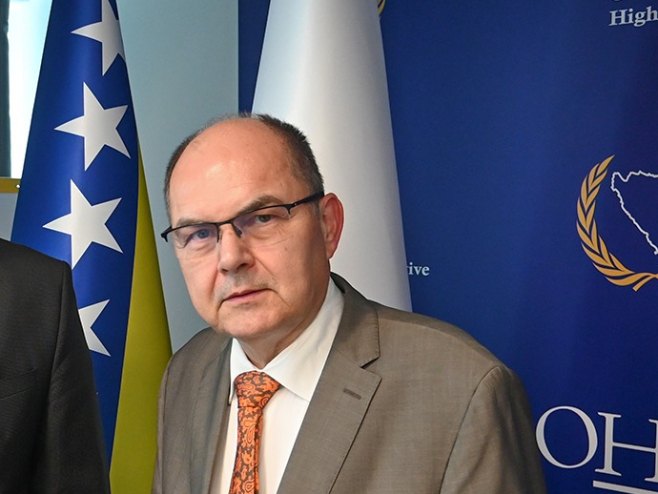
Former Serbian Ambassador to Germany, Milovan Božinović, stated that federal authorities will have to answer very uncomfortable questions regarding the appointment of Christian Schmidt as the so-called High Representative in Bosnia and Herzegovina, which the parliamentary group of Alternative for Germany (AfD) has submitted to the Bundestag.
Božinović assessed that the new government will not be able to avoid responding to each of the 18 questions that AfD has submitted to the Bundestag regarding Schmidt’s role in Bosnia and Herzegovina. AfD has requested an assessment of the legitimacy of his position, given that his appointment lacked approval from the UN Security Council.
“This means that the German authorities will have to respond to AfD, which has become the second strongest party after the recent parliamentary elections in Germany, immediately after the parliament is constituted. The relevant authority, namely the Ministry of Foreign Affairs, will be officially required to answer all of AfD’s questions,” Božinović told Sputnik, referring to Alternative for Germany’s request for a parliamentary investigation in the Bundestag regarding Schmidt’s role in Bosnia and Herzegovina.
He pointed out that AfD representatives could request a parliamentary debate and expect the German government to take a stance on this issue.
“The response will depend on the answers they receive, as it will be interesting to hear what the Ministry has to say about these questions, given that Schmidt’s appointment is highly controversial. If he acted on behalf of the entire international community, then he should have obtained approval exclusively from the UN Security Council, which did not happen, as his appointment never reached the Security Council for discussion,” Božinović recalled.
From this, he concluded that those who installed Schmidt believed it was sufficient to invoke the so-called Bonn Powers, introduced in the second half of the 1990s, under which the High Representative for Bosnia and Herzegovina was tasked only with overseeing the implementation of the Dayton Peace Agreement and nothing more.
Božinović emphasized that this is certainly not a comfortable issue for the new German government.
“They will try to justify it by claiming that it stems either from decisions of the Council of Europe or from the former Contact Group for Bosnia and Herzegovina. However, they do not have a genuine and well-founded response to these questions, and in this regard, Serbs from Republika Srpska are right,” Božinović stated.
AfD has asked whether the German government has taken a position on the international legal legitimacy of Schmidt, given the lack of UN Security Council approval, and if so, what that position is. AfD also inquired what conclusions the federal government draws from the fact that the Russian Federation and China refused to confirm Schmidt as the High Representative in the UN Security Council.
“What legally binding decisions has Schmidt made in 2022 and 2023, according to the federal government’s assessment? Has the federal government taken a stance on these decisions, and what is it?” AfD representatives asked.
The party also questioned whether the German government sees Schmidt’s decisions as exceeding his competencies under Annex 10 of the Dayton Agreement, and if not, why not.
AfD further asked what consequences the federal government sees for the stability and sovereignty of Bosnia and Herzegovina due to these measures, as well as whether the German government has taken steps to have Schmidt’s appointment confirmed by the UN Security Council. If such steps were taken, which ones, and if not, why not?
“Does the federal government plan to advocate for reforms in the appointment mechanisms for Schmidt in order to strengthen his international legitimacy, and if so, how?” AfD representatives asked.
The party also inquired whether the German government has considered whether judicial processes in Bosnia and Herzegovina, particularly against representatives of Republika Srpska, are politically motivated. If so, what findings are available, and what measures, if any, has the federal government taken to ensure fair and transparent proceedings?
AfD further asked whether the federal government has taken a position on whether Schmidt’s decisions could lead to further political destabilization in the region, and if so, what that position is. The party also asked whether the German government has formed an opinion on how it assesses Schmidt’s actions in the context of Bosnia and Herzegovina’s sovereignty and independence, and if so, what that stance is.
“Has the federal government taken a position on whether Schmidt’s actions are worthy of support, even if local actors and international partners deem them legally questionable? If so, what is that position? Has the federal government taken a position on the various international perspectives regarding Schmidt’s appointment and actions, and what is that stance?” AfD asked.
The party also asked whether the federal government is engaging in discussions with international partners to develop a common stance on Schmidt’s role, and if so, with which partners and on what topics. Furthermore, they inquired whether the government has assessed the impact of Schmidt’s decisions on Bosnia and Herzegovina’s economic stability, and if so, what that assessment is.
“Does the federal government see the possibility of EU economic support to reduce tensions in the region, and if so, what kind? Does the federal government plan to take steps to assist Bosnia and Herzegovina in implementing reforms for EU integration, and if so, which ones?” AfD representatives asked.
The party also asked whether the German government believes that Schmidt’s current role contributes to or hinders the long-term peace process and political stability of the country, and if so, how.
“Has the federal government taken a position on the impact of Schmidt’s decisions on human rights protection in Bosnia and Herzegovina, and if so, what is that position?” AfD representatives asked.
Source: RTRS