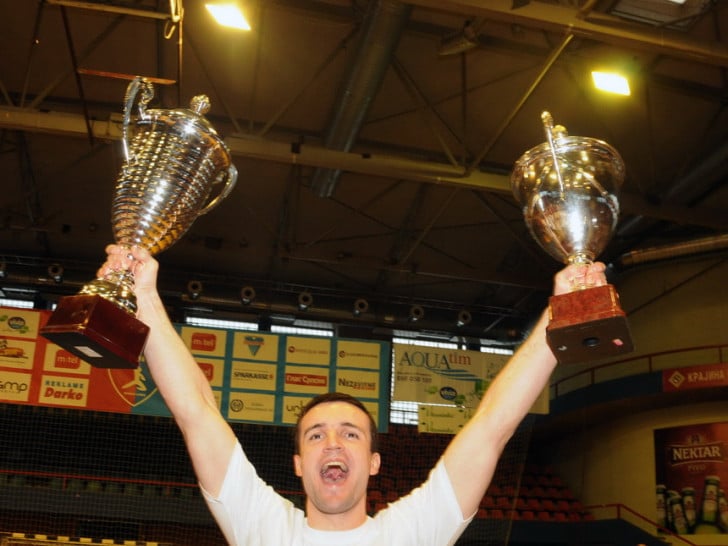

Former handball star Srđan Trivundža, who enjoyed a successful career in Serbia, Slovenia, Spain and beyond, has reflected on his years at Borac Banja Luka, the club where his journey began and to which he returned three times. In an interview with Glas Srpske, he discussed unforgettable European matches, championship triumphs, financial struggles and the responsibility that comes with wearing Borac’s famous red-and-blue jersey.
Trivundža won national championships in BiH, Slovenia and Serbia and Montenegro, represented clubs including Red Star Belgrade, Vojvodina, Bosna, Koper, Celje, Bidasoa Irún and Antequera, and played in the SEHA League.
Yet despite his international achievements, Borac remains the club that shaped both his sporting career and his character.
From school handball to Borac’s first team
Trivundža’s handball journey began at Georgi Stojkov Rakovski Primary School in Banja Luka, where teacher Ifet Mujkanović encouraged him and his classmates to take up the sport.
His first coach, Milan Zec, and Nemanja Vojnović established RK Veteran, bringing together a generation of young players that included Bojan Ljubišić and Nemanja Bijelić.
“We started playing handball relatively late, at the age of 11 or 12,” Trivundža recalled.
He credited Miro Bjelić and Momo Golić with recognizing the potential of local talent and creating opportunities for young players.
By the age of 15 or 16, Trivundža and several teammates were already training alongside Borac’s senior squad, learning from experienced players such as Nebojša Golić, Dejan Unčanin and goalkeeper Vito Ćetković.
His first senior appearance lasted only a few minutes, but the experience left a lasting impression.
“For me, it was something enormous. It motivated us to work even harder,” he said.
European nights that Banja Luka still remembers
Among his most cherished memories are Borac’s European encounters with Shakhtar Donetsk and Sandefjord.
Trivundža recalled how Borac overturned a nine-goal deficit against Shakhtar by winning the return leg in Banja Luka by 18 goals.
He also remembered the atmosphere at the packed Borik Sports Hall and the excitement surrounding the team’s European performances.
“We felt like stars. You are 19 years old, and people recognize you as an athlete, as a handball player and as a child of the city,” he said.
“We did not have big contracts, but we played with our hearts. The supporters recognize genuine commitment.”
Being appointed Borac captain was another defining moment.
Trivundža emphasized that previous generations taught younger players to respect the club’s history and traditions.
“They always reminded us that Borac’s jersey does not come wrapped in cellophane. You have to sweat and bleed to earn it,” he said.
He was particularly proud that his performances at Borac helped him reach the Yugoslav junior national team for the 2001 World Junior Championship in Switzerland.
Championship success with Red Star and Celje
After leaving Banja Luka, Trivundža played for Vojvodina and Koper before joining Bosna and later Red Star Belgrade.
He recalled Red Star’s dramatic championship-winning season in the final years of the Serbia and Montenegro state union.
Despite a difficult start and financial problems, the team recovered under coach Vuk Roganović and secured the title with a draw in Berane.
Trivundža subsequently joined Spanish club Bidasoa Irún, a former European champion with a distinguished handball tradition.
However, a serious Achilles tendon injury interrupted his career.
An unexpected opportunity arrived when coach Kasim Kamenica, who had taken charge of Celje, contacted him during his recovery.
“I explained that I was injured, but Kasim seemed not to listen. He simply said he knew my character and potential and that we would speak again in July,” Trivundža recalled.
At Celje, he played alongside Eduard Koksharov, Renato Sulić and Mirsad Terzić.
He fulfilled a childhood dream by competing in the Champions League and also won the Slovenian championship.
Lessons from Spanish handball and Carlos Ortega
Trivundža also spoke highly of renowned Spanish coach Carlos Ortega, whose systematic approach to handball left a lasting impression.
According to Trivundža, Spanish coaches place particular emphasis on preparation, tactical organization and efficiency.
“There is no improvisation with the Spanish. Everything is planned. They know why they attack and whom they attack,” he explained.
He compared Ortega’s coaching philosophy to the methods of prominent basketball coaches Željko Obradović, Dušan Ivković and Duško Vujošević.
Trivundža also noted that Spanish clubs had long appreciated players from the former Yugoslavia, including Veselin Vujović, Jovica Cvetković, Nenad Peruničić and Mladen Bojinović.
He believes their determination and commitment helped establish a strong reputation for handball players from the region.
Borac’s historic double in 2013
Trivundža eventually returned to Banja Luka, motivated by the desire to be closer to his family and finish his career at his hometown club.
One of his proudest achievements came in 2013, when Borac won its first BiH league championship and completed a historic domestic double by also lifting the cup.
The squad included the Burić brothers, Dejan Malinović and Branislav Obradović.
“Everything came together. We won the championship and the cup. It was a special feeling and the fulfillment of a dream to lift trophies with my Borac,” Trivundža said.
However, he also recalled a major missed opportunity in 2015, when Borac hosted a Champions League qualifying tournament but lost 35–33 after extra time to Alpla Hard.
Trivundža believes the team’s preparations were disrupted by late changes to the squad, including the arrival of himself and Mladen Bojinović just days before the match.
“Playing Champions League handball in front of the Banja Luka supporters was certainly a dream for all of us,” he said.
Financial problems and criticism of former management
Trivundža was outspoken about Borac’s financial difficulties and what he considered poor management decisions during previous periods.
He argued that some former officials lacked the necessary knowledge, financial resources and long-term vision to develop the club.
According to him, the club also made mistakes in recruiting players and failed to show sufficient patience with promising young coaches.
He specifically mentioned Igor Rađenović, Aleksandar Međedović and Mirko Mikić as coaches who deserved greater opportunities.
Trivundža also criticized the treatment of goalkeeper coach Mario Blažević, arguing that financial and professional disagreements had driven talented individuals away from the club.
He emphasized that his criticism was directed at previous administrations rather than the current leadership.
“The people currently at the club are fighting and looking for solutions. I wish them all the best. I would be happiest if they succeeded in returning Borac to where we all want it to be,” he said.
SEHA League was a missed opportunity
Trivundža believes Borac failed to fully capitalize on the opportunities offered by the SEHA League.
He described the regional competition as a smaller version of the Champions League, bringing major European clubs and internationally recognized players to Banja Luka.
With travel and accommodation costs covered through sponsorship arrangements, clubs had an opportunity to focus more resources on developing their squads.
Borac regularly welcomed prominent players, including Momir Ilić, Ivano Balić, Renato Sulić, Luka Cindrić and Arpad Šterbik.
“The SEHA League was a magnet for players, but the club did not recognize its full potential,” Trivundža said.
He pointed to players such as Marko Panić, Vladimir Vranješ and Ivo Karačić, who benefited from exposure to high-level competition.
A club that shaped a generation
Trivundža also recalled the difficult conditions under which Borac players sometimes trained and competed.
Following one match against Veszprém, some Borac players had to ask their opponents for spare shoes because they lacked adequate equipment.
“A German international asked us why we were involved in professional sport if we did not even have the basic conditions,” he recalled.
Although such circumstances were difficult, Trivundža believes they helped develop resilience and determination.
He also revealed that financial problems contributed to his decision to join Al Shabab in the United Arab Emirates in 2014, following an invitation from Veselin Vujović.
At the time, Borac reportedly owed him approximately 20 salaries.
After his spell abroad, he returned to Banja Luka, played another season for Borac and ended his professional career.
Today, Trivundža has completed his university education, works outside professional handball and is the proud father of two daughters.
Looking back, he considers Borac much more than a sports club.
“Borac shaped me as a person, above all as a human being. That is the greatest satisfaction. It gave us our identity in the handball world,” he said.
He hopes future generations will achieve something that remained beyond his reach: bringing Champions League handball to Banja Luka.
“Playing in the Champions League at Borik remained an unfulfilled dream. I would love to see someone achieve that in the future and experience watching a match from Europe’s biggest competition in Banja Luka,” Trivundža concluded.
Source: Glas Srpske