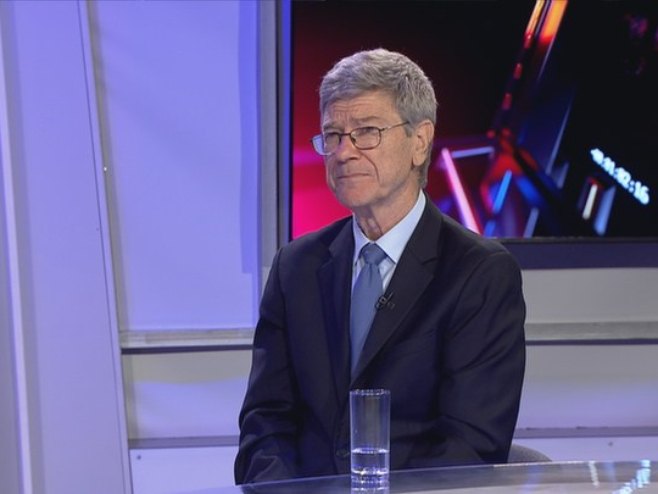




Relations between Republika Srpska and Israel have always been good, but have grown increasingly close in recent years, perhaps particularly over the past decade, Israeli writer Iddo Netanyahu, brother of Israeli Prime Minister Benjamin Netanyahu, told RTRS.
He said another indication of the strong relationship was the opening of an Israeli Chamber of Commerce office, which he believes will help strengthen economic cooperation between Republika Srpska and Israel.
“I think we are in similar situations, which is why we support each other. They are trying to force you to do certain things that you believe are bad for you. You do not want to commit national suicide. It is the same with Israel. They are trying to force us to do things that are not good for us. And that is why we resist them, to one degree or another,” Netanyahu said on RTRS’s Aktuelno program.
He argued that Republika Srpska and Israel face comparable challenges and, in some respects, similar adversaries.
“That is why I think we understand each other very well,” Netanyahu said.
He stressed that there is broad support for strengthening relations between Israel and Republika Srpska.
“We have very few allies in the West, very few. We have many countries that want good military relations with us because now, suddenly, in Europe they have realized: Wait, there is a threat here. How do we fight it? How do we defend ourselves against missiles that Russia might fire at us?” Netanyahu said.
He added that European countries are signing agreements with Israel to acquire missiles, missile defense systems, and air-defense technology, while at the same time condemning Israel at the United Nations.
“That is very hypocritical,” Netanyahu said.
One of the reasons for Netanyahu’s visit to Banja Luka was the promotion of his book Yoni’s Last Battle: The Rescue at Entebbe, 1976, which has been translated into Serbian.
“I never think about messages when I write. I simply write. I tell the story. Even with my plays, people always ask me: What is the message of this play? I don’t know. Watch the play and see what the message is. You decide what the message is,” Netanyahu said.
He described the story as highly inspirational, saying one lesson readers could draw from it is that determination must be accompanied by the ability to achieve one’s goals.
“Every nation that wants to survive in this world, this very dangerous world, must develop the means that enable it to survive. It is not enough simply to have the will. And that, in the case of Entebbe, is demonstrated very well in this book,” he said.
Netanyahu argued that the world and human nature do not fundamentally change and that nations must be capable of defending themselves.
“Wars will happen, and every nation must ensure that, if war comes, it can resist and survive. And the best way to prevent war is, of course, to be prepared for war,” he said.
Speaking about the book’s international reach, Netanyahu noted that it was originally published in Hebrew 35 years ago, while his extensive research into the Entebbe operation began around 40 years ago.
The book was later translated into English and Russian and has more recently appeared in Chinese, Spanish, German, Czech, and Serbian.
“I think this operation can teach people many things. It is very important that the story reaches audiences, perhaps especially Serbian-speaking audiences, because of what it says about national sovereignty, the fight against terrorism, how to resist, how to confront attacks by those who want to destroy you, and how a state can stand up to them,” Netanyahu said.
Reflecting on the 1976 Entebbe operation, Netanyahu said the events were so extraordinary that even a Hollywood screenwriter could hardly have invented them.
He recalled that two Palestinians belonging to a militant organization and two German left-wing militants hijacked an Air France flight traveling from Tel Aviv to Paris after a stop in Athens.
The aircraft was eventually flown to Entebbe Airport in Uganda, where, according to Netanyahu, the operation had been coordinated in advance with Ugandan President Idi Amin and members of the Ugandan military cooperated with the hijackers.
Around 250 passengers were taken to the Old Terminal at Entebbe Airport, while the hijackers demanded the release of approximately 55 prisoners, most of whom were being held in Israel.
Seven days later, shortly before the ultimatum was due to expire, an Israeli military force landed at Entebbe Airport.
“The unit commanded by my brother Yoni managed to kill the terrorists and free the hostages. Yoni was killed in the fighting, and the hostages were brought back to Israel. That, in short, is the whole story,” Netanyahu said.
Source: RTRS