

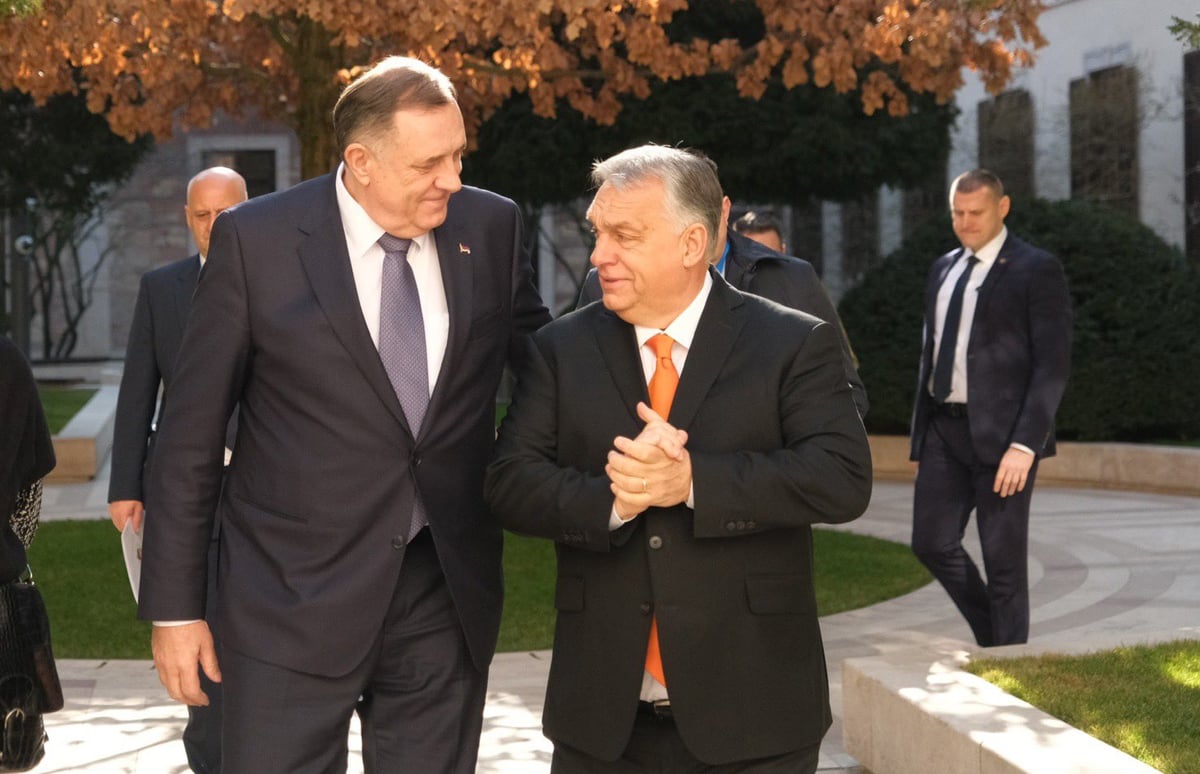
The strategic partnership between Republika Srpska and Hungary has once again been confirmed. Official Budapest understands the position of Republika Srpska in Bosnia and Herzegovina and the region, which is precisely why Srpska supports Hungary’s right to be involved in all Balkan issues and challenges. This was emphasized by the President of Republika Srpska during his meeting with Hungarian Prime Minister Viktor Orban. The agenda included economic as well as political-strategic issues.
It was the eleventh meeting between Dodik and Orban, and the second one this year. More are expected. Achievements were reviewed, and joint plans announced. Strategic political issues were at the center. Hungary’s support for Srpska and its commitment to peace in the Balkans, Ukraine, and the world was highlighted.
“We see Hungary as a strategic partner. They show this in the best possible way and understand the position and relations of Republika Srpska in Bosnia and Herzegovina and the region. They believe that Srpska is indispensable and that, in accordance with international agreements, the right of Srpska to its position must be affirmed. This political support is not one-sided,” said Dodik.
Srpska supports Hungary’s involvement in all Balkan matters and in defining solutions to those issues, especially concerning peace and stability. This involvement also provides insight into developments within the European Union and globally. Due to the relationship between Prime Minister Orban and the new U.S. administration, Dodik added, Hungary has the potential to shape new strategic U.S.-Hungarian relations.
“This was an opportunity to express that those relations should also touch upon our region, and that Republika Srpska and the entire area should not be marginalized or disappear from the international radar. We do not want anything to be done to the detriment of others; what we do with Hungary is not aimed against the Federation. We have been given an opportunity and we appreciate the foresight of Prime Minister Orban, who initiated this cooperation on a strategic level,” the President of Srpska stated.
The stability of Republika Srpska remains vital for peace and security across the Western Balkans. “I’m always glad to see you, Mr. President,” Orban said in a post on X. He noted that the progress of joint projects in agriculture, energy, and the economy was discussed. Hungary has long shown interest in the energy sector, and this interest has now been made concrete—projects defined, responsibilities clear.
“This relates to the Hrgud wind power plant and the solar power plant in the Trebinje area. There is also potential for other energy projects, particularly for the construction of a transmission network and capacity to ensure that energy produced in Srpska can be safely transferred to the market, which is a point of interest for cooperation,” said Petar Đokić, Minister of Energy and Mining of Republika Srpska.
There is also interest in higher education. Hungary has already assisted Srpska with European accreditation of higher education institutions. In the field of high technology, cooperation has been established between Hungarian science and technology parks and the one currently under construction in Srpska. The signing of the contract with the Saudi fund has finally been unblocked.
“We are intensifying cooperation with Hungary on the construction of the Science and Technology Park, which will be a key link between the economy and science in Republika Srpska. The goal is to achieve high technologies and bring technology transfer to Republika Srpska, where Hungary plays a crucial connecting role,” added Željko Budimir, Minister for Scientific-Technological Development and Higher Education of Republika Srpska.
Old ideas of cooperation between Srpska and Hungary, as well as new ones, will be considered before the next Dodik-Orban meeting. What is certain is that cooperation between police structures in the fight against the global challenge of terrorism will be intensified. According to Dodik, this will guarantee the safety of citizens in both Republika Srpska and Hungary.
Source: RTRS