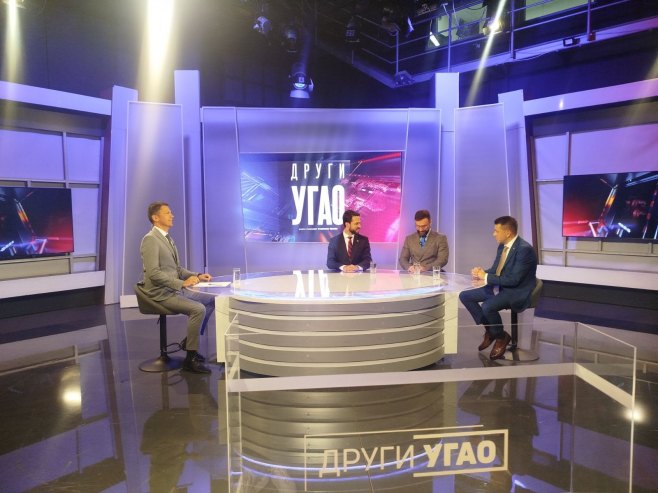

Republika Srpska has demonstrated its commitment to the Dayton Peace Agreement and constitutional principles through the establishment of its new National Assembly, according to guests appearing on RTRS’s political discussion program Drugi ugao (Another Angle). They emphasized institutional continuity, political stability and the importance of dialogue in resolving outstanding issues in BiH.
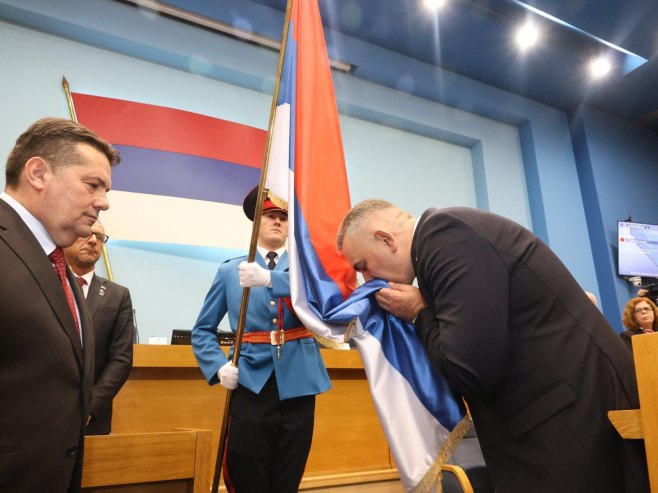
The discussion followed the inaugural session of the 12th convocation of the National Assembly of Republika Srpska, during which President Savo Minić and Serb member of the BiH Presidency Željka Cvijanović took their solemn oaths.
Romić: Republika Srpska demonstrates commitment to Dayton principles
Marko Romić, Secretary-General to the President of Republika Srpska, said the messages delivered during the inaugural session reflected a consistent commitment to the Dayton Peace Agreement and the Constitution of Republika Srpska.
“Republika Srpska could teach everyone in the Federation of BiH a lesson, particularly through the messages we heard today from President Savo Minić and other officials. These messages are firmly grounded in Dayton and the Constitution of Republika Srpska,” Romić stated.
He also discussed the electoral system in Republika Srpska, arguing that it respects the political representation of constituent peoples.
According to Romić, Republika Srpska has not experienced an electoral situation comparable to the controversy surrounding Željko Komšić’s election as the Croat member of the BiH Presidency.
“Nobody in Republika Srpska elected representatives for another people. Serbs voted for their president, Bosniaks elected a vice president, and Croats also elected a vice president from the Croat people,” he said.
Romić described the electoral process as an example of democratic participation and emphasized that the inaugural parliamentary session marked the constitutional beginning of a new legislative term.
He added that the formation of a new National Assembly represents continuity in the exercise of public authority, which should remain uninterrupted under constitutional principles.
“All the messages we heard were fully consistent with Dayton and the Constitution. That remains unchanged in the institutional life of Republika Srpska,” Romić said.
He concluded that Republika Srpska had demonstrated its readiness and ability to uphold constitutional arrangements established by the Dayton Peace Agreement.
Dakić: National Assembly represents continuity of popular sovereignty
Dragan Dakić, Secretary-General of the National Assembly of Republika Srpska, emphasized the institution’s historical continuity and its role in representing the will of the people.
“The National Assembly of Republika Srpska is a direct expression of popular sovereignty. It has existed continuously since 1991, functioning without interruption and with considerable efficiency,” Dakić stated.
He argued that the effectiveness of Republika Srpska’s institutions has been recognized beyond BiH, including by international partners and the European Union.
Looking ahead, Dakić warned that political and institutional challenges would continue both domestically and internationally.
He described the current international environment as one marked by a broader trend toward the erosion of state sovereignty.
“The legitimacy and legality of state institutions around the world are being called into question. Structures operating outside or alongside states are emerging and taking over some of their fundamental functions,” Dakić said.
He pointed particularly to developments in Europe, arguing that such processes have contributed to the weakening of the traditional role of the state.
Dakić expects institutional stability despite international challenges
In contrast to what he described as global institutional uncertainty, Dakić praised the ability of Republika Srpska’s leadership and governing coalition to establish the necessary institutions quickly.
He said the formation of governing bodies and their continued functioning demonstrated political resilience and administrative capacity.
According to Dakić, the leadership’s experience and established decision-making practices would help Republika Srpska respond to future challenges.
“We can expect continued stability through leadership that has demonstrated determination both internationally and domestically,” he stated.
“Challenges will certainly not be lacking, but I am convinced that our institutions and elected representatives will respond appropriately through their experience, continuity of decisions and demonstrated diplomatic ability,” Dakić added.
Šolaja: International partners increasingly understand Republika Srpska’s position
Political scientist Bojan Šolaja said he expected considerable continuity in Republika Srpska’s political direction and institutional policies.
He argued that international actors have gained a clearer understanding of Republika Srpska’s constitutional position within BiH.
According to Šolaja, recent international engagement has provided opportunities for Republika Srpska’s representatives to explain and defend positions they have maintained for years.
“Republika Srpska finally has an opportunity to firmly establish its position within BiH, as envisaged by the Dayton Peace Agreement, while also making full use of the possibilities provided by the Constitution, including international activities,” Šolaja said.
He suggested that stronger international engagement could
Source: RTRS