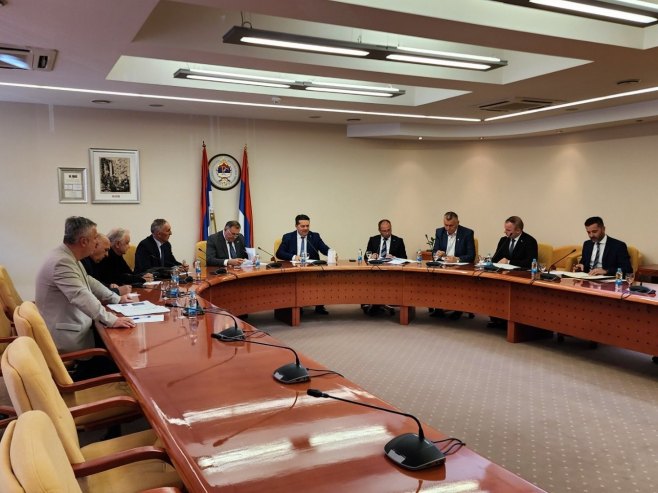
The Organizing Committee for the 35th anniversary of the National Assembly of Republika Srpska, chaired by Milorad Dodik, has adopted a program of commemorative events scheduled for Saturday, October 24, in Pale.
The program was approved at a committee meeting held in Banja Luka.
According to the adopted schedule, delegations representing the Republika Srpska leadership, the Association of Founders of Republika Srpska and the Veterans’ Organization will lay wreaths at the monument dedicated to the founders and defenders of Republika Srpska.
The wreath-laying ceremony will take place at 2:30 p.m. at the Square of the Founders of Republika Srpska in Pale, in front of the Republika Srpska House.
A formal commemorative ceremony will follow at 4:00 p.m. at the Pale Cultural Center.
Dodik: National Assembly played a decisive role in preserving Republika Srpska
Milorad Dodik, chairman of the Organizing Committee, said the National Assembly had played a decisive role in preserving Republika Srpska and maintaining its strength throughout its existence.
“The National Assembly of Republika Srpska has always been an expression of the democratic will of the people. It was within the Assembly that the most serious discussions took place and the most important decisions were made, not only during the Homeland Defense War but also throughout the period when we faced strong pressure from international actors,” Dodik told reporters in Banja Luka following the committee meeting.
Dodik also announced that the National Assembly would soon begin drafting a new Constitution of Republika Srpska.
Stevandić emphasizes institutional unity
Nenad Stevandić, Speaker of the National Assembly of Republika Srpska, said the Organizing Committee reflected unity between the legislative and executive branches of government, with representatives of both the ruling parties and the opposition participating.
Stevandić noted that considerable work had been undertaken during the current parliamentary term in preparation for the 35th anniversary.
These activities included preparing a commemorative monograph, installing busts and illuminating the National Assembly building in the colors of the Republika Srpska flag.
Founding members recall the establishment of the Assembly
Božidar Vučurević, a member of the first National Assembly, told Srna that the establishment of the Assembly of the Serb People in BiH 35 years ago represented a turning point in Serb politics.
He argued that without the Assembly’s establishment, Serbs in BiH would today be politically subordinated.
Vučurević described the Assembly of the Serb People in BiH as the foundation from which Republika Srpska emerged.
“October 24, 1991, the date when the Assembly of the Serb People in BiH was established, is one of the most important dates for the creation and survival of Republika Srpska,” Vučurević said.
He recalled the political decision of 13 Serb representatives to leave the continuation of a session of the BiH Assembly in October 1991.
According to Vučurević, their decision was a direct response to what he described as unlawful outvoting and attempts by Bosnian Muslim political representatives, supported by Croat representatives, to impose a new constitutional order.
Dragan Kalinić, another member of the first Assembly and a former Speaker of the National Assembly of Republika Srpska, said the establishment of the Assembly of the Serb People in BiH had laid the foundation for defending the Serb population against further suffering.
Kalinić recalled that, at the time, he and Milorad Dodik belonged to the reformist political movement.
He said they had recognized the need to protect Serbs from being outvoted and from what they feared could be a repetition of tragic events from their history. They therefore concluded that their place was alongside the representatives of the Serb Democratic Party (SDS).
“We established the Assembly of the Serb People, which, like the source of a clear river, provided the foundation on which the Constitution of Republika Srpska, Republika Srpska itself, the army, the police and all other state institutions were built,” Kalinić said.
“We accomplished this before the flood of civil war swept through BiH, during which all three peoples paid a heavy price,” he added.
The establishment of the National Assembly in 1991
The National Assembly of Republika Srpska was established on October 24, 1991, in Sarajevo, originally under the name Assembly of the Serb People in BiH.
Its establishment marked the beginning of the formal process of constituting what is now Republika Srpska.
The decision to establish the Assembly was made by Serb representatives elected to the Assembly of the then Socialist Republic of Bosnia and Herzegovina during the multiparty elections held in autumn 1990.
The first Assembly initially consisted of 77 representatives: 72 from the Serb Democratic Party, four from the Alliance of Reform Forces of Yugoslavia and one from the Serbian Renewal Movement.
Other Serb representatives subsequently joined, increasing the number to 83, which has remained the number of parliamentary seats to the present day.
Momčilo Krajišnik was elected the first Speaker of the Assembly on October 25, 1991.
During its first months, the Assembly adopted several decisions that established the legal and constitutional framework of Republika Srpska.
The Declaration Proclaiming the Republic of the Serb People of Bosnia and Herzegovina was adopted on January 9, 1992.
The first Constitution of Republika Srpska and the Constitutional Law on its Implementation were adopted on February 28, 1992, establishing the formal legal and constitutional framework for the Serb political entity.
The establishment of the National Assembly remains a central political milestone in the history of Republika Srpska. Through its institutions, key laws and decisions have been adopted that define and safeguard its constitutional and legal position within BiH.
Source: RTRS