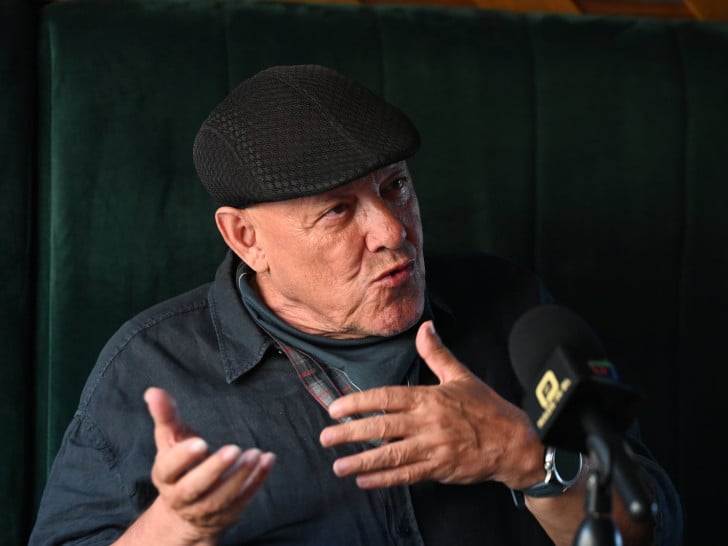


Nenad Milosavljević, frontman of the legendary rock band Galija, says that even after nearly five decades of music, the band continues to approach every concert and every new song with the same enthusiasm that marked its beginnings.
In an interview with Glas Srpske, Milosavljević reflected on Galija’s 50-year journey, its musical legacy, the changing music industry and the band’s upcoming concert in Banja Luka.
Galija will perform at the Obilićevo Sports Hall on October 17 as part of its 50th anniversary celebrations.
Discussing the differences between his acoustic solo performances and concerts with the full band, Milosavljević explained that each format offers a distinct artistic experience.
“An acoustic performance allows the lyrics to be understood differently because there is more room for dramatic interpretation. You dress the song in different clothes, giving it the possibility of a multilayered emotional interpretation,” he said.
In acoustic performances, he explained, musicians can spontaneously change the structure, dynamics, emphasis and tone of a song, responding directly to the audience and the atmosphere.
A Galija concert, however, is an elaborate production with a carefully developed concept.
“A Galija concert is a grand performance with its own theme, just as a theatrical production has its own title. There is very little room for improvisation, and even the interaction with the audience is planned in advance,” Milosavljević explained.
The theme of the upcoming Banja Luka concert will be time, reflecting the band’s five decades of existence.
“We have our own understanding of the importance of songs created in different periods and emotional circumstances, and that determines their place in the concert. After all, this is our celebration, which has little to do with media exposure or record sales,” he said.
Fifty years of Galija: “If I were born again, I would change nothing”
Glas Srpske: It has been 47 years since your debut album Prva plovidba and half a century since Galija’s first rehearsal. From the audience’s perspective, those decades have been filled with remarkable events. As the band’s captain, how do you look back on the first 50 years of this journey?
Milosavljević: If I were born again, I would change nothing.
It was wonderful to live through it all: the excitement of our first success, our first disappointment, our first negative review and our first positive review. Ultimately, that was our life. We lived it as best we knew how, wholeheartedly, sincerely and to the fullest, whatever the outcome.
That extraordinary energy still keeps us going. We continue to look forward to every concert, every new song and every discovery of new paths we might explore.
I believe it will remain that way until the very end. At least, that is what I would like, and I believe the rest of the band feels the same.
The concert that changed everything
Glas Srpske: Looking back at Galija’s beginnings, can you single out a concert when you first realized you were becoming a serious professional band rather than simply a group of music enthusiasts from Niš? Was it a performance in Zaječar, Subotica, the BOOM Festival or another moment?
Milosavljević: Those festivals were primarily a source of encouragement. They showed us that what we were doing could matter.
We were still boys chasing our dreams who had been fortunate enough to succeed on a few occasions.
Of course, those experiences were extremely important, but we understood that we had not yet achieved what we wanted.
We had seen many bands begin in a similar way, winning festivals before eventually disappearing. Some of them were excellent, which taught us that being good was not enough. You needed something more.
I think what saved us was that we did not spend too much time thinking about it. All that mattered was being together and playing our music.
The first concert at which we realized we had reached another level was Bijelo Dugme’s performance at Partizan Stadium in 1979.
We performed as one of the opening acts alongside other bands from the former Yugoslavia, and we delivered a brilliant performance.
That afternoon, the audience gave its verdict, and we understood it.
We were unusually quiet throughout the evening. We knew something important had happened.
How Galija developed its distinctive sound
Glas Srpske: Your debut album Prva plovidba introduced an unusual sound that contrasted with the emerging new wave movement. Nevertheless, it found its audience. What was your first experience in the recording studio like, and how difficult was it to preserve your musical identity against the expectations of the
Source: Glas Srpske