
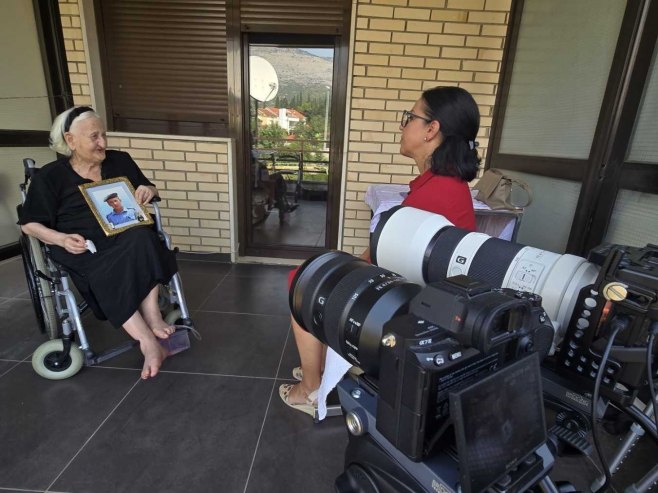
At the Retirement Home in Trebinje, a team from the Memorial Centre of Republika Srpska met Koviljka Zelenović, dressed in black and sitting almost motionless in her room. Side by side on a small table stood a photograph of her only son, Nebojša, and an icon, with a lit candle burning beside them.
She welcomed the visitors warmly, embracing them, thanking them for coming, and asking them to return again. From the window and balcony of her room, she can see the part of Trebinje where her son, whom she affectionately called Neno, is buried.
“As long as I was able, I sat on the balcony every morning with a cup of coffee. I would call for Neno to come, so he would know I was close to him, so he would hear that our house is gone, our yard is gone, the flowers, the big gate—everything is gone,” Koviljka recalled.
Every morning, while she was still able to walk, she would go out onto the balcony, drink her coffee, and call out to her son—not because she expected an answer, but because she wanted him to know that his mother had never forgotten him.
Between tears, she would often whisper:
“Your mother drinks her coffee alone and sheds bitter tears. Come, Neno, come, my dear son. See how your mother lives without you.”
Koviljka says she knows she lives in a retirement home and that others can hear her, but she cannot always suppress her grief.
“Sometimes the words simply escape me. I know this is a nursing home and that others may not want to hear it, but the heart cannot resist,” she said.
Today, she also meets her son in her dreams.
About a week before the interview, she dreamed that he came beneath her window while she was seriously ill. She admitted that, after seeing him in her dream, she hoped she too would soon leave this world.
“I dreamed of him just a week ago. I was very ill, and when I saw him in my dream, I thought perhaps I would die too. But death does not come, my dear. It simply will not come,” she said.
In the dream, Nebojša was riding a chestnut horse with a white star on its forehead, wearing a jacket similar to one once worn by the famous football coach Miljan Miljanić.
“I know how much you admired Miljanić, Mother, so I dressed like him before coming to visit you,” she remembers her son saying in the dream.
Nebojša Zelenović was born in 1970 and was the only child of Koviljka and Milorad. He grew up in Sarajevo and spent part of his childhood in Bratač near Nevesinje, where his mother’s relatives, the Gušić family, lived.
Koviljka remembers him as a kind and hardworking young man. He studied mechanical engineering, completed practical training at the “Orao” factory, served his military service with distinction, and even received a commendation, which she still keeps. Whenever he visited Bratač, he helped his relatives with farm work.
In the Sarajevo neighborhood of Nedžarići, where the family lived, his closest friends included both Serbs and Bosniaks.
“Back then, nobody cared who belonged to which nation,” Koviljka said.
Nebojša had also fallen in love with a young woman who was slightly older than him.
Then the war began.
On August 6, 1992, Nebojša was killed by sniper fire while serving in a trench on Stupsko Brdo, near the family’s home in Nedžarići. His father, Milorad, volunteered to take his son’s place at the front in an effort to protect him. Although he was wounded three times, he was unable to save his only child.
Koviljka says that life ended for her that day.
Yet she had to bury her son—not once, but three times.
He was first buried at the cemetery in Vlakovo near Ilidža. After the Dayton Peace Agreement, his remains were transferred to the Military Cemetery in Sokolac. Finally, Nebojša was laid to rest in Trebinje, at the cemetery visible from the balcony of the retirement home where his mother now lives.
“My heart broke three times,” she said quietly.
Behind Koviljka and her son stands the tragic history of two families.
Born in Zenica, she lost her father at the age of four and grew up in Bratač with the Gušić family, seven members of which were killed during the Second World War. Later, an uncle who had survived imprisonment on Goli Otok took her to Sarajevo so she could continue her education.
“He understood hardship and poverty. Back then we simply called it poverty. If you have no father and no brothers, then you truly are poor,” she recalled.
In Sarajevo she met her future husband Milorad, and together they had their only son, Nebojša.
Today, Koviljka still remembers her relatives from both the Zelenović and Gušić families who lost their lives in war. Among them, she proudly mentions her cousin Novica Gušić, the wartime commander of the Nevesinje Brigade.
“My Zelenović and Gušić families have never forgotten me,” she said.
Neither has she forgotten her home in Nedžarići, its courtyard, flowers, or the large gate. Most of all, she has never forgotten her Neno.
His photograph and an icon remain beside each other in her room, with a candle always burning nearby. Beyond the balcony lies Trebinje—and the hill where her son rests, within reach of the mother’s voice that still calls to him:
“Come, Neno, come, my dear son.”
Source: RTRS