

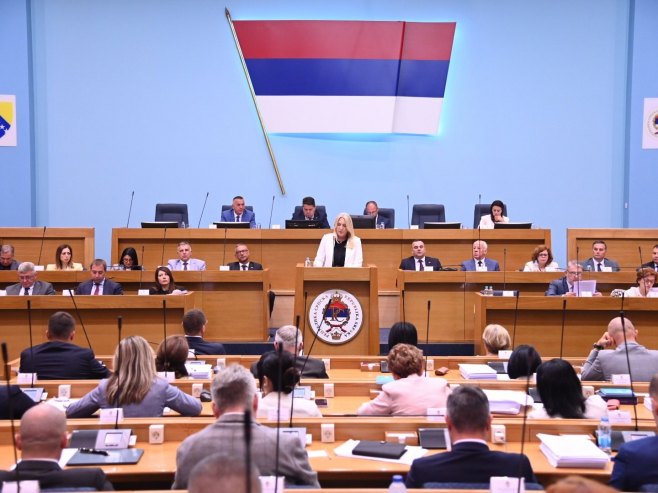
Support for the veto of the Serb member of the Presidency not only protects Republika Srpska’s position in the Commission to Preserve National Monuments, but also safeguards the status of Serbs as a constituent people within Bosnia and Herzegovina’s constitutional and legal system. That is, in the briefest terms, the assessment of the decision adopted by the National Assembly of Republika Srpska, which yesterday backed Željka Cvijanović’s veto and thereby annulled the Presidency’s decision to return foreign experts to the Commission.
Bosniak member of the Presidency Denis Bećirović, however, has announced an appeal to the incomplete Constitutional Court, claiming that Cvijanović had no right to challenge the decision, nor did the National Assembly have the authority to support her veto. Legal experts, for their part, predict a debacle for Bećirović’s request, although the incomplete Constitutional Court has previously delivered unpleasant surprises for Republika Srpska.
The unity of Serb lawmakers proved to be an insurmountable barrier to pressure coming from Sarajevo. The National Assembly of Republika Srpska blocked what it described as an attempt to rewrite history and bring foreigners back into the Commission to Preserve National Monuments of Bosnia and Herzegovina. It also defended the right, guaranteed by Dayton and the Constitution, to support the veto of the Serb member of the Presidency.
“This was a demonstration exercise in which we could see what kind of Bosnia and Herzegovina is being offered to us if we do not have constitutional mechanisms of protection to defend ourselves. What is being offered is a state in which you will simply be outvoted. That is why the National Assembly exists, with full legitimacy and full constitutional authority, and with a provision that makes it an integral part of the decision-making process in the Presidency, because the process ends here by annulling the decision as if it had never existed,” said Serb member of the Presidency Željka Cvijanović.
The attempt to return foreigners to the monuments commission and abolish consensus voting is aimed at rewriting history, seizing Serb cultural heritage and presenting it as Bosnian, such as the medieval printing house in Novo Goražde or the Čajniče Gospel, said current Commission member Anđelina Ošap Gaćanović.
“The intention behind this decision is to use foreign members as a mechanism to outvote Republika Srpska in that Commission, to turn a Dayton category into an institution whose task would be to create a ‘Bosnian’ nation and seize property. The attempt to turn the Čajniče Gospel into something ‘Bosnian’ was a clear example of identity and property being stolen at the same time,” said Commission member Anđelina Ošap Gaćanović.
Bosniak member of the Presidency Denis Bećirović is not accepting the decision of the National Assembly. What bothers him, critics say, is that the RS Assembly forms part of the Presidency’s decision-making process through its support for Cvijanović’s veto. He is now threatening to appeal to the incomplete Constitutional Court of Bosnia and Herzegovina, where foreign judges sit, in an effort to return foreigners to the monuments commission.
“In this specific case, the National Assembly of Republika Srpska has no constitutional authority to conduct a procedure declaring a decision destructive to the vital interest of an entity. Because the Assembly confirmed Željka Cvijanović’s veto, I will initiate proceedings before the Constitutional Court of Bosnia and Herzegovina,” Bećirović announced.
By denying the Serb member of the Presidency the right to veto, critics argue, Dayton itself is being challenged and peace in Bosnia and Herzegovina is being undermined. Legal experts are unanimous in saying that the incomplete Constitutional Court has nothing to do with the decision on appointing foreign members to the Commission, citing its own earlier position that it would not enter into matters of foreign policy. They therefore expect Bećirović’s request to be dismissed.
“The right of a member of the Presidency to use a veto predates the Dayton Peace Agreement itself. It was established in the New York Principles in September 1995 as a precondition for peace to be concluded at all. Anyone who attacks the right of a Presidency member to veto is, in fact, attacking peace in Bosnia and Herzegovina,” said legal expert Ognjen Tadić.
“Denis Bećirović’s announced request to the Constitutional Court is entirely unfounded. On the one hand, it is unfounded because the legal issue in this specific case concerns the definition of foreign policy. It is also unfounded because Bećirović’s claims that the National Assembly has no authority to decide on the veto of the Serb member of the Presidency are simply incorrect,” said legal expert Damir Sakić.
In order to prevent the erasure of Serb identity and the imposition of some kind of Bosnian identity, the National Assembly supported Željka Cvijanović’s veto of the decision to return foreign members to the Commission. At the same time, Bosniak politicians are openly calling for foreign tutelage, not only in the monuments commission, but also in the OHR and the Constitutional Court.
Source: RTRS