


Bosnia and Herzegovina cannot survive in any form, as even the largest international intervention—not only military but also political—has failed to create a functioning state, SNSD President Milorad Dodik said.
According to Dodik, it has become clear to everyone in Bosnia and Herzegovina that the country lacks internal cohesion and that such cohesion was impossible from the moment the war began.
He argued that historical animosities have created divisions that cannot be overcome through external political pressure.
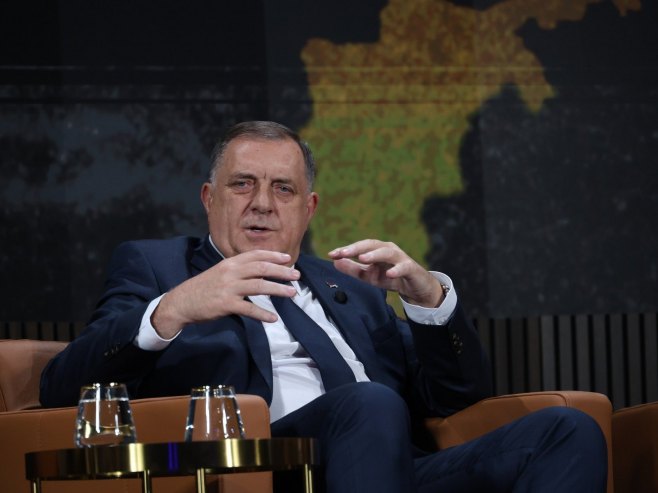
“Irreconcilable historical differences have left no possibility for such a project to succeed,” Dodik said during the panel discussion The Geostrategic Direction of Republika Srpska.
He added that what he described as anti-Dayton institutions—including SIPA, the Court and Prosecutor’s Office of Bosnia and Herzegovina, as well as the Constitutional Court of Bosnia and Herzegovina, which he referred to as unconstitutional—are being used as mechanisms to impose a centralized state structure and discipline political actors.
Dodik reiterated that Republika Srpska cannot accept attempts to place the institutions of Bosnia and Herzegovina above the institutions of Republika Srpska.
“Republika Srpska should finally reject such a concept,” he said.
He also stated that international intervention in Bosnia and Herzegovina would continue for some time but argued that it was gradually losing cohesion, adding that he was encouraged by what he described as a prevailing desire for peace throughout the region.
“There is no agreement with political Muslims in Sarajevo”
Dodik also said there is no possibility of reaching an agreement with what he described as “political Muslims” in Sarajevo, adding that, under such circumstances, proposals concerning a third entity would also be impossible to implement, despite, in his view, Croats never abandoning that objective.
“Someone promised the Muslims a unitary Bosnia and Herzegovina in which they would be in charge, and that promise was made on the basis of deception and manipulation,” Dodik said.
He argued that Croats had previously sought what he described as a “third self-governing entity,” but that the initiative had been blocked by what was then a stronger international community.
According to Dodik, international actors continue to reject what he described as the legitimate aspirations of the Croat people, referring in that context to the territory of Herceg-Bosna.
“We are not defending the Croats. By defending their rights, we are also defending our own position,” he said.
Dodik further stated that before the signing of the Dayton Peace Agreement, the Serb people had been subjected to what he described as complete demonization, adding that the key question today is not what others want, but what the Serb people want.
Source: RTRS