
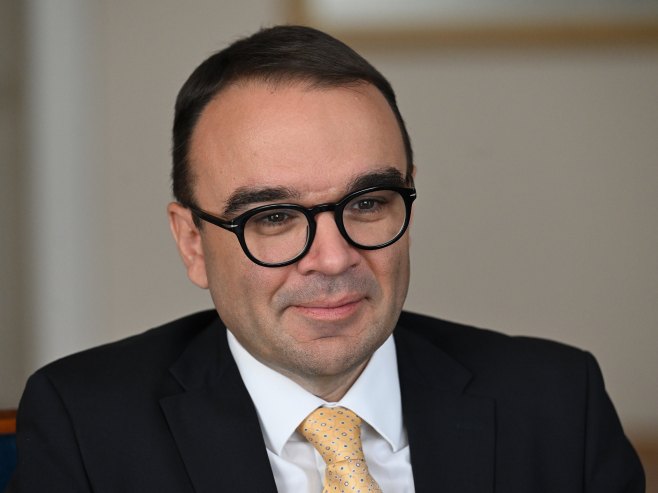
Aleksandar Vranješ, Ambassador of Bosnia and Herzegovina to Serbia, stated that Republika Srpska is today significantly stronger than it was after some of the most difficult political challenges it faced, emphasizing that this strength is reflected in its institutions, strategic approach, and long-term vision for the position of the Serb people.
“What saved Republika Srpska? The awareness that the lives of people in Republika Srpska are sacred. Once you have that awareness, you understand that this is a matter beyond political compromise. The only aspiration of the Serb people on the other side of the Drina—because the Serb people live on both sides of the Drina—is to belong to the same national community, the same entity, the same state. That was never a maximalist goal or an expression of hegemony,” Vranješ said during the television programme Perspectives on K1 TV.
Discussing changes in the policies of major powers, Vranješ argued that the United States made it clear in 2025 that it no longer wished to see Christian Schmidt in Bosnia and Herzegovina and that Schmidt received a message in New York that he could not ignore.
“We can see that the interests of the three major powers are increasingly converging regarding the issue of the High Representative in Bosnia and Herzegovina. This is a major success for us because we have finally found interlocutors who understand our arguments. Supporting a sovereignist approach, which is now personified by President Donald Trump, was recognized as an opportunity because we saw the possibility of finally finding a partner in Washington,” he said.
Vranješ also stressed that perceptions of the Serb people abroad are gradually changing due to technological progress and consistent political positioning, adding that generations raised on narratives portraying Serbs exclusively in a negative light are slowly leaving the public stage.
“What they tried to build through negative public relations campaigns is gradually disappearing. As a people, we have a strong value system. Our identity, traditions, and faith are the pillars that sustain us. We do not have to follow every trend that comes from abroad, especially if it contradicts who we are. Our strength lies precisely in that consistency. By remaining true to ourselves, we have earned the respect of those who value sincerity and firm principles,” Vranješ said.
Speaking about the concept of the “Serbian World,” he described it as an idea reflecting a shared cultural space in which Serbs live, regardless of their place of residence.
“You cannot deny Serbian cultural heritage simply because someone was not born in Serbia. That does not make them any less of a Serbian writer or cultural figure. This is something that cannot be erased. For thirty years there have been attempts to undermine our identity, but it is connected to a people that has existed for centuries. That cannot be undone. I believe the Serbian Orthodox Church represents the strongest symbol of our shared cultural and spiritual space, where we all identify,” he stated.
Reflecting on his diplomatic career, Vranješ noted that he was the first ambassador of Serb nationality to represent Bosnia and Herzegovina in Zagreb after an 18-year period.
Regarding Bosniaks living in the Raška region, he said that many of them do not maintain ties with Bosnia and Herzegovina and generally do not use the services of the Bosnian embassy.
“They do not come for consular services because they identify with the national framework of Serbia. That is their personal choice. From the perspective of state institutions, however, I cannot provide any additional status or capacity to individuals who do not hold citizenship of Bosnia and Herzegovina,” Vranješ concluded.
Source: RTRS