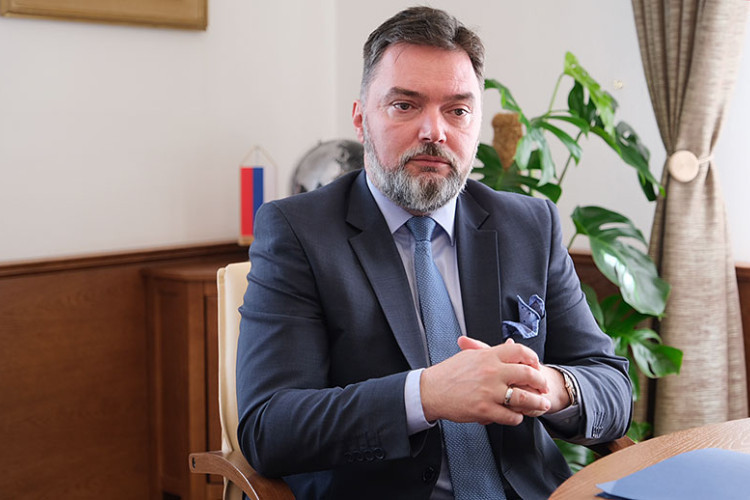

Closing the Office of the High Representative (OHR) would represent a form of political emancipation for Bosnia and Herzegovina because it would mark the end of direct foreign administration over an independent country, University of Belgrade professor Uroš Šuvaković said in an interview with Glas Srpske.
According to Šuvaković, High Representatives have effectively exercised powers comparable to those of colonial governors, including the ability to impose laws, suspend regulations and remove democratically elected officials.
He described the OHR as a political remnant of the past and argued that Bosnia and Herzegovina should return to the constitutional framework established by the Dayton Peace Agreement.
Return to the original Dayton framework
Šuvaković said the basis for the future functioning of Bosnia and Herzegovina should be a return to what he described as the original Dayton arrangement.
“The problem is that the international community, particularly Western countries, began changing the essence of that agreement from 1998 and 1999 onward,” he said.
According to Šuvaković, Dayton was based on the equality of the three constituent peoples — Bosniaks, Serbs and Croats — as well as the equality of the two entities, Republika Srpska and the Federation of BiH.
He argued that pressures, political conditionality, removals of officials and transfers of competences to the BiH level gradually altered that structure.
In his view, political Sarajevo increasingly promoted the concept of Bosnia and Herzegovina as a state of a single political nation rather than a country based on three constituent peoples.
“Every departure from Dayton increases the risk of new crises,” Šuvaković said, adding that Bosnia and Herzegovina should return to what he called its “factory settings” — the constitutional framework established by the Dayton Peace Agreement.
Return of transferred competences
Asked whether competences transferred from Republika Srpska to the BiH level could be returned, Šuvaković said that this was possible through a return to the original Dayton framework and strict observance of the constitutional order.
“Dayton is not the problem. The problem is changing it outside the prescribed procedures and without the political consent of all sides,” he said.
Dissolution as a possible consequence of majorization
Šuvaković also addressed the possibility of dissolution as one of the potential consequences of continued political pressure.
He stressed that this issue does not concern only Republika Srpska but also Croats in Bosnia and Herzegovina.
He referred to earlier arguments associated with Henry Kissinger and said attempts to politically dominate one or two constituent peoples inevitably create deep institutional tensions.
Šuvaković cited the position of Croats in the election of members of the Presidency as an example and argued that continued majorization could eventually raise questions linked to the right of peoples to self-determination.
He emphasized that he was not advocating such an outcome, but warning about what he considers the possible consequences of continued political imbalance.
Domestic actors should take responsibility
Asked whether the international community could abandon direct intervention in Bosnia and Herzegovina’s political processes, Šuvaković said this was the only correct path.
“BiH must be a country in which its peoples and political representatives take responsibility for their own future. The international factor cannot permanently replace domestic political agreement,” he said.
US policy could influence the future of the OHR
Šuvaković believes changes in US policy could significantly influence the future of the OHR.
He described the current situation as a transitional period in which there is no agreement on a new High Representative and said he does not believe the United States is particularly interested in filling the position quickly.
In his view, this could ultimately benefit Bosnia and Herzegovina.
Šuvaković also said US President Donald Trump should take into account the views and writings of Henry Kissinger, whom he described as one of the major strategists of US foreign policy.
Europe remains more interventionist
Asked why Brussels and other European centres of power continue to support a strong international role in Bosnia and Herzegovina, Šuvaković said part of the explanation is ideological.
He argued that liberal political circles in the United States and Europe had long promoted state-building and nation-building policies that, in his view, often generated crises because they lacked sufficient internal political support.
Šuvaković said the international system is no longer unipolar but increasingly multipolar, arguing that the United States has moved away from some of these policies while Europe continues to rely on them.
Balkans in a changing world order
Speaking about the Balkans in the emerging global order, Šuvaković said countries in the region could benefit from a policy of balance and neutrality.
“We should cooperate with our friends, but also with everyone who wants cooperation. Small nations do not benefit from being drawn into conflicts among great powers or from putting other people’s interests ahead of their own,” he said.
Šuvaković described his concept of political emancipation as a policy of “the Balkans to the Balkan peoples.”
He argued that regional countries should avoid becoming instruments of competing external powers and instead focus on their own political, economic and security interests.
Source: Glas Srpske