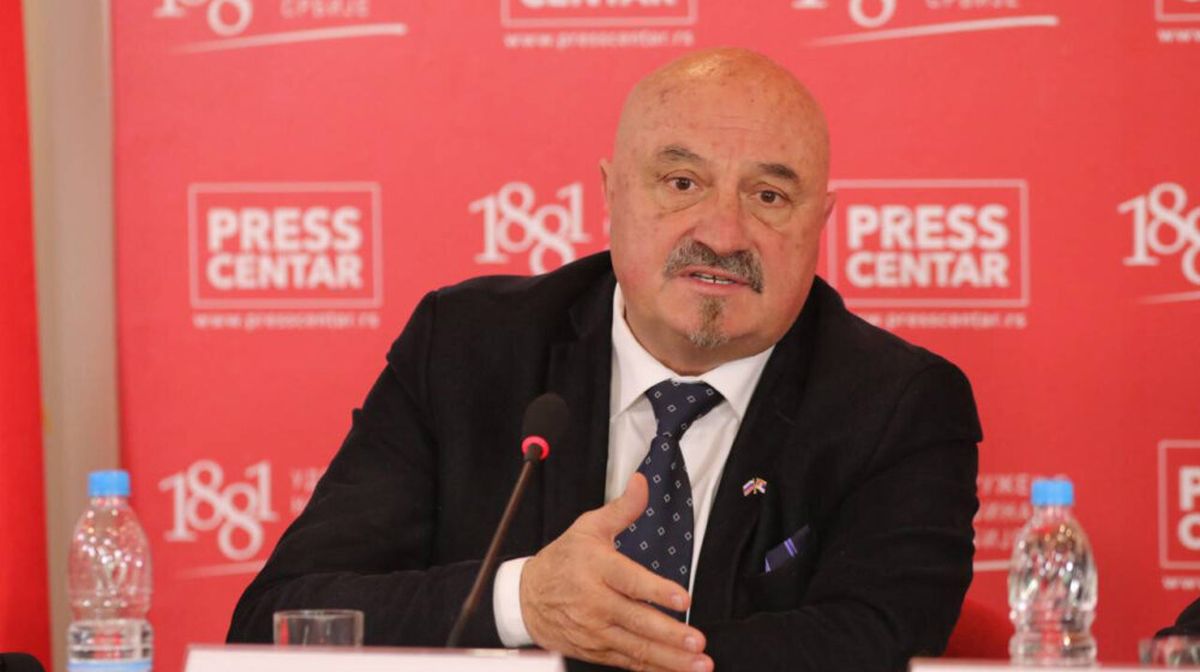

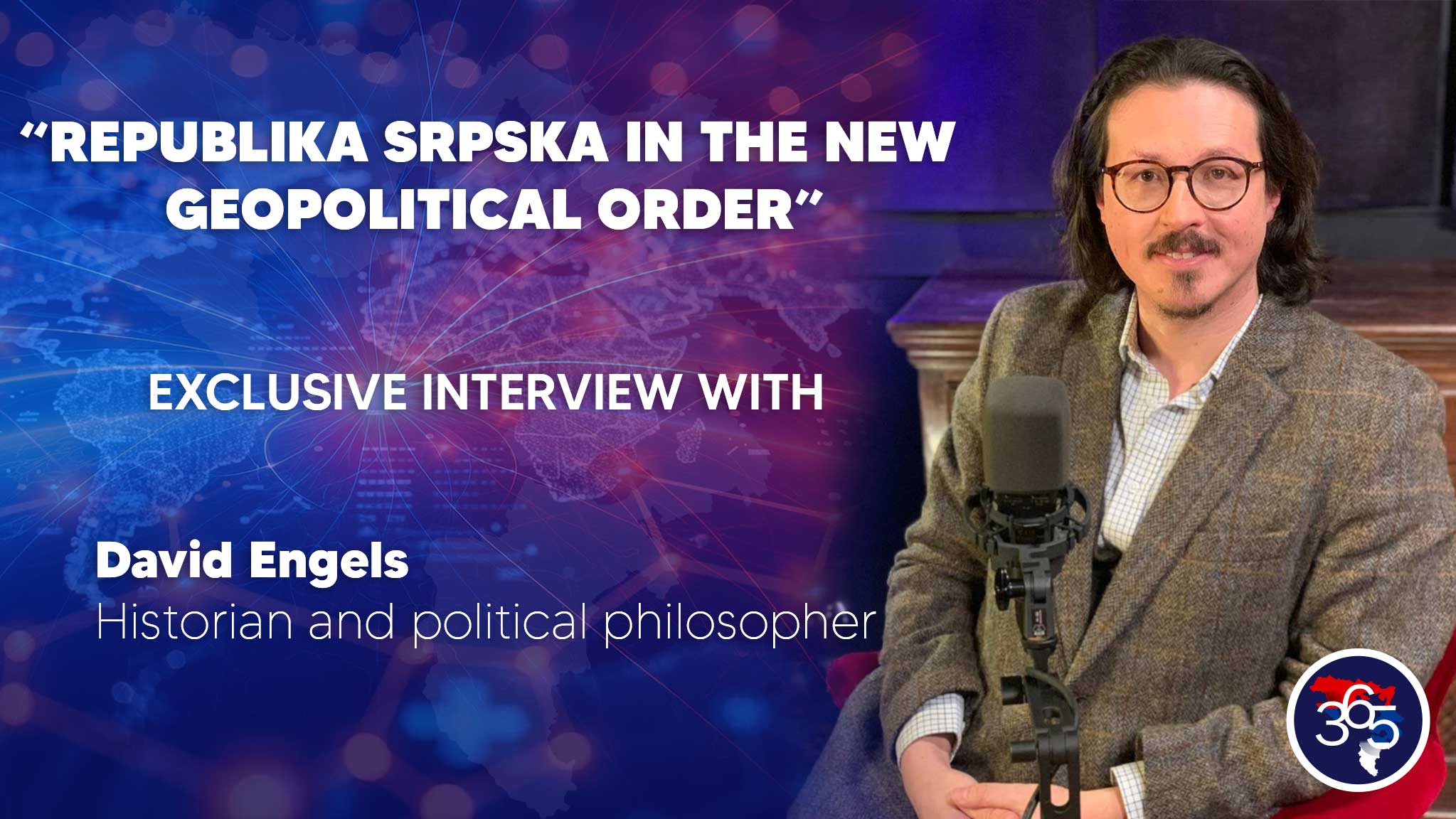
David Engels, Belgian historian, political philosopher and one of Europe’s most prominent conservative intellectuals, speaks to Srpska365.net about the future of Europe, the rise of a multipolar world, and the geopolitical position of Republika Srpska in a time of major global transformation.
In this exclusive interview, Engels discusses the decline of the post-1945 liberal order, the crisis of European identity, relations between global powers, and why Republika Srpska may play an increasingly important role in the emerging geopolitical balance of the Balkans and Europe.
Interview
From the perspective of historical cycles and civilisational dynamics, how do you interpret the current phase of geopolitical transformation in Europe?
David Engels:
From a long-term historical perspective, Europe is clearly undergoing the transition from the post-1945 order, which was based on American protection, economic growth, liberal ideology and the gradual dissolution of historical identities, into a far harsher world in which power, borders, resources and civilisational cohesion again become decisive. This development should not surprise anyone familiar with the history of late civilisations: Periods of globalist optimism, universalist values and institutional abstraction are always followed by a transition to Caesarist ambitions, imperial competition and the rise of a traditionalist civilisational state.

Europe, after decades of imagining itself as a post-historical space governed by law, markets and moral rhetoric, is now discovering that history never disappeared, but merely shifted into those hidden domains where today’s financial monopolies and media superpowers were forged and slowly started to undermine the credibility of liberal values. Now, the war in Ukraine, the decline of American liberal hegemony, the rise of China, the assertiveness of Russia, the instability of the Middle East, the crisis linked to mass migration and Islamisation and the demographic transformation of Europe itself all show that the continent is entering a hot phase in which its survival will depend less on declarations of values than on its capacity to act as a civilisational subject and take difficult and very concrete decisions. The tragedy is that Europe possesses the scale required for such a role, yet lacks the spiritual and political unity necessary to assume it.
Do you observe a transition from a unipolar to a multipolar world order, and how does this affect smaller political actors?
David Engels:
Yes, although I would phrase it slightly differently: we are not merely witnessing the end of unipolarity, but the return of a more classical imperial grammar of world politics. The American moment after 1991 was exceptional, and like most exceptional moments, it created illusions among both the dominant power and its dependants. Smaller political actors were encouraged to believe that their security could be guaranteed by legal frameworks, international institutions and abstract principles, but in a multipolar world, such an innocence becomes dangerous. Smaller entities must once again learn the ancient art of survival between greater powers: cultivating multiple channels, teaming up with other small actors, avoiding total dependence on one patron, preserving internal cohesion and understanding that moral language often conceals strategic interest. This does not mean opportunism in the vulgar sense, but rather prudence. A small people that ties its fate entirely to one declining hegemon risks being abandoned; one that provokes all surrounding powers risks destruction. The old language of diplomacy, balance, alliance and historical patience becomes relevant again.
In that context, how would you interpret the position of Republika Srpska as a political entity navigating between different global powers?
David Engels:
Republika Srpska occupies a particularly delicate position because it is neither a sovereign state in the full sense nor a mere administrative region without historical consciousness. Born from the Dayton settlement, it exists within Bosnia and Herzegovina, but also carries the memory, fears and aspirations of the Serbian people west of the Drina. This gives it a structural ambiguity which may be burdensome, yet also offers a certain diplomatic flexibility. In the present geopolitical constellation, Republika Srpska must navigate between Brussels, Washington, Belgrade, Moscow and, increasingly, other extra-European actors, while deciding where it thinks its future should lie. Its leadership has long cultivated relations with Russia, while more recent developments suggest a renewed interest from circles close to the current American administration, leading to the surprising renewal of the local energy network and the resignation of Christian Schmidt. And of course, the integration into the political and economic sphere of the EU is still a crucial, perhaps even the most crucial topic: Obviously, the Bosnian territories play a unique role in modern global geopolitics. Of course, this does not mean that Republika Srpska suddenly becomes a decisive actor itself; it means rather that its symbolic and strategic value increases whenever the great powers begin reconsidering the Balkan order.
How do you assess the importance of maintaining relations with multiple centers of power, such as Russia and the United States, in the current geopolitical environment?
David Engels:
Obviously, for a small political entity, maintaining relations with several centres of power is not a luxury but almost a condition of survival. However, in the long run, I think that the fate of the Republika Srpska, like the destiny of all peoples living on the European continent, is tied to the destiny of the European unification project, as I have tried to show in my book “Defending the European Civilisation” (just translated into Serbian). Not participating in the fight for a truly unified, strong, patriotic and Christian Europe because of an opportunistic wish to play Brussels against Moscow would be ultimately self-destructive.

Should Europe fail and either remain in the hands of the current leftist elites or be dissolved because of the pressure from Russia and the sovereigntists, the political destabilisation of the continent, its economic decline and its weakness in fighting both mass migration and foreign interference would sooner or later also impact the Balkans in an extremely negative way, and the European states’ newly won “sovereignty” would quickly make way to vassallisation under the competing rules of China, Russia, the US or Turkey. Thus, in my view, the Republika Srpska has a double historical mission: avoiding being taken over by Western wokism while striving for more intense cooperation with the other conservative and patriotic powers of the continent.
To what extent can informal political contacts and symbolic visits—such as those involving prominent international figures—be seen as indicators of deeper geopolitical shifts?
David Engels:
Informal visits should never be overinterpreted, especially when coming from erratic and often unreliable governments such as the current US administration, yet they should not be dismissed either. In periods of transition, symbolism often precedes formal policy. A dinner, a conference, a private visit, or an apparently “friendly” encounter may indicate that actors are testing possibilities before committing to institutional change. Donald Trump Jr.’s April 2026 visit to Banja Luka was reported by several outlets as part of a broader pattern of engagement between Republika Srpska and Trump-linked circles, including speculation about business interests and infrastructure projects. Similarly, Michael Flynn’s expected role in hosting an economic summit in Republika Srpska suggests that parts of the American right now view Banja Luka not merely as a provincial capital, but as a node in a broader anti-Brussels, sovereigntist, and possibly transactional network. These gestures do not yet amount to a new geopolitical order, but they reveal a weakening of the old consensus, particularly the automatic alignment between Washington, Brussels and the Office of the High Representative.

This creates an unusual situation in which Republika Srpska may be able to speak simultaneously to Russian traditionalists, American national-conservatives and certain European patriots. Such a position is promising but dangerous. It can increase room for manoeuvre, yet it can also provoke counter-pressure from all those feeling played. The decisive question is therefore whether Republika Srpska can use these contacts to strengthen institutional stability, cultural continuity and a commitment to the long-term defence of our common European civilisation, or whether it will overplay its cards out of parochial short-sightedness and be sooner or later overwhelmed by the rivalries of larger powers for whom Banja Luka is just a minor asset easily traded for other interests.