
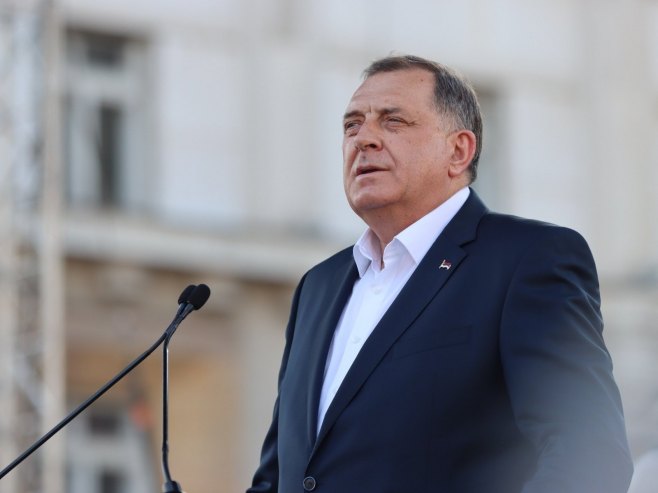
SNSD President Milorad Dodik stated in an authored text for Tanjug that many still fail to understand that Republika Srpska has never been merely a political project, but rather the result of a historical decision by a people to survive. He emphasized that in Republika Srpska, political offices are not just technical positions of power, but carry the symbolism of survival.
Dodik pointed out that the office of the President of Republika Srpska has never been merely an administrative norm, but an expression of the political will of the people who created Republika Srpska during the Homeland Defense War.
He stressed that those who believed they could break him through political processes are now discovering the opposite—that not only have they failed to weaken him, but have made him politically stronger than ever, while at the same time strengthening awareness of Republika Srpska.
In his authored text for Tanjug, Dodik writes:
There comes a moment in every politics when the story of an individual ends and the story of a people begins. In Republika Srpska, that moment has long passed.
Anyone who once stands before the people must know that they can never again hide behind them. This is not a political figure—it is a rule of politics in a country that was created in war and survived in a peace that has never been entirely peaceful.
That is why the current political moment is far broader than a single court case or a single office.
For years, in Sarajevo and within parts of the international community, the same political assumption has been repeated: that by targeting the presidents of Republika Srpska, they can break Republika Srpska itself. This assumption rests on a fundamental misunderstanding—of what that office actually represents.
The President of Republika Srpska has never been merely an administrative norm. That office is an expression of the political will of the people who created Republika Srpska in the Homeland Defense War. It is a political symbol of a historical choice.
That is why every attempt to weaken Republika Srpska by exerting pressure on that office begins from a flawed assessment.
Because Republika Srpska was not created by office decisions—it was created by the historical decision of a people to survive.
And that is precisely why the paradox continues—one that many refuse to see.
Those who believed they could break a man through political processes now find they have achieved the opposite. Not only have they failed to break him—they have made him politically stronger than ever. And alongside that, awareness of Republika Srpska has grown stronger.
This is the result of yet another misunderstanding.
In Republika Srpska, political functions are not merely technical positions of power. They carry the symbolism of survival.
A country is not made up of institutions alone. A country is made up of its people and its symbols. When you attempt to remove a symbol, you often awaken the people that symbol represents.
That is why this entire situation is far more than a political conflict.
It raises the question of what kind of community Bosnia and Herzegovina truly is.
Imagine a system that calls itself sovereign, yet accepts that a foreign official imposes laws under which its own political representatives are then judged. Imagine a system that calls itself democratic, yet prosecutes political positions.
Paddy Ashdown once openly stated that the role of the High Representative gave him “powers that should make any liberal blush.” Few political systems have so openly acknowledged their own lack of democracy.
Today, there is no other position in Europe with such powers. There is no politician who can wake up, sit at a computer, and publish a law that changes the legal order of a country.
And yet, Republika Srpska is expected to accept such a system as normal.
In Sarajevo, it is often said that everything is illegal—the High Representative, the Election Commission, the court, and the verdict. Yet it is then added that all of it must still be respected.
The logic is simple: whatever is against Republika Srpska is declared legal.
That is why it is important to return the discussion to the only document that has real legitimacy—the Dayton Peace Agreement.
Republika Srpska is not against Bosnia and Herzegovina as defined by Dayton. But it is against a Bosnia and Herzegovina in which rules are changed by decrees of foreign administrations.
In that difference between Dayton and the political experiments of the international community lies the essence of today’s conflict.
What is happening today is not a legal dispute—it is a political attempt to redefine the balance of power in Bosnia and Herzegovina.
And this brings us to another important point.
They are in a hurry.
They are in a hurry because the world is entering a new phase of international relations in which it will no longer be possible to make political decisions in the way they have been made over the past twenty years. Major powers are entering a new redistribution of power, and many in the region want to complete old projects before that window closes.
That is why Republika Srpska is under pressure today.
But the paradox is that this very pressure has further strengthened political awareness in Republika Srpska.
If we yield now, in a few years Republika Srpska will no longer decide on key issues of its economic and political life. Decisions on budgets, taxes, or institutions would be made outside of it.
This is why this is not a question of one man.
This is a question of the survival of the political will of a people.
In such moments, differences between political parties should become less important than the common interest.
The need for national unity has never been more evident than today.
Let us imagine what the political scene would look like if all parties in Republika Srpska agreed on a unified approach in defending its constitutional rights.
Let us imagine that they agreed to set aside political differences in such a moment.
In such circumstances, Sarajevo would have almost no room for political pressure.
Because when Republika Srpska stands united, there is no force that can break it.
History is full of such examples. Peoples survive not because they have no opponents, but because in decisive moments they know how to stand together.
Republika Srpska has already shown throughout its history that it knows how to do this.
It has endured war, sanctions, political isolation, and numerous attempts to strip it of political power. And each time, the same rule has been confirmed: when Republika Srpska is united, pressure turns into its political capital.
That is why it will likely be shown once again what many do not see today.
History often arranges its chapters differently.
What seemed to some, during the days of political and judicial persecution against me, like a victory, has proven to be the moment when Republika Srpska became stronger than before.
Because what many still fail to understand is a simple fact: Republika Srpska has never been merely a political project.
It is the historical decision of a people to remain who they are.
Source: RTRS