

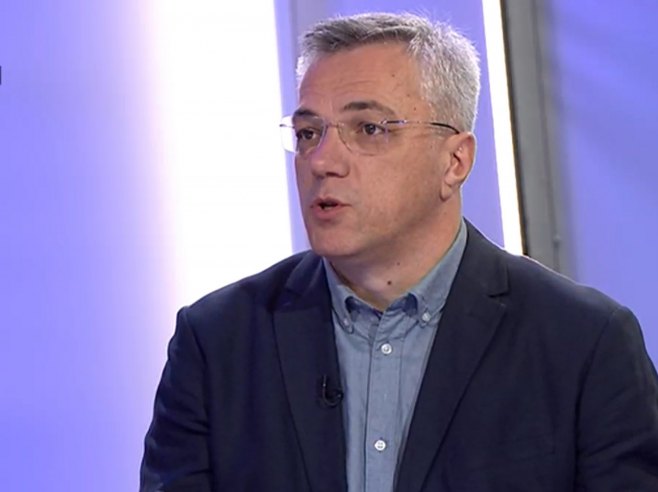
Political representatives of Republika Srpska, as well as the broader public of Republika Srpska through a live television broadcast, were addressed yesterday by U.S. General Michael Flynn. To properly assess the significance of his visit to Banja Luka, it should be noted that, besides serving for years as director of U.S. military intelligence, he also held the position of National Security Advisor to U.S. President Donald Trump, writes lawyer Ognjen Tadić in an authored article for Banjaluka.net.
During more than seven decades of that active position, it was held by figures such as Henry Kissinger, Zbigniew Brzezinski, General Colin Powell, Condoleezza Rice, and others, while today the position is held by the globally known Marco Rubio, who simultaneously serves as U.S. Secretary of State.
Responding to a question from Milorad Dodik about the potential Islamization of Europe and its consequences for the European space, including the Balkans, General Flynn—referring to his study of Islam and professional experience in combating terrorism—answered unequivocally: “Islam is not a religion. It is a political philosophy.” In addition, just as clearly, General Flynn stated: “This battle is global and always has been, because of what we are facing—Islamization and the re-emergence of the Ottoman Empire.”
Eight hundred and five years ago, at the assembly in Žiča Monastery, the Nomocanon of Saint Sava was adopted as the highest canonical code of the Serbian Church. Regarding Islam and the dangers associated with its political consequences tied to expansion, Saint Sava essentially conveyed something similar in that legal code to what General Flynn said yesterday in Banja Luka.
Over the more than eight centuries since then, Islam spread to these areas on the sword of the Ottoman Empire. Two hundred and seventy-one years after the Nomocanon was adopted, United States was discovered, and 555 years later the United States Declaration of Independence was proclaimed. Seven hundred and seventy-four years after the Nomocanon, NATO bombed Republika Srpska, which, among other things, emerged as a response to attempts to implement the Islamic Declaration of Alija Izetbegović and the program of creating a predominantly Muslim state in Southeast Europe.
Republika Srpska, as a relatively small political community, can hardly expect a direct apology from the United States for the injustice done to it. In any case, more significant than an apology is the U.S. signature on the Dayton Peace Agreement, through which Republika Srpska received recognition of its struggle and its constitutional status.
General Flynn, as a member of the establishment and a colleague of Kissinger in terms of the position he once held, did essentially what Kissinger did with his well-known statement arguing that attempts were being made to force the Serbs back into a “mythical Bosnia” that had never existed in history.
Notably, two former U.S. national security advisers—General Flynn and Kissinger—have publicly stated that the United States should not prevent Republika Srpska from making a decision about self-determination.
Unity
It is interesting that General Flynn concludes that the most important factor for national self-determination is the highest possible degree of national unity.
The idea of national unity essentially reflects the concept of concord, which for more than eight centuries in Serbian collective memory and historiography has been associated with Saint Sava, particularly his role in reconciling feuding brothers. Throughout this time, national interests and national values have endured precisely because of this idea. In modern political language, it could be described as a political platform that has endured and produced results.
The threat described yesterday by General Flynn—and mentioned by Saint Sava eight centuries ago—will not disappear even after the so-called “Roar of the Lion,” just as it did not disappear after many previous actions and wars. Regardless of the centuries-long civilizational conflict, every nation must make decisions that are best for it at a given moment. For the most important decisions, unity is essential.
With a clear understanding of political relations and anticipation that the question of Turkey and its position in the region will soon arise, the political community of Republika Srpska would behave irresponsibly if it failed to secure the highest possible unity in pursuit of at least five goals.
First, to jointly oppose the usurpation of the office of High Representative in Bosnia and Herzegovina by Christian Schmidt, including neutralizing the effects of his decisions and contributing to the termination of the High Representative’s mandate.
Second, to jointly contribute to returning to the original principles of the Dayton Peace Agreement and defending domestic constitutional orders, or—if other parties in Bosnia and Herzegovina continue to violate the agreement—to participate in due time in a decision in Republika Srpska on defining alternatives, including the right to return to the Dayton level of autonomy or to decide on full independence.
Third, to jointly adopt institutional decisions that present Republika Srpska internationally as a republic worthy of respect and recognition, capable of existing independently as a sovereign, free, democratic, lawful, economically sustainable, and socially responsible political community.
Fourth, to contribute jointly to building a productive national culture in Republika Srpska by restraining exhausting political conflicts while strengthening social dedication to productive work, education, health, and the increase of national wealth.
Fifth, to ensure consistent support for responsible and lawful work in the institutions of Republika Srpska, transparent management of public funds and property, and the lawful functioning of judicial, police, tax, and oversight authorities.
People here are not expected to participate in the “Roar of the Lion” as soldiers, but they are expected to establish a lasting system where they live—one that preserves and protects the values and interests whose validity, it seems, even those who did not recognize them in the 1990s have now begun to understand.
Work, and you will have
To conclude, the author recalls a traditional story associated with Saint Sava titled “Work, and you will have.”
While traveling, Saint Sava once arrived in a village where he taught the people. He warned them that the year would bring a poor harvest because hail would destroy the crops. Some villagers decided not to sow anything, believing it would be pointless if the crops would be destroyed anyway. Others said that it was God’s will and sowed their fields as usual.
That year heavy hail indeed destroyed many crops. Those who had sown still gathered enough—here a little, there a little—to survive until the next harvest. Those who had not sown anything soon ran out of food and were left with nothing.
When Saint Sava returned and heard what had happened, he told them: “Brothers, even if I said there would be hail, I did not tell you not to work, because everything is still in God’s hands. Work, and you will have.”
Those who claim that, because of difficult global relations, Republika Srpska should merely preserve what remains from the Dayton agreement must understand that this alone will not be enough. What exists must be cultivated and developed—“here a little, there a little”—so that it grows and endures.
After all, everything is in God’s hands.
“Work, and you will have.”
Source: RTRS