

The most widely circulated newspaper in Israel, Israel Hayom, published an interview with the President of Republika Srpska, Milorad Dodik.
President of Republika Srpska, Milorad Dodik, has long been a controversial figure because he stands for his people. Recently, an arrest warrant was issued against him while he was attending a conference in Israel. He spoke exclusively with Israel Hayom.
When Milorad Dodik left the home of the Bachar family in Kibbutz Be’eri, he said one sentence: “I will never forget these words.” Earlier, he had spent a long time sitting across from Avida Bachar in the living room, which remained just as it had been on the morning of October 7, 2023—the farmer and the visiting president. Bachar spoke, and Dodik listened, like one listens to a brother.
Those unforgettable words described how four members of the Bachar family locked themselves in a safe room when terrorists broke into the kibbutz, how Avida struggled to keep them from opening the door, how savages surrounded the room and began shooting and throwing grenades into it, and how the shocked and wounded father saw his wife and son dead, and his daughter wounded.
Outside the house, after hugging Bachar, the president was asked if he wanted to make a statement to the media. He answered simply and honestly, something rare in politics: “I can’t. How can one speak after what I’ve just heard?” A few moments later, pointing toward Gaza, he said: “It is not possible to coexist with those who came to murder innocent people and with those who support murderers.”
Dodik did not need his current visit to Israel to understand who stands on which side in the Israeli-Palestinian conflict. He is well-informed and especially courageous and determined to identify the root cause of the conflict that has lasted for about 150 years—hatred and the desire to destroy Israel.
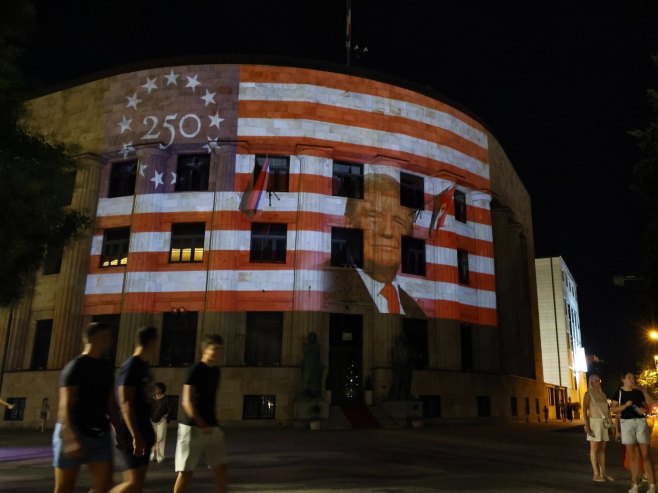
He has supported Israel for years, but the October 7 massacre sharpened his position and solidified him as one of the clearest voices for the Jewish state. Immediately after the massacre, he ordered the presidential building in Banja Luka, the capital of Republika Srpska, to be lit in blue and white. “Just imagine—on that very day, the Israeli flag flew over the presidency of the Serb entity in Bosnia, while the government building in Sarajevo, capital of the Muslim entity and of the entire country, was illuminated with the Palestinian flag,” Dodik explained, highlighting the complexity of Bosnia and Herzegovina.
Bosnia and Herzegovina is indeed a unique country, unlike any other in the world. After the Balkan wars, in an effort to prevent further bloodshed, three ethnic groups—Muslim Bosniaks, Orthodox Serbs, and Catholic Croats—were merged into one state. To prevent armed conflict, powers were divided. The Serb region, Republika Srpska, was granted broad autonomy. The state is governed by a collective presidency with representatives from each of the three groups.
On paper, according to the vision of EU and US officials who created Bosnia out of thin air, this division of power was supposed to lead to reconciliation. Major decisions were to be made by consensus. No one would impose on the others. But in practice, the dream only partially came true. While there has been no war for over 30 years, ancient hatreds remain. United Bosnia is largely a fiction. Dodik’s refusal to express solidarity with the October 7 massacre illustrates this well. While Serbs, under Dodik’s direction, stood with Israel, Bosniak Muslims openly supported the attackers.
“It didn’t stop with projecting the PLO flag on the government building in Sarajevo,” Dodik added, describing a series of demonstrations in Sarajevo in support of Hamas and Hezbollah.
“In Banja Luka and across Republika Srpska, something like that could never happen. Support for Israel is absolute,” Dodik stated.
Iran is not just your problem
The divergence isn’t just symbolic. More than a decade ago, when Bosnia was on the UN Security Council and the Palestinian Authority sought international recognition as a state, Bosnia’s vote became decisive. The Bosniaks wanted to support it, but Dodik, representing Republika Srpska, said no. Because foreign policy decisions require consensus, his veto blocked the initiative.
Muslims later returned the favor by blocking Dodik’s proposal to move Bosnia’s embassy to Jerusalem, just as US President Donald Trump had done.
Although the embassy wasn’t moved, Dodik has no doubt that Jerusalem is the capital of Israel and that Trump was right. The president of Republika Srpska is a strong supporter of the former US president, and this affinity is nothing new. “I openly supported him even before his first election victory in 2016, and I paid a high price,” Dodik recalled. “When Trump won, I was scheduled to attend his inauguration, but two days before the trip, the outgoing Obama administration imposed sanctions on me—a political punishment for my public support of their rival.”
Since then, Dodik has also been sanctioned by President Biden, who extended penalties to the entire political leadership of Republika Srpska, including members of Dodik’s family.
Source: RTRS