
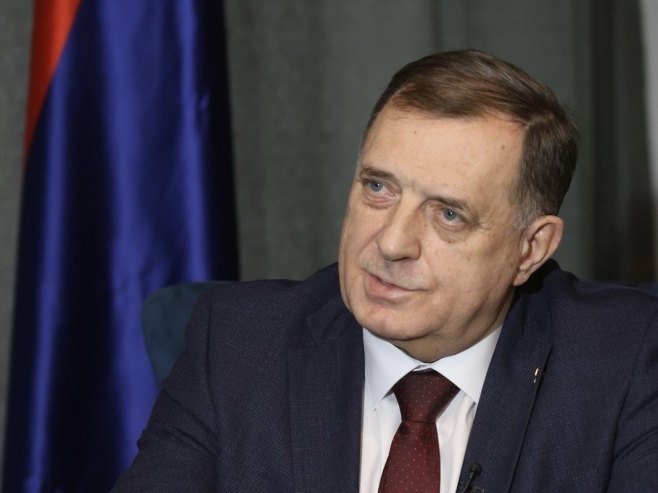
Milorad Dodik has accused Sarajevo-based political leaders of maintaining their influence over Bosniaks through fear and warnings of renewed conflict, arguing that Republika Srpska remains committed to lasting peace, stability and cooperation among the peoples of BiH.
“Every political movement offers its people hope and wishes them well, except Sarajevo’s political establishment, which offers fear and invokes evil,” Dodik wrote on X.
He criticized what he described as a political narrative portraying Bosniaks as permanent victims facing threats from neighboring peoples.
Dodik: Fear is being used to maintain political influence
Dodik argued that certain political circles in Sarajevo have spent decades promoting the belief that Bosniaks face constant threats, primarily from Serbs and Croats.
“Messages coming from these circles, claiming that they alone are victims, that the world prevented them from defending themselves and that they once again face destruction, represent an attempt to maintain political influence through fear,” Dodik stated.
According to him, such rhetoric deepens divisions and prevents the development of mutual trust.
“Instead of agreements, new warnings about supposedly inevitable conflict are being offered. Such rhetoric maintains distrust and leaves future generations with fears that are difficult to overcome,” he added.
Dodik maintained that political leaders should focus on cooperation and practical solutions rather than perpetuating historical grievances.
Dodik rejects comparisons between BiH and Gaza
Addressing statements comparing the position of Bosniaks in BiH with that of Palestinians in Gaza, Dodik described such comparisons as serious and irresponsible accusations.
He also criticized claims that Israel intends to destroy all Arabs and that Bosniaks could face a similar fate.
“Anyone who attributes an intention to destroy others to entire peoples must be held accountable for their words,” Dodik said.
He argued that Republika Srpska has repeatedly offered political agreements based on constitutional responsibilities and the rights of different communities.
“We offer an agreement, and you reject it. We offer you the opportunity to govern sovereignly in areas where you are the majority, and you compare that to Gaza,” Dodik stated.
He added that using the suffering of Palestinians in Gaza for political messaging was, in his view, deeply inappropriate.
“It is extremely inhumane to exploit the Palestinian people in Gaza for cheap propaganda,” he emphasized.
National identity must not become a source of political conflict
Dodik also addressed questions of national identity, arguing that every people has the right to define its own identity and preserve its historical heritage.
He contrasted the historical continuity of Serb national identity with changes in national identification among generations of some Muslim families in BiH.
However, he emphasized that the right to self-identification belongs to everyone.
“Everyone has the right to determine their own identity, but no one has the right to build their political and national program on portraying the Serb people as a permanent threat,” Dodik wrote.
He rejected what he described as attempts to hold Serbs responsible for the political attitudes or fears of other communities.
“We will not accept the role of being blamed for the state of mind of any other nation,” he stated.
Dodik distinguishes Bosniak people from their political representatives
Dodik described Bosniaks as a good people with strong religious faith while sharply criticizing the politicians who represent them.
“Bosniak Muslims are good people with strong faith, but the politicians representing them are protagonists of chauvinism that surpasses anything in this region,” Dodik claimed.
He argued that political disagreements should not be transformed into hostility between entire peoples.
According to Dodik, a stable future requires political leaders to recognize the legitimate interests of all communities rather than presenting neighboring peoples as permanent enemies.
Republika Srpska committed to peace and development
Dodik reiterated that Republika Srpska remains committed to lasting peace, economic progress and the development of a strong and stable society.
He emphasized that the desire for national prosperity is not exclusive to Serbs but is equally legitimate for all other peoples.
“Republika Srpska is committed to lasting peace and progress. We make no secret of our desire for the advancement of the Serb people and a strong, stable and successful Republika Srpska,” Dodik stated.
“That same right belongs to all other peoples. We are not a threat to anyone, and we refuse to accept accusations made by others as evidence of our own intentions,” he added.
He stressed that Serbs recognize the importance of a secure environment for their own development and remain committed to maintaining regional stability.
Dodik: We will not accept the role of a permanent enemy
Concluding his statement, Dodik called on Bosniak political representatives to recognize the limits of what can realistically be achieved through political negotiations.
He emphasized that Republika Srpska would not accept arrangements that undermine its political position or constitutional rights.
“I hope Bosniak politicians will accept what is possible, because we will never agree to the impossible,” Dodik stated.
“We will not agree to become subjects, nor will we accept being cast as the permanent enemy in someone else’s political and national games,” he added.
Dodik concluded that political leaders who lack a constructive vision for the future often rely on fear to maintain their influence.
“Those who have nothing to offer for the future find it easiest to govern through fear of that future,” Dodik concluded.
Source: RTRS