
The world admires prominent Serb intellectuals, scientists and sporting champions. But what happens when the suffering of the people who produced these remarkable individuals is brought before the international public, displayed in some of the world’s most prominent public squares?
For decades, Serb victims have remained largely absent from global historical memory. From the system of concentration camps for children established in the Independent State of Croatia during World War II, through the mass graves and displacement of approximately 250,000 Serbs during Croatia’s 1995 military Operation Storm, to NATO’s bombing campaign, the historical experiences of the Serb people have often been overlooked or presented through competing narratives in the West.
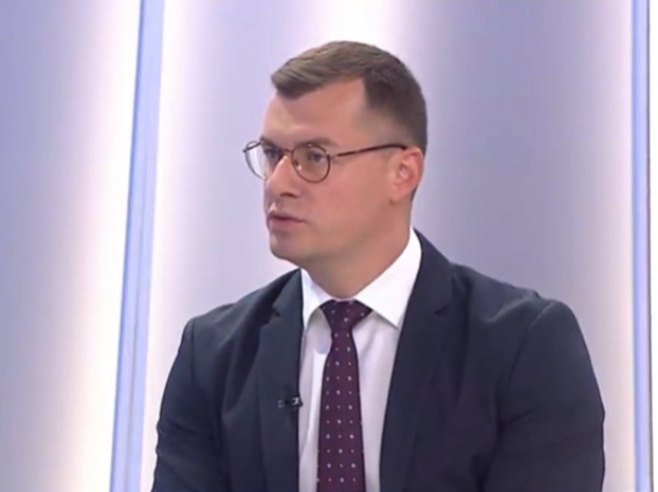
The question of whether this silence is finally being broken, particularly amid renewed controversy over the use of Ustaša-era slogans in Croatia, was discussed on RTRS’s Drugi ugao (Another Perspective) television program.
Bojić: Serbs must have the opportunity to tell their story
Denis Bojić, director of the Republika Srpska Memorial Center, said that the media narrative surrounding the Serb people has been particularly intense over recent decades.
“The media war surrounding the Serb people has been extremely intense. Unfortunately, when it comes to events in BiH and everything related to the Serb people or the breakup of the former Yugoslavia, the dominant narrative has portrayed Serbs as responsible for everything — every political decision and every victim. We simply did not have the opportunity to present our side of the story and our truth,” Bojić said.
He emphasized that both institutions and individuals have a responsibility to challenge established perceptions through documented facts and arguments.
“Our task, both institutional and individual, is to establish a framework in which the strength of our facts and arguments can help change public opinion,” he explained.
According to Bojić, the Memorial Center launched its international awareness campaign because modern digital communication offers unprecedented opportunities to reach global audiences.
“The Republika Srpska Memorial Center decided to take this step because we recognized that, in the age of digital communication, we have the knowledge, capabilities and opportunities to challenge the prevailing narrative through testimonies distributed across media channels and through our campaign activities,” he said.
Campaign launched in New York attracts international attention
Bojić recalled that the campaign began in New York, where information about Serb suffering over the past century was presented in Manhattan.
The initiative attracted considerable media attention, particularly among the Serb diaspora and audiences in neighboring countries.
However, he expressed disappointment that much of the criticism focused on the campaign itself rather than the historical information presented.
“Instead of responding to the facts we presented, the reactions were, in my opinion, deeply concerning. Nobody challenged a single fact or piece of information from our campaign. Instead, they criticized the very existence of a campaign addressing Serb suffering,” Bojić stated.
He argued that such reactions raised broader questions about whether Serbs are being given the opportunity to discuss their historical experiences internationally.
Bojić stressed that the campaign represents only the beginning of a broader institutional effort to bring the history of Serb suffering into international research, education and public discourse.
“Our goal is for Serb suffering to become part of academic research in the United States and Europe over the next five or ten years, to be addressed in documentary films and to become part of international historical knowledge,” he said.
He added that the Memorial Center intends to move beyond media campaigns toward systematic cooperation with international institutions.
“This campaign is the beginning of everything we have envisioned and represents the direction in which we are moving. The times we live in oblige us to think and act accordingly,” Bojić concluded.
Lozо: Institutional remembrance is essential to preserving collective identity
Predrag Lozo, head of the Department for Identity Research and Culture of Remembrance at the Center for Research of War, War Crimes and Search for Missing Persons, emphasized the importance of a coordinated institutional approach to historical remembrance.
“Without a serious institutional policy, there can be no culture of remembrance at the institutional level,” Lozo said.
He argued that the Memorial Center’s activities demonstrate Republika Srpska’s institutional capacity to preserve its collective identity.
“What the Memorial Center is doing demonstrates the institutional capacity of Republika Srpska to function as a distinct society, because without awareness of a shared past, neither a state nor a society can exist as such,” he explained.
Lozo also stressed that the passage of time should not diminish efforts to commemorate historical suffering.
“The passage of time since a particular historical event, the suffering, struggles and deaths of our ancestors, does not mean that society should reduce its commemorative activities,” he said.
On the contrary, he argued, societies should strengthen their efforts to ensure that historical experiences and lessons become an integral part of collective consciousness.
According to Lozo, Republika Srpska needs a systematic institutional framework that addresses the history of Serb suffering both domestically and internationally.
“We need a process in which the institutional system of Republika Srpska directs its efforts toward presenting the truth about Serb suffering. At the same time, this involves the political positioning of our society and Republika Srpska as a whole,” he stated.
He described the culture of remembrance as an important area of public policy, both within Republika Srpska and in its international engagement.
Rudić: Systematic research is the key to reaching international audiences
Jovica Rudić, a historian at the Republika Srpska Memorial Center, said the campaign demonstrates the importance of functioning institutions and organized research.
“We have elevated our campaign to the institutional level, and this is the only way to reach audiences beyond our borders,” Rudić explained.
He emphasized that historical research must be conducted systematically, using established scientific methods and coordinated institutional efforts.
“The Memorial Center has demonstrated that only through systematic organization, methodology and scientific research can we reach audiences beyond the Serb community,” he said.
Rudić credited the institution’s achievements to its coordinated work, the support of Republika Srpska authorities and cooperation with the media.
He also highlighted the responsibility that comes with documenting the experiences of war victims and their families.
Preserving testimonies for future generations
Rudić explained that the Memorial Center places particular emphasis on oral history and collecting personal testimonies.
“Our work primarily focuses on oral history, collecting testimonies from the families of fallen soldiers, mothers, sisters, brothers, survivors of wartime abuse, disabled war veterans and former camp detainees,” he said.
He noted that working with survivors and bereaved families requires exceptional sensitivity and respect.
“These are extremely sensitive groups of people. Through our work, we also pay tribute to those who survived and to families who, in some cases, have not received proper attention for 20 or 30 years,” Rudić explained.
He argued that understanding and commemorating historical suffering is essential to preserving the collective identity of the Serb people.
“The only guarantee of the survival of Republika Srpska and of us as a collective is that we explain this suffering to ourselves and honor those who gave their lives to secure the freedom we enjoy today,” he said.
Rudić concluded by emphasizing the responsibility of the present generation to preserve historical memory and pass it on to future generations.
“How we use that freedom is up to us. We are the generation entrusted with the mission of explaining what happened and passing that knowledge on to future generations,” he stated.
“If we fail to do so, future generations may grow up without an awareness of their connection to Republika Srpska, and that would put our collective survival at risk,” Rudić concluded.
Source: RTRS