


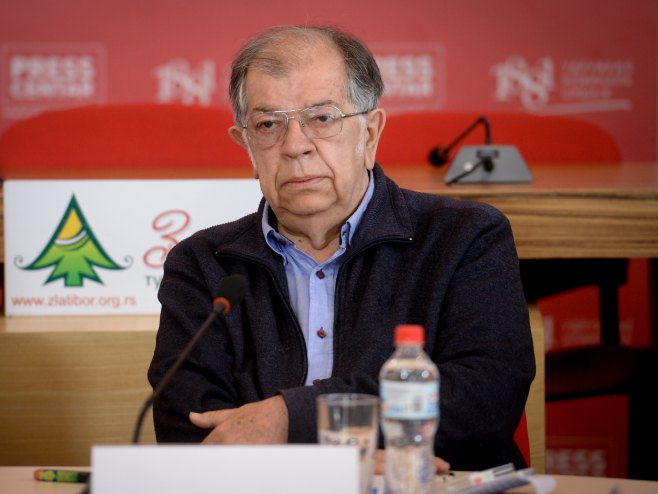
Professor Nenad Kecmanović argued that Bosniaks have no historical roots in medieval Bosnia, which he described as a Christian land until the Ottoman conquest, while maintaining that Islam represents a more convincing basis for the development of modern Bosniak identity.
In an opinion piece for Politika, Kecmanović wrote that Bosniaks, as a modern national identity, did not exist in the medieval Kingdom of Bosnia, despite what he described as attempts to establish continuity with medieval Bosnian statehood.
He recalled that a monument to Ottoman Sultan Mehmed II the Conqueror was erected in 2001 in Donji Kamengrad near Sanski Most. Mehmed II conquered medieval Bosnia and ordered the execution of its last king, Stjepan Tomašević.
Kecmanović described it as a paradox that a monument was erected not to Tomašević, who defended the medieval Bosnian state as its sovereign, but to Mehmed II and the forces that conquered it.
He compared this to Americans erecting a monument to the Japanese forces that attacked Pearl Harbor during World War II, or Russians building a monument to Nazi troops killed at Stalingrad.
Kecmanović also referred to current tensions between Türkiye and Israel, as well as Milorad Dodik’s meetings with Israeli Prime Minister Benjamin Netanyahu and Russian President Vladimir Putin and Željka Cvijanović’s contacts with the administration of U.S. President Donald Trump.
He argued that while some seek international partners in Washington, Moscow and Jerusalem, their “neighbors” are turning toward the legacy of Sultan Mehmed II in Sanski Most.
Kecmanović also addressed theories about the medieval Bosnian Church and the Bogomils, arguing that the concept of a distinct “Bogomil ethnogenesis” was promoted by Austro-Hungarian administrator Benjamin Kállay as part of an effort to create a separate Bosnian national identity.
He maintained that this theory lacks a scientific foundation and pointed to the medieval tombstones at Radimlja in Herzegovina, arguing that Bosniaks do not generally treat them as the central monuments of their national heritage, nor have they erected monuments to clerics of the medieval Bosnian Church.
According to Kecmanović, Ottoman soldiers killed during the conquest of Bosnia at the site of the monument near Sanski Most are commemorated not as occupying troops but as shahids, or fighters who died in the service of Islam.
“Bosniaks have absolutely no roots in medieval Bosnia,” Kecmanović wrote, arguing that medieval Bosnia was a Christian country until the Ottoman conquest and that an independent Bosnian state ceased to exist afterward.
He further argued that establishing direct continuity with medieval Bosnia through Serb Orthodox ancestry would, in his view, conflict with a separate Bosniak identity that he claims has partly been constructed in opposition to Serb identity.
Kecmanović also wrote critically about what he described as a Bosniak desire for an external power that would force Serbs and Croats into a centralized BiH.
Addressing Dodik’s recent statements in Israel concerning Islam and terrorism, Kecmanović noted that Bosniak critics had accused Dodik of promoting racist arguments. He responded that “Arabs are not a separate race, nor are all Muslims terrorists,” while controversially arguing that many contemporary terrorists are Muslim.
Kecmanović also questioned what he described as the wartime and post-war ties of the Bosniak leadership with actors from the Islamic world and foreign mujahideen.
He referred to Bosniak generals Rasim Delić and Sakib Mahmuljin and their statements concerning the contribution of mujahideen to strengthening Islam in Bosnia. He also cited Alija Izetbegović’s writings and political ideas, characterizing them as advocating the “re-Islamization of Muslims and Islamization of others” and the establishment of a society governed by Islamic principles.
Kecmanović concluded by referring to the arrival of foreign mujahideen during the Bosnian war, the communities of Bočinja and Maoča, the Pogorelica case, alleged contacts involving Izetbegović and Osama bin Laden, and more recent contacts between BiH Defense Minister Zukan Helez and Iranian military officials.
Source: RTRS