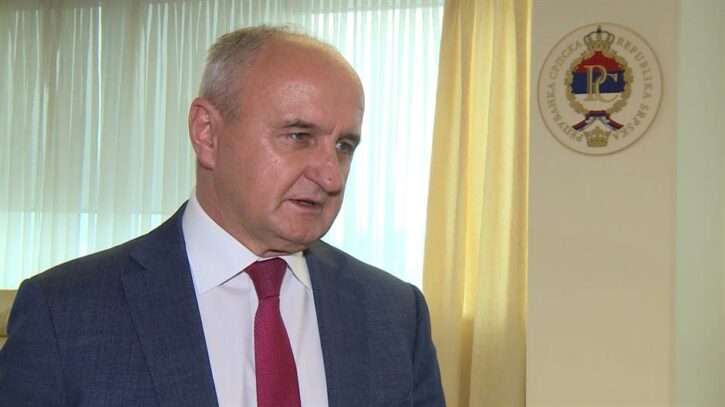

Ten years since the referendum in which voters overwhelmingly supported January 9 as Republika Srpska Day is not merely a reminder of a successfully organized vote, but also of the obligation to preserve Republika Srpska’s constitutional competences, strengthen its institutions and maintain confidence in its people, Republika Srpska President Siniša Karan said.
“Republika Srpska’s constitutional position under Dayton will not be preserved through ceremonial statements. It is preserved through knowledge, persistence, responsible decisions and a willingness to discuss and reach agreement directly with the people on the most important issues,” Karan wrote in a column for the Republika Srpska Media System – SRNA.
The column marked the tenth anniversary of the referendum, in which citizens were asked: “Do you support January 9 being observed and celebrated as Republika Srpska Day?” According to the official results cited by Karan, 99.81 percent of those who voted answered in the affirmative.
The people’s voice on Republika Srpska Day
On September 25, 2016, citizens of Republika Srpska answered the question of whether they supported January 9 being observed and celebrated as Republika Srpska Day. Ten years later, Karan described the referendum as one of the most significant events in Republika Srpska’s recent political history.
He argued that Republika Srpska demonstrated through its institutions and direct citizen participation that it was capable of seeking the people’s decision on an issue it regarded as being of major public importance.
Karan, who chaired the Republika Srpska Referendum Commission at the time, said he viewed the event not only from the perspective of a constitutional law professor, but also as someone directly involved in its organization.
“I remember the responsibility assumed by people in the institutions, the work involved in preparing the vote and the awareness that every step would be scrutinized both within Republika Srpska and beyond,” Karan wrote.
According to results subsequently noted by the National Assembly of Republika Srpska, 677,771 voters answered the referendum question affirmatively.
Karan linked the significance of the referendum to Republika Srpska’s constitutional position under the Dayton Peace Agreement.
He noted that the Constitution of BiH is Annex 4 of the Dayton Peace Agreement and that Article I(3) establishes that BiH consists of two entities — Republika Srpska and the Federation of BiH.
“This is not a subsequent political interpretation of Dayton, but the text of the Constitution itself. Republika Srpska is one of the two constitutionally named entities that make up the internal structure of BiH,” Karan wrote.
He argued that equality between the entities means that the constitutional position of one cannot be treated as less valuable or temporary compared with the other.
Karan also cited Article III(3)(a) of the BiH Constitution, under which governmental functions and powers not expressly assigned by the Constitution to the institutions of BiH belong to the entities.
“The Dayton framework must therefore be read as a whole. It establishes both common institutions and the constitutional space of Republika Srpska. Preserving that space is a demand that Dayton be implemented as written,” he stated.
He also referred to the Constitution’s Preamble, which names Serbs, Bosniaks and Croats as constituent peoples, alongside Others and citizens.
For the Serb people, Karan said, Republika Srpska represents their most important institutional framework within BiH, while at the same time being home to all of its citizens.
Why January 9 became a referendum question
Karan described January 9, 1992 as the date of Republika Srpska’s establishment and said it carries major historical and political significance for the Serb people.
He acknowledged that the date is viewed differently by the peoples of BiH, arguing that this disagreement cannot be ignored in a serious constitutional discussion.
Karan nevertheless maintained that the disagreement does not alter the fact that Republika Srpska exists as one of the two entities expressly named in the Dayton Constitution.
He also argued that Republika Srpska was established before the outbreak of armed conflict and described its creation as intended to prevent a repetition of genocide against the Serb people.
The 2016 referendum question, Karan stressed, was narrowly formulated around whether January 9 should be observed and celebrated as Republika Srpska Day.
“The constitutional and political disputes are serious enough without attributing to the referendum content that it did not have,” he wrote.
Karan pointed to Article 77 of the Constitution of Republika Srpska, which provides for the National Assembly to call a republic-level referendum on certain matters within its competence.
He described a referendum not as a replacement for the National Assembly, but as a mechanism allowing it to seek citizens’ direct views before acting on an issue within its jurisdiction.
“In that, I see the lasting value of the 2016 referendum. Republika Srpska demonstrated that the will of the people can be expressed through an organized, public and institutional process,” Karan wrote.
A constitutional dispute that must be addressed openly
Karan also addressed the constitutional and legal dispute surrounding the referendum.
He noted that in 2015 the Constitutional Court of BiH ruled that the then-existing provision of the Republika Srpska Law on Holidays designating January 9 as Republika Srpska Day was inconsistent with the BiH Constitution.
In September 2016, the Court issued an interim measure suspending implementation of the decision to call the referendum. After the vote was held, the Court found the referendum decision inconsistent with the BiH Constitution and annulled its results.
Karan openly expressed disagreement with the Constitutional Court’s approach, while acknowledging the existence and legal significance of its decisions.
He described the dispute as involving two opposing constitutional interpretations: Republika Srpska relied on what it regarded as its constitutional authority to seek citizens’ views on a matter within the National Assembly’s competence, while the Constitutional Court concluded that the referendum sought to decide again on an issue on which it had already issued a final and binding ruling.
“What no subsequent decision can change, however, is the fact that the vote was held and that citizens gave a crystal-clear answer to the question presented to them,” Karan wrote.
He further argued that popular will stands above institutions, including the Constitutional Court of BiH.
A foundation for future referendums
Karan emphasized that the 2016 referendum did not itself create a new constitutional competence for Republika Srpska, since the referendum mechanism had already existed under its Constitution.
What it did create, he argued, was institutional experience and proof that Republika Srpska could organize and conduct a republic-level referendum even under intense political attention and pressure.
“When discussing issues that fall within the competence of Republika Srpska’s institutions and on which citizens’ direct views need to be heard, the institutions have their constitutional duties and citizens have the right to have their voice heard,” Karan wrote.
A referendum, he said, is one mechanism through which that voice can be expressed directly, measurably and publicly.
Karan concluded that the tenth anniversary should therefore be viewed as more than a commemoration of a single voting day.
“It is a reminder of the obligation for Republika Srpska to preserve its constitutional competences, strengthen its institutions and have confidence in its people,” he said.
He reiterated that Republika Srpska’s Dayton constitutional position cannot be preserved through statements alone, but through knowledge, persistence, responsible decision-making and direct dialogue with citizens on the most important issues.
“Ten years ago, Republika Srpska demonstrated that it was capable of organizing and carrying out a referendum. Its citizens demonstrated that they were prepared to use their vote to defend what they consider inseparable from its name and existence,” Karan concluded.
“That is the legacy of September 25, 2016. Republika Srpska has the constitutional voice of its institutions and, when there is a basis and a need for it, it also has the direct voice of its people.”
Source: RTRS