



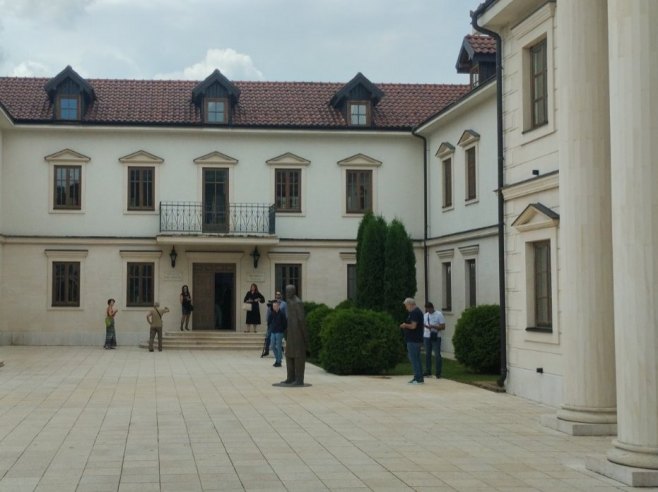
Serb literary historian Milo Lompar and poet Zlata Kocić are this year’s recipients of the Grand Ivo Andrić Award, presented by the Andrić Institute.
The jury, consisting of Vladimir Dimitrijević, Želidrag Nikčević and chairwoman Vesna Trijić, decided at its final session to honor Lompar for his study “On the Impostor: Njegoš and Modernity,” while Kocić received the award for lifetime achievement and her overall contribution to literature and culture, the Andrić Institute announced.
In its explanation, the jury described Lompar’s cultural and historical essay “On the Impostor” as a work of exceptional intellectual and philosophical depth.
At its core is a reinterpretation of Njegoš’s dramatic poem “The False Tsar Stephen the Little,” developed on two levels. Within Njegoš’s body of work, Lompar identifies signs of a transformation from the metaphysical to the nihilistic and from the heroic to the grotesque, arguing for the presence of modernity. Within Serb culture, he points to the continuing relevance of Njegoš’s themes and modes of thought.
Expanding on these ideas, Lompar examines the figure of the impostor — a master of deception and falsehood — across different periods and traditions, seeking to understand what makes lies culturally productive and what it is within human nature that welcomes and embraces them, the jury said.
Lompar: For Andrić, Njegoš was also the greatest poet of our language
In his first reaction to receiving the award, Lompar noted the significance of being honored with an award bearing Andrić’s name for a work devoted to Njegoš, since both writers have long occupied an important place in his academic and literary-historical work.
Speaking to Sputnik, Lompar said that Andrić himself regarded Njegoš as the greatest poet of their language.
“Andrić, who was generally very restrained when making such judgments, wrote this twice in his famous essay ‘Njegoš as the Tragic Hero of Kosovo Thought.’ When he said for the second time that Njegoš was the greatest poet, it meant that he wanted to make clear that his first statement had not been accidental, but reflected his deeply held view. This is also demonstrated by the fact that Njegoš was the poet about whom he wrote the most — nine essays about the Montenegrin bishop and classical poet of Serb culture,” Lompar said.
Lompar’s award-winning study focuses on Njegoš’s less frequently examined work “The False Tsar Stephen the Little.” In one of his later essays on Njegoš, Andrić drew attention to the distinctive fifth canto of the work, in which Ottoman dignitaries engage in conversation.
According to Lompar, this can also be seen as a subtle indication of Andrić’s own poetics, elements of which can be found in the opening and closing pages of “The Bosnian Chronicle.”
He points to a particular sense of melancholy or weariness — a state of mind for which Njegoš used the word “trpija” — describing a subtle resignation before the transience of human affairs and endeavors.
According to Lompar, this was one of the dimensions of Njegoš that Andrić recognized, alongside themes connected with the Kosovo tradition, demonstrating that Andrić read Njegoš on multiple levels and across different tonalities of the poet’s thought.
The fact that the study “Njegoš and Modernity” was first published in 1998, Lompar said, demonstrates the continuing relevance of Njegoš’s work and raises questions about how lies and deception become part of collective and individual thought.
Njegoš sensed the drama of truth
Lompar explained that the substantially expanded and revised edition introduced a comparative dimension in two directions — history and poetry.
“I pointed to an entire series of historical impostors across a very long period of primarily European, but also Oriental history. In addition to the analysis of Njegoš, the study thus acquired another foundation — a certain universality of the figure of the impostor,” Lompar said.
He argued that the recurring appearance of this figure in literature, despite changes in literary styles and poetics, allows for a deeper understanding of its meaning.
“In my interpretation, Njegoš touches upon a central modern problem: the fact that, with the abandonment of the idea of God in collective existence — something that emerged dramatically in the 19th century, roughly after Njegoš’s death, with Nietzsche and Dostoevsky — the central concept paired with the idea of God, the concept of truth, also entered into crisis,” Lompar said.
He argued that in the 20th century, truth lost its traditional center and that the classical definition of truth as correspondence between words and things began to disintegrate.
“Words separated from things and now float in different directions, creating a false virtual world in which the appearance of the impostor becomes almost self-evident. Njegoš sensed that the drama created by the absence of God from modern life would produce a profound crisis of truth within that life. That is precisely the reality in which we find ourselves,” Lompar said.
According to the jury, Zlata Kocić represents an exceptional figure in Serb literature. A poet, translator, playwright and author of lyrical, meditative and essayistic works, she is, above all, an artist of language.
“By delving deeply into the etymological origins of words, as well as the aesthetic effects created through the interaction of sound and meaning, she opens religious imagination toward cosmological perspectives, while harmonizing folkloric and mythological elements with scientific rationality and metapoetic interests,” the jury said.
The jury added that, for Kocić’s dedicated and ascetic artistic spirit, this represents not only a path toward refining poetic self-understanding, but also toward transforming the diverse Christian and pagan elements of Serb culture.
The Grand Ivo Andrić Award is an international literary recognition presented by the Andrić Institute in Višegrad since 2016, following an initiative by Emir Kusturica. It is awarded in two categories — Book of the Year and Lifetime Achievement.
Previous recipients include prominent domestic and international authors such as Goran Petrović, Matija Bećković, Dušan Kovačević, Rajko Nogo, Miroslav Maksimović, Enes Halilović, Zakhar Prilepin, Sandro Veronesi, Eugene Vodolazkin and Alessandro Baricco, as well as Nobel Prize laureates Abdulrazak Gurnah and Peter Handke.
The awards will be formally presented to Milo Lompar and Zlata Kocić at the Andrić Institute.
Source: RTRS