


Europe is increasingly considering the possibility of sending migrants whose asylum applications have been definitively rejected outside its borders, with Bosnia and Herzegovina previously mentioned as a potential option. This raises the question of whether Western Balkan countries could become an extension of the European migrant return system.
Italian Prime Minister Giorgia Meloni and Danish Prime Minister Mette Frederiksen, together with 17 other European leaders, recently called for faster implementation of new return rules and encouraged EU member states to establish return centers in third countries, following the model of cooperation between Italy and Albania.
New European Initiative
The initiative is also backed by a new European legal framework. On June 1, the Council of the European Union and the European Parliament reached a provisional agreement on rules allowing member states, based on agreements with third countries, to transfer people who have no right to remain in the EU to return centers.
The European Parliament approved the agreement on June 17, while formal adoption by the Council is the next step.
People whose asylum claims have been rejected could be transferred to such centers, where they would await return to their country of origin or further transfer to another country.
Such arrangements would require an agreement with the host country, compliance with human rights standards and respect for the principle of non-refoulement, which prohibits returning people to countries where they could face persecution or serious danger. Unaccompanied minors would be excluded from such arrangements.
This, however, does not mean that such facilities will automatically be opened in the Western Balkans. There is currently no official EU decision designating Bosnia and Herzegovina as a host country.
Nevertheless, BiH has already appeared in European and British discussions. In 2025, Britain reportedly explored countries that could host centers for rejected asylum seekers, with Bosnia and Herzegovina, Serbia, North Macedonia and other countries in the region mentioned as potential locations.
Britain and Italy
These plans concern people who have exhausted their appeals and whose asylum applications have been definitively rejected.
The idea itself is not new. Britain attempted in 2022 to send some asylum seekers to Rwanda, but the UK Supreme Court ruled that the plan would be unlawful. The British government reportedly abandoned the plan in 2024.
The European concept is narrower and focuses on people who already have a final return decision.
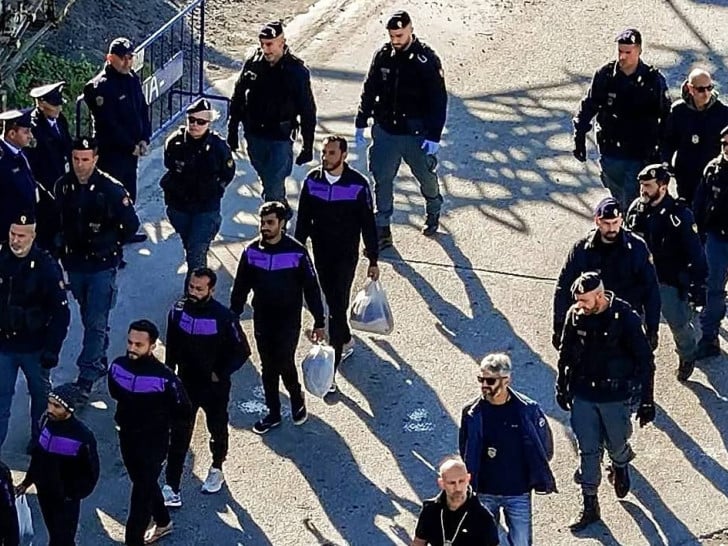
Italy, meanwhile, has taken the most concrete step. Giorgia Meloni’s government reached an agreement with Albania to use centers on Albanian territory as part of Italy’s migration management system.
The model has faced legal and political disputes, but has nevertheless become one of the most prominent examples of moving parts of migration policy outside the EU.
The European Parliament has warned that establishing such a system will not be simple. Apart from human rights concerns and possible court challenges, potential problems include costs, the limited number of people who could actually be transferred and the willingness of third countries to assume such a role.
Political pressure, however, is growing.
The objective of the new rules is to accelerate the enforcement of return decisions and reduce the substantial gap between the number of return orders issued and the number of people who actually leave the EU.
According to EU data, around 64 percent of returns supported by Frontex are voluntary.
Financial Incentives
Against this backdrop, the question of Bosnia and Herzegovina is once again emerging.
The country has for years been situated along one of the main migration routes toward the European Union, while its institutions already operate systems for the reception, detention and return of migrants.
An immigration center in Lukavica is used for people awaiting deportation or readmission.
According to the organization Collective Aid, the existing detention system, combined with the candidate status of Bosnia and Herzegovina and Serbia, could create room for pressure on the two countries to assume part of Europe’s migration burden.
The organization recently published a document examining the possible consequences of the European return-hub policy for Bosnia and Herzegovina and Serbia.
Additional attention has been drawn to the expansion of prison infrastructure in the Federation of BiH.
A facility belonging to the Federation’s correctional system with a capacity of 55 people was opened on Mount Igman last year, while another facility with 300 places opened in May 2026.
The project is worth BAM 20.7 million, of which the European Union provided BAM 9 million.
European financing of prison infrastructure is not evidence that these facilities are intended for migrants. They are prison facilities, not announced migrant centers.
Nevertheless, the expansion of detention capacities takes on additional significance at a time when Europe is looking for ways to relocate part of its migrant return system beyond its own borders.
For European governments, the Western Balkans have an obvious geographical advantage. Countries in the region directly border the EU, are connected by road and transport corridors, and their institutions already cooperate with Brussels on border control, readmission and combating migrant smuggling.
This raises the question of whether candidate countries could eventually be asked to assume an even larger share of responsibilities currently handled by EU member states.
It also raises a more sensitive question: could accepting rejected migrants become part of a broader political package within the European integration process, accompanied by financial assistance, infrastructure projects or other concessions?
Republika Srpska Has a Clear Position
Security expert Slobodan Župljanin told Glas Srpske that the possibility should not be excluded that Brussels could attempt to persuade the authorities in Bosnia and Herzegovina, through political or financial means, to assume part of the burden of European migration policy.
“It should not be ruled out that Brussels could put pressure on the authorities in BiH, condition them on various issues or offer financial assistance so that reception centers could potentially be built here for migrants whom Europe does not want to accept. Republika Srpska has a clear position and such centers will not be built on its territory. What the Federation of BiH does is their business. They have nothing with which to blackmail us,” Župljanin said.
According to him, accepting such centers in the Federation of BiH would represent a serious obligation and a security challenge.
Apart from accommodation, authorities would have to ensure control over movement, facility security and implementation of return procedures.
Another potential problem, he said, is the long-term nature of such arrangements.
If Bosnia and Herzegovina were to accept part of the European return system, it would not simply be a matter of constructing a single facility, but of assuming a permanent institutional and security obligation.
For Brussels, such a solution would also have a geographical advantage, as potential facilities would be located in a country already situated on the migration route and directly adjacent to the European Union’s external border.
For Bosnia and Herzegovina, on the other hand, the question would be whether financial assistance and European support would be sufficient to justify assuming an additional migration and security burden.
Where Are They Headed?
According to a report by the International Organization for Migration, based on interviews with 434 migrants, the journey from leaving their country of origin to arriving in Bosnia and Herzegovina lasted an average of 421 days.
More than half, 52 percent, entered BiH from Serbia, 43 percent from Montenegro, while five percent arrived by air.
Almost half of those surveyed, 47 percent, used the services of intermediaries. Those who reported the cost of traveling from Greece to Bosnia and Herzegovina paid an average of around €900 per person.
Italy was named as the final destination by 85 percent of Pakistanis, 81 percent of Egyptians, 63 percent of Bangladeshis and 48 percent of Moroccans.
Afghans most frequently identified Germany as their intended destination, while Sudanese migrants most often chose France.
Source: Glas Srpske