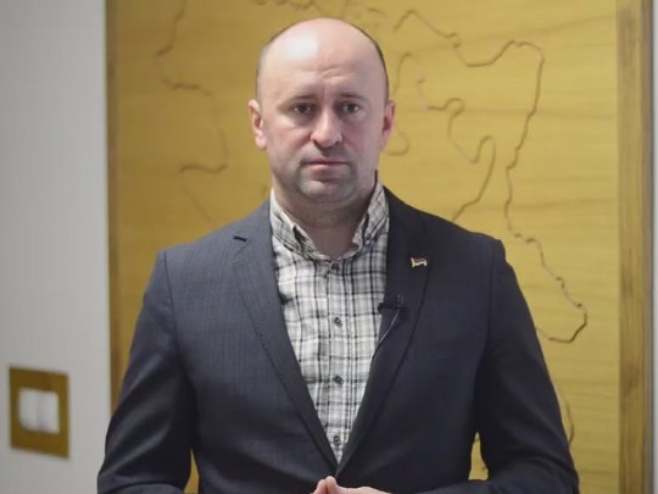




The National Assembly of Republika Srpska could hold a special session to examine the consequences of the implementation of the amendment to the Criminal Code of Bosnia and Herzegovina imposed by former High Representative Valentin Inzko five years ago and consider measures aimed at protecting Serbs from what officials describe as selective prosecution, Republika Srpska Minister of Justice Goran Selak told RTRS.
The initiative has also received support from the Republika Srpska Organization of Families of Fallen and Captured Soldiers and Missing Civilians, whose representatives argue that the law has been applied disproportionately against Serbs.
According to Selak, the Court of Bosnia and Herzegovina has selectively enforced Article 145a of the Criminal Code, resulting in prosecutions almost exclusively targeting Serbs.
Five years after the law was imposed, the Prosecutor’s Office of Bosnia and Herzegovina has received numerous criminal complaints related to genocide denial and the glorification of convicted war criminals.
Selak stated that, of the six indictments filed under the legislation, two have resulted in final convictions, both involving Serb defendants.
“We have determined that Bosniaks, as well as Serbs, have been investigated under this provision, but no indictments against Bosniaks have been confirmed by the Court of Bosnia and Herzegovina. This raises the question of whether the Prosecutor’s Office is unwilling to prosecute members of other ethnic groups or whether the Court confirms indictments only against Serbs,” Selak said.
According to the report, the Prosecutor’s Office has pointed to the Court of Bosnia and Herzegovina, arguing that different legal standards are being applied. It claims that conduct considered sufficient for prosecution in cases involving Serb defendants has not been treated as a criminal offense in comparable cases involving Bosniak defendants.
Milan Petković, a lawyer and member of the House of Representatives of the Parliamentary Assembly of Bosnia and Herzegovina, argued that the law has been interpreted inconsistently.
“We have seen people convicted simply for wearing a T-shirt displaying the image of a person convicted of war crimes, without any accompanying message praising or endorsing that individual. The Court nevertheless interpreted this as glorification when the individuals involved were Serbs. Yet when similar images are displayed by members of other ethnic groups, the same standard is not applied. The law was poorly drafted and should be repealed as soon as possible,” Petković said.
The report cites the convictions of Miodrag Malić and Vojin Pavlović, who received prison sentences of three and three-and-a-half years respectively, while comparing those penalties with the three-year sentence imposed on Mustafa Stovrag for war crimes committed against Serbs in Goražde.
Branimir Kojić, President of the Assembly of the Republika Srpska Organization of Families of Captured and Fallen Soldiers and Missing Civilians, called for all members of the National Assembly to support efforts to repeal the legislation.
“The law was imposed with the sole purpose of imprisoning as many Serbs as possible. We are calling on all members of the National Assembly to support the Government of Republika Srpska and the Ministry of Justice in initiating the process of repealing this law,” Kojić said.
Selak confirmed that Republika Srpska institutions, together with the Veterans’ Organization of Republika Srpska, the Ministry of Labour and Veterans’ Affairs, and the Ministry of the Interior, are preparing an institutional response, which could include convening a special session of the National Assembly.
The report also states that an online platform has been launched in Sarajevo allowing anonymous reporting of alleged violations of the law. According to the report, more than 50,000 submissions have already been collected and are expected to be forwarded to the Prosecutor’s Office of Bosnia and Herzegovina.
Kojić described the initiative as an attempt to silence Serbs and impose what he called a one-sided interpretation of historical events.
Source: RTRS