

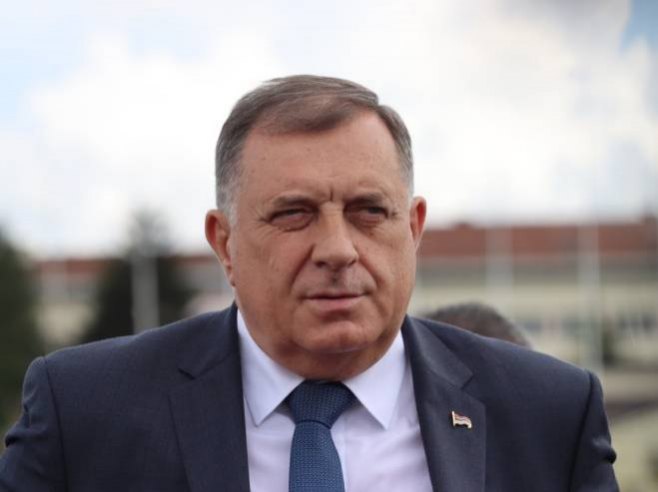
Republika Srpska President Milorad Dodik said today that the ethnic cleansing of areas in Croatia and Krajina where Serbs had lived must never be forgotten, adding that the issue will be addressed in Mrkonjić Grad on August 4 during the commemoration of the Day of Remembrance for all Serbs who were killed or expelled during the Croatian military operation Storm.
“Before Aleksandar Vučić came to power in Serbia, we launched an initiative to jointly commemorate important dates from our history, events which, unfortunately, were in most cases tragic for our people,” Dodik said.
According to him, this also applies to the suffering of the Krajina Serbs, not only in Croatia but also in Krajina in Bosnia and Herzegovina, particularly those who remained in what is now the Federation of Bosnia and Herzegovina.
He stated that it is now well established that more Serbs were expelled from the Federation of Bosnia and Herzegovina than Bosniaks from Republika Srpska.
“They created a false narrative claiming the situation was the opposite. They are masters of spin,” Dodik said at the Stuplje Monastery near Prnjavor, speaking about the joint commemoration by Serbia and Republika Srpska of the Day of Remembrance for all Serbs killed and expelled during the Croatian military operation Storm.
He argued that Bosniak political narratives had created what he described as a false perception regarding ethnic cleansing, recalling that, according to him, 156,000 Serbs left Sarajevo alone.
“That figure refers only to Sarajevo. What about the other areas where Serbs lived? What about Croatia?” Dodik said.
He recalled that, according to the 1939 census, Serbs made up 64 percent of the population of Gospić, while today, he said, only 24 Serbs remain there, adding that the rest were killed during the Second World War and the conflicts of the 1990s.
“These are things we must never forget, and we have to speak about them. Muslims and Croats who periodically attacked Serbs first committed crimes, then calmed the situation for a time, only to return later to the same actions. That is why we cannot understand those who believe this area can be turned into a single unified space,” Dodik said.
He stressed that such an outcome was impossible, saying that history, the present day and the recent past all demonstrated this.
“In Mrkonjić Grad we will speak precisely about that connection,” Dodik added.
He also referred to Nobel Prize-winning writer Ivo Andrić, saying that Andrić had described the region by claiming that “when you enter Bosnia and Herzegovina, logic ends.”
“After returning to Belgrade, Andrić said he would never again go to Sarajevo or Bosnia and Herzegovina because, in his view, Kállayism was at work there—the ideology of Benjamin Kállay, which sought to separate that area. Kállay wanted to create a Bosnian script, a Bosnian nation, and turn the Drina River into a frontier,” Dodik said.
He added that Andrić, in his opinion, best understood Bosnia and Herzegovina and what he described as the region’s alternating cycles of hatred and affection.
“In the overall balance of suffering, the Serbs suffered disproportionately, and that is why it is important that we continue to speak about it,” Dodik said.
Serbian President Aleksandar Vučić announced yesterday that Serbia and Republika Srpska will jointly mark the Day of Remembrance for all Serbs killed and expelled during the Croatian military operation Storm on August 4 in Mrkonjić Grad.
According to data from the Veritas Documentation and Information Centre, more than 220,000 Serbs were expelled during Operation Storm. Veritas has recorded the names of 1,903 Serbs who were killed or remain missing during and after the operation, including 1,247 civilians, representing 66 percent of the total, while approximately three quarters of the victims were over the age of 60.
Source: RTRS