

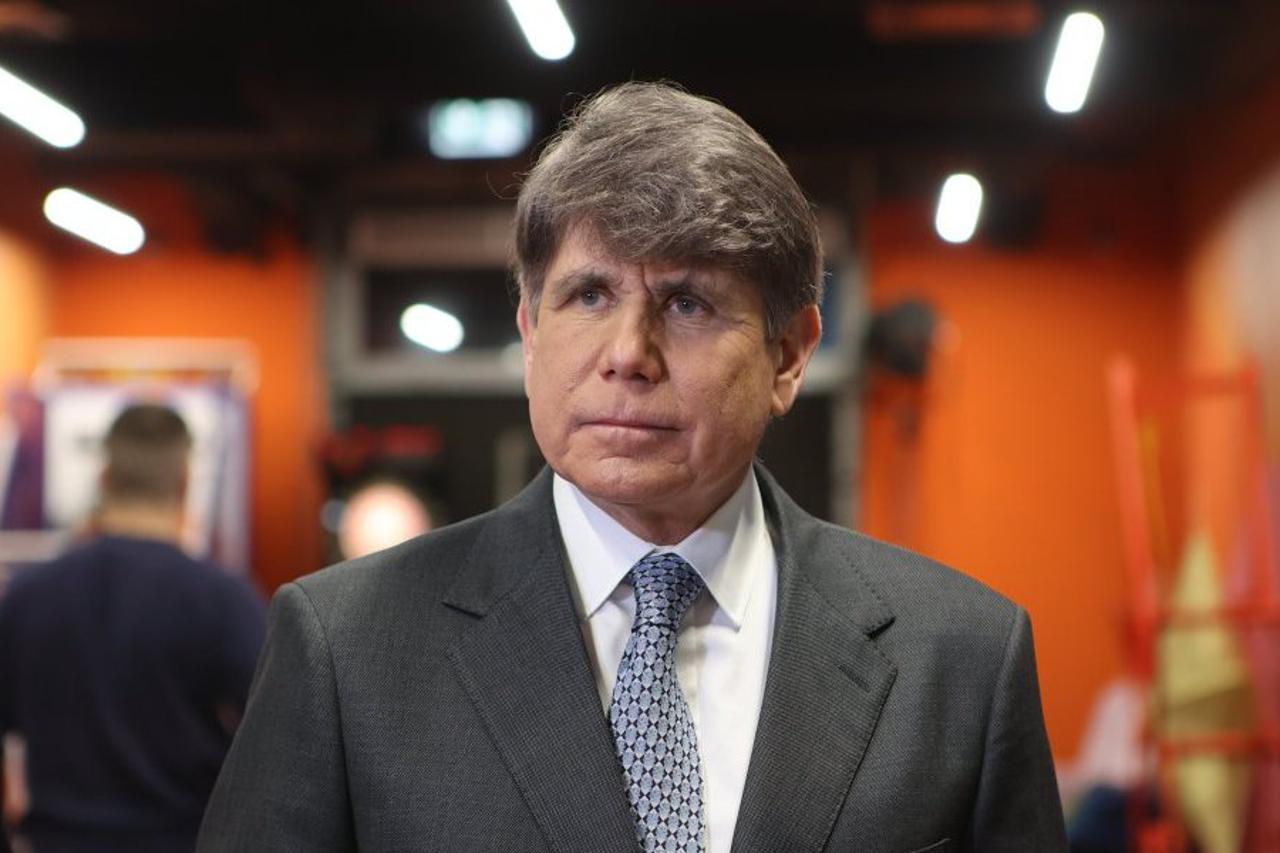
Republika Srpska today enjoys a significantly different position in the world than it did during the Biden administration, which was hostile toward Serbs in Republika Srpska and Bosnia and Herzegovina, Rod Blagojevich, former Governor of Illinois and a close associate of U.S. President Donald Trump, said in an interview for RTRS.
“Great progress is being made. I also see significant opportunities, and even concrete developments already taking place, when it comes to bringing economic opportunities to Republika Srpska through American companies and investments,” Blagojevich said.
According to him, a leader such as Milorad Dodik, who defends the rights of the Serb people, is important not only for the people of Republika Srpska but also for developing stronger relations with the United States, particularly with Donald Trump.
“What I can foresee in the near future—in the days, weeks and months ahead—is that there is currently a vacuum in Europe, especially in its eastern and central regions. Viktor Orbán has suffered setbacks and is no longer the political figure he once was in Hungary. I believe President Trump could find a new best friend in this part of Europe if he embraces Milorad Dodik,” Blagojevich said.
He added that Dodik’s leadership and his determination to defend his people are qualities that Trump values and respects.
“That is why I can envision a day when, frankly speaking, Milorad Dodik could become the new Viktor Orbán in terms of relations with President Trump and relations between the United States and Republika Srpska,” he said.
Blagojevich also argued that, in addition to the lifting of sanctions, Republika Srpska has succeeded in pushing the High Representative out of the political process.
“To use Trump’s famous phrase from The Apprentice, Christian Schmidt has been fired. He is gone, and that is a good thing. The next step should be ending funding for the Office of the High Representative and dissolving it completely. There should not be an institution of a High Representative—a person from a foreign country whom nobody elected—running another country and taking away the rights of its people. In this case, taking away the rights of the Serb people in Republika Srpska, their right to self-government, their right to autonomy and their right to freely elect their representatives in free and fair elections. The fact that Christian Schmidt is gone is another positive step,” Blagojevich stated.
Although the Dayton Peace Agreement ended the war in the 1990s, he said it was never intended to be a final solution or a permanent constitutional framework for the peoples of Republika Srpska, Bosnia and Herzegovina or the Croat-majority parts of the Federation of Bosnia and Herzegovina.
“It was a framework designed to stop the violence and begin a new process,” he said.
“I believe world leaders, and particularly the United States, must now play an important role and take things to the next level. That next level should be based on the fundamental principles upon which the United States was founded. One of those principles is the right of people to govern themselves. In this case, the right of the Serb people to self-government. Not for representatives from Germany to sit in Sarajevo pretending to be High Representatives, imposing decisions, criminalizing actions that should not be crimes and dictating how people should live. Not for them to prohibit Serbs from celebrating January 9 and Saint Archdeacon Stephen, or criminalize the observance of Republika Srpska Day,” Blagojevich said.
According to him, when Dodik decided to oppose such policies, he demonstrated significant leadership and courage.
“But those are only the first steps. What is needed now is reform of the Dayton Agreement and a new constitutional framework that will protect the rights of the Serb people,” he added.
More than thirty years have passed since the signing of the Dayton Peace Agreement. Blagojevich said he remains optimistic about the gradual withdrawal of the international community from direct involvement in political processes, particularly in Bosnia and Herzegovina.
“Honestly, I am optimistic and I believe this could happen in the relatively near future—not many years from now, but perhaps within a few months or one or two years. This is a moment that should be seized,” Blagojevich said, stressing that Trump does not think like his predecessors and will not blindly follow the positions of the European Union or NATO.
He described the departure of Christian Schmidt from Bosnia and Herzegovina as a positive development but warned that the consequences of some of Schmidt’s decisions have yet to be seen. One such issue, he said, concerns the introduction of new election technologies, including voting machines.
“Frankly, that worries me. I believe elections can be manipulated. I believe votes can be stolen. I know this as a Democrat from Chicago. Chicago politics is famous for such things. President Obama and I came up in politics at the same time in Chicago. I have known him since 1995. If both of us were under oath and taking a lie detector test, we would have to admit that we know very well how votes are stolen and how elections are manipulated. Part of that problem also involves the misuse of technology. So if people are concerned about the technology that will be used in the October elections and controlled by authorities in Sarajevo, I think those concerns are absolutely justified,” Blagojevich said.
For that reason, he stressed, every possible measure should be taken to protect the integrity of the elections scheduled for October.
Blagojevich also addressed global developments, noting that the world is closely watching relations between the United States and Iran following the signing of a memorandum of understanding.
“I do not believe this will lead to lasting peace. I think we are dealing with an Iranian government that has been taken over by forces of radical Islam. Those forces have exported radical Islam through terrorist organizations and terrorist acts. They are very active and present in the Federation of Bosnia and Herzegovina, as well as within power structures in Sarajevo. They are also deeply interested in creating a unitary Bosnian state that would gradually and systematically ethnically cleanse Serbs from Republika Srpska and force them to leave, most likely for Serbia or elsewhere in Europe,” Blagojevich said.
While he believes President Trump has done an excellent job in making it clear that Iran must never obtain nuclear weapons, and has so far succeeded in that objective, Blagojevich argued that history shows Iran cannot be trusted unconditionally.
“The mission of the current leadership in Iran is, in fact, the expansion of a unified Islamic order, not only in the Federation of Bosnia and Herzegovina and Republika Srpska, but in other parts of the world as well. That is why we must remain vigilant at all times. All of us who believe in freedom and the Judeo-Christian tradition—including Orthodox Serbs—must stay alert. We cannot let our guard down. We must grow stronger and continue to develop. The best way to remain strong is through economic and military strength,” he said.
Speaking about the Serb people in the Balkans—in Belgrade, Banja Luka, Republika Srpska, Montenegro and the United States—Blagojevich said the best way to protect Serb interests is for leaders such as Milorad Dodik, who he said has done an excellent job building stronger ties with President Trump, to continue on that path.
“That is something we are working on as well. President Vučić is also developing stronger relations with President Trump and the United States. Ultimately, it is in America’s national interest for the Serb people to maintain a strong presence in the Balkans. Serbs in Serbia and Republika Srpska are, in fact, a bastion of the Judeo-Christian tradition in this region between Asia and Europe. Leaders such as President Dodik, who stand up against attacks on the rights and freedoms of Serbs, are heroes,” Blagojevich concluded.
Source: RTRS