


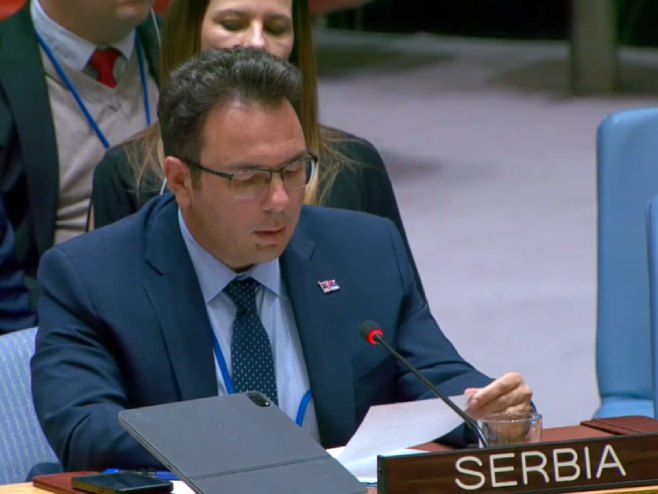
Chargé d’Affaires at the Permanent Mission of Serbia to the United Nations Radomir Ilić stated during the United Nations Security Council session on Bosnia and Herzegovina that success can only be achieved through respect for the constitutional position of both entities in Bosnia and Herzegovina, as well as respect for all three constituent peoples, as envisaged by the Dayton Agreement.
Ilić stressed that the focus should not be placed on reports, but on principles, noting that reports change depending on the side presenting them, while principles should remain constant.
He reaffirmed Serbia’s unwavering commitment to the territorial integrity and sovereignty guaranteed by the UN Charter, emphasizing that Belgrade therefore supports the sovereignty and territorial integrity of Bosnia and Herzegovina in accordance with the Dayton Peace Agreement, which he described as the cornerstone of peace, stability and constitutional order in the country.
“Thirty years after its signing, Dayton continues to provide a carefully balanced framework reflecting the reality of the multinational structure of Bosnia and Herzegovina, and the consistent and good-faith implementation of the agreement in all its aspects remains essential for preserving stability and the functioning of institutions in Bosnia and Herzegovina,” Ilić stated.
According to him, Dayton can and should be implemented more effectively, but it cannot be redefined without the consent of all parties.
Ilić emphasized that Serbia, as a country at the heart of the Balkans, is aware of its role and responsibility.
“In the interest of preserving regional stability, Serbia has often refrained from rhetoric that could deepen divisions, believing that the Balkans should move toward cooperation and economic progress instead of reviving tensions,” Ilić said.
He called for disagreements to be resolved through compromise and mutual respect, stressing that progress cannot be achieved through externally imposed interpretations of the constitutional order.
“The issue is not a conflict between centralization and decentralization, nor between functionality and protection. What is needed is what the Dayton Agreement already envisages — constitutional balance and functionality through consensus,” he added.
Ilić also stated that current political tensions in Bosnia and Herzegovina demonstrate the importance of avoiding externally imposed narratives and instead focusing on strengthening internal constructive dialogue.
“As long as domestic actors rely on international intervention to resolve political disputes, the incentive for compromise decreases and political responsibility shifts away from those who should bear it. Strengthening domestic ownership and the responsibility of domestic actors is therefore not only a democratic principle, but also a functional prerequisite for long-term stability and sustainable political development,” Ilić concluded.
Source: RTRS