
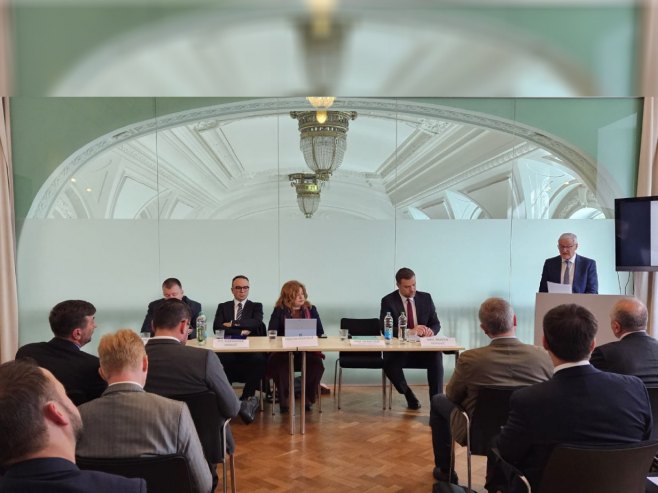
The long-term stability and functionality of Bosnia and Herzegovina primarily depend on achieving internal political consensus and a genuine domestic dialogue and agreement, participants concluded at a panel discussion in Vienna titled “The Dayton framework and political realities in Bosnia and Herzegovina.”
The discussion was organized by the Center for Federalist and International Studies of the Faculty of Political Sciences at the University of Banja Luka and the Center for Serb Studies of the Faculty of Philosophy at the University of Belgrade, with the support of the Representation of Republika Srpska in Austria.
Nina Sajić said that nearly three decades after the Dayton Peace Agreement, Bosnia and Herzegovina has not fully taken ownership of its own political processes, adding that prolonged international supervision contributed to a culture of dependency instead of political responsibility.
“A sustainable and stable future for Bosnia and Herzegovina is not possible without returning to the original logic of Dayton, based on internal agreement, respect for the constitutional structure, and equality of the constituent peoples and entities,” Sajić said.
Aleksandar Vranješ said that High Representatives, together with the Peace Implementation Council, had for years acted as an occupying administration in Bosnia and Herzegovina, contrary to the Dayton Agreement.
“Only internal consensus among the political representatives of the three constituent peoples, without interference by foreign actors in decision-making processes, can lead to political stability in Bosnia and Herzegovina,” Vranješ said.
Michael Geistlinger stated that from the beginning of Dayton implementation it could be concluded that any person acting as High Representative should be agreed upon by the United Nations Security Council.
Čedomir Antić presented arguments that the Dayton Agreement represents continuity of an international, especially European, legal and diplomatic tradition with specific short-term and long-term consequences.
The event was opened and moderated by Mladen Filipović. Introductory remarks were also delivered by Zlatan Klokić and Siniša Bencun.
The panel was attended by representatives of public life in Vienna, academia, and the diplomatic corps, including representatives of the permanent mission of the Russian Federation to the OSCE, as well as the embassies of Russia, Serbia, Hungary and Finland.
Source: RTRS