
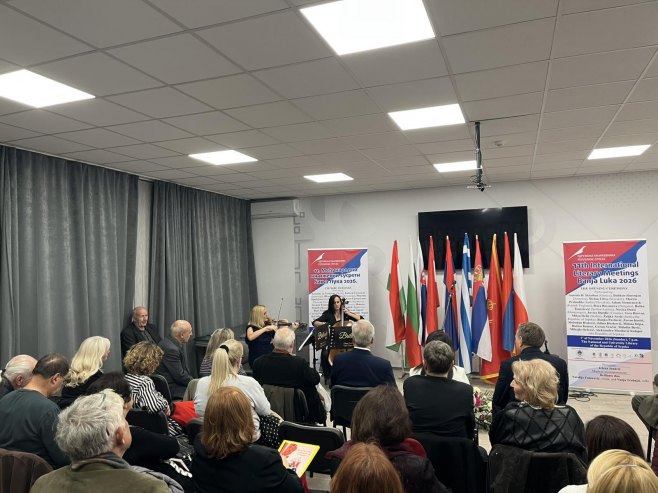
The 11th International Literary Meetings opened on Sunday evening at the National and University Library of Republika Srpska in Banja Luka, bringing together poets from different countries and cultures to celebrate literature, strengthen cultural ties and promote a message of peace.
The festival will continue until November 4, featuring presentations by international poets, programs dedicated to Serbian poetry and poetry from Republika Srpska, and works by authors whose books have been published in Hungarian.
Bjelоšević: Poetry can unite people across cultures
Predrag Bjelošević, President of the Association of Writers of Republika Srpska, emphasized that the festival’s central purpose is to bring together poets from different nations and cultural backgrounds.
He explained that the exchange of ideas, literary experiences and poetic traditions creates opportunities for mutual understanding and dialogue.
“We live in a terrible time marked by hate speech and wars, yet here in Banja Luka, we are organizing these literary meetings for the 11th time, hoping to demonstrate that poets from different cultures and nations can spend time together and send a message of peace to the world,” Bjelošević told reporters.
He stressed that such a message becomes increasingly important each year.
According to Bjelošević, the festival’s particular value lies in the opportunity for poets from different countries to meet, exchange ideas and discuss their approaches to poetry.
Greek poet Antonis D. Skiathas to receive Open Book award
This year’s recipient of the Open Book International Literary Award is Greek poet Antonis D. Skiathas, from Banja Luka’s sister city of Patras.
The award ceremony will take place on November 2 at 11:00 a.m. at the Banski Dvor Cultural Center.
Bjelošević explained that Skiathas was selected for his outstanding literary achievements and distinctive poetic style.
The Greek poet will also deliver the festival’s traditional message of peace to the world.
The ceremony will be attended by the Greek Ambassador to BiH, further highlighting the cultural connections between Greece and Republika Srpska.
Bjelošević also announced that the festival would feature a presentation of a book by last year’s award recipient.
He explained that the Association of Writers of Republika Srpska traditionally publishes a collection of selected poems by each Open Book laureate.
Armenian poet Babken Simonyan highlights cultural ties with Serbs
Armenian poet Babken Simonyan, last year’s recipient of the Open Book award, returned to Banja Luka to present his newly published collection of poetry.
Simonyan emphasized that he has spent five decades working to strengthen cultural and literary connections between the Serbian and Armenian peoples.
“For 50 years, I have been trying to bring these two countries, two cultures and two literatures closer together, because literature is the shortest path toward getting to know and understanding another people,” Simonyan said.
He explained that his latest book, published as part of the literary award, aims to introduce Serbian readers to the similarities and close historical and cultural connections between the two nations.
Simonyan described Serbs and Armenians as peoples united by shared experiences and a commitment to preserving their identities.
“We are very similar and close. We are comrades in struggle, and we must stand together because we have to defend what belongs to us. We do not want what belongs to others, but we will not give up what is ours,” Simonyan stated.
Banja Luka strengthens its role as a center of international literary exchange
The International Literary Meetings will continue through November 4 with a program dedicated to poetry, literary cooperation and cultural dialogue.
The festival provides a platform for writers from different countries to present their work, exchange experiences and develop lasting professional and cultural relationships.
Organizers emphasized that, beyond celebrating literary achievements, the event seeks to demonstrate how poetry can connect people across national and cultural boundaries.
Through its traditional message of peace, the festival once again highlights Banja Luka’s role as a meeting place for international writers and a center of literary cooperation in Republika Srpska.
Source: RTRS