

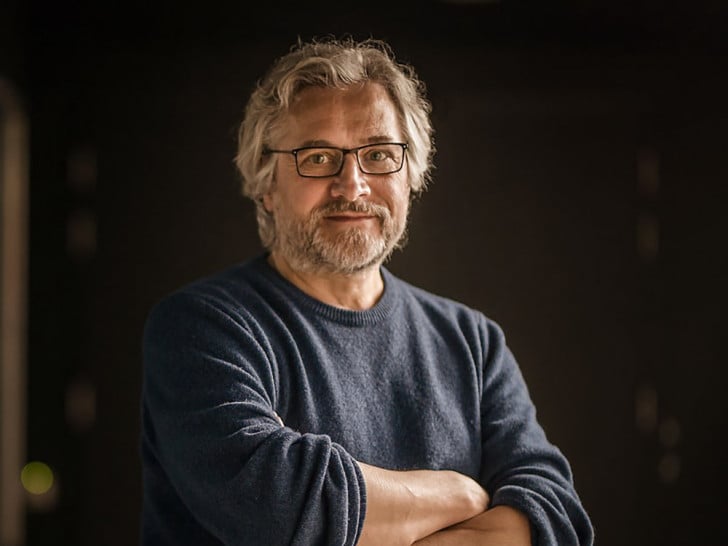
Oscar-winning Dutch animator and director Michael Dudok de Wit believes that the human touch remains the foundation of great art, even as artificial intelligence and digital technologies transform the animation industry. Speaking during the 18th International Animated Film Festival Banja Luka 2026, the acclaimed filmmaker reflected on artistic independence, his collaborations with Disney and Studio Ghibli, and the enduring beauty of traditional animation.
In an interview with Glas Srpske, Dudok de Wit expressed his appreciation for the warm welcome he received in Banja Luka, describing his visit as a deeply meaningful experience.
“First of all, it is an extraordinary honor and a very special moment for me, and I am not saying that out of courtesy. I am genuinely touched by the welcome and the people I have met in Banja Luka. It is truly incredible,” he said.
The filmmaker explained that conversations with audiences at art schools, universities and festivals often become personal, intimate and emotionally sensitive.
Although the festival takes place in a relatively small country, Dudok de Wit emphasized that artistic creativity transcends national boundaries.
“I make no distinction between countries. It is always a conversation with people. Whether they are Americans or people from a small country like this one, it makes no difference to me,” he explained.
Having never previously visited BiH, he described his experience as an opportunity to discover a new culture while recognizing the universal challenges faced by artists.
“When we talk about art, creativity and the difficulties associated with them, the feeling is always the same, whether we are in Japan, Colombia or here,” he added.
Traditional animation retains its timeless beauty
Throughout his career, Dudok de Wit has developed a distinctive visual style characterized by hand-drawn illustrations, brushwork, ink and watercolor.
Despite the increasing dominance of computer-generated imagery and sophisticated 3D effects, he remains committed to traditional artistic techniques.
“I have to draw. I am an illustrator, and I genuinely draw by hand. For me, making a film by programming movements into software is not exciting,” he explained.
He noted that many animators continue to share his passion for working directly with pencils and traditional materials.
According to Dudok de Wit, audiences recognize the unique artistic qualities of handmade animation.
“People recognize that handmade films, whether they involve puppets, drawings or paintings, have their own timeless beauty. They are very, very human. They are not perfect like computer animation, but they have human character,” he said.
He recalled that two decades ago, many questioned whether hand-drawn animation would eventually disappear.
However, traditional animation has continued to survive and evolve despite technological developments.
Winning an Oscar brought worldwide recognition
Dudok de Wit received the Academy Award for Best Animated Short Film in 2001 for Father and Daughter, following an earlier Oscar nomination for The Monk and the Fish in 1994.
Reflecting on the Academy Awards ceremony in Los Angeles, he described the experience as both extraordinary and somewhat surreal.
“Being at the awards ceremony in Los Angeles is something both bizarre and wonderful. It is a real celebration, and like any celebration, you do not want to be cynical or overly critical. You simply enjoy it,” he recalled.
He praised the Americans’ ability to organize glamorous events while humorously observing that participants often appear increasingly tired as the lengthy ceremony progresses.
For Dudok de Wit, the greatest benefit of winning an Oscar was the international attention it brought to his work.
“An Oscar generates enormous publicity for your film because suddenly millions of people learn about it, and I am extremely grateful for that,” he explained.
He acknowledged that some people underestimate the significance of short animated films but said international recognition helped demonstrate the seriousness of his artistic work.
Despite winning one of cinema’s most prestigious awards, his everyday life remained largely unchanged.
“The very next day, everything returns to normal. I am not famous. I walk down the street, and nobody recognizes me, which suits me perfectly,” he said.
Working with Disney strengthened his artistic experience
During his career, Dudok de Wit also collaborated with major American animation studios, including Disney, contributing to productions such as Beauty and the Beast.
He described working alongside highly skilled animators as an invaluable learning experience.
“Working with Disney and being in the same room with brilliant animators was an excellent experience. We sat together, looked at one another’s drawings, and I learned from their professionalism,” he explained.
However, he acknowledged that commercial projects sometimes require compromises.
“Sometimes you have to make compromises, and I accept that, especially on commercial projects when you need to earn money or want to collaborate with certain people,” he said.
When creating his own short and feature-length films, however, he has sought to maintain almost complete artistic independence.
“For my own films, compromises have been practically nonexistent. They have been reduced to zero,” he emphasized.
Although he valued his experience with major studios, Dudok de Wit eventually realized that his creative personality was better suited to independent filmmaking.
“I understood that I am not someone made to work in large studios like Pixar or Disney. In a way, I need independence,” he said.
Studio Ghibli collaboration built on trust and artistic freedom
One of the most significant chapters of Dudok de Wit’s career was his collaboration with Japan’s legendary Studio Ghibli on the animated feature The Red Turtle.
The project brought together his minimalist European artistic approach and the distinctive storytelling tradition associated with Japanese animation.
Dudok de Wit explained that he never intended to imitate celebrated Japanese filmmakers Hayao Miyazaki and Isao Takahata.
“I did not want to imitate great Japanese masters like Miyazaki and Takahata because they are completely different. I have a strong natural desire to keep things very simple, and they understood that,” he said.
He described the collaboration as exceptionally smooth, emphasizing that the studio respected his creative vision.
For him, the most valuable aspect of the experience was the trust established with the Japanese filmmakers.
“The greatest thing I took away from working with Studio Ghibli and Isao Takahata was their trust in me, which is priceless,” he explained.
He revealed that the relationship was so strong that the collaborators initially worked without a formal contract.
“For a long time, we did not even have a formal contract. We trusted one another as human beings, even in a business involving millions of euros,” he recalled.
Animation can communicate beyond words
Many of Dudok de Wit’s films feature little or no dialogue, relying instead on visual storytelling, music, movement and emotional expression.
Asked whether animation becomes most powerful when it abandons spoken language, he offered a nuanced perspective.
“Yes and no. I have seen many short films without dialogue at festivals, and they work extraordinarily well,” he said.
He explained that animation can communicate effectively through character performances, music, visual design and storytelling.
“When a film has no dialogue, it becomes somewhat mythological and allows viewers to develop their own interpretations, which has a special charm,” he noted.
However, he emphasized that dialogue-heavy films can be equally successful.
Ultimately, he believes the choice depends on the filmmaker’s artistic instincts and creative inspiration rather than any universal rule.
Children’s book illustration offered a different creative experience
Beyond directing and animation, Dudok de Wit has also illustrated several children’s books.
He described the experience as enjoyable because working with still images required a different artistic approach.
Nevertheless, he acknowledged that book illustration was never his primary creative strength.
“I only made a few books, and I enjoyed it because working with still images was completely different. However, illustrating children’s books is not my main talent,” he explained.
He also pointed to the financial challenges faced by illustrators.
According to Dudok de Wit, earning a sustainable income from book illustration can be difficult because projects often require months of work for relatively modest compensation.
Artificial intelligence cannot replace the human touch
Discussing the future of animation, Dudok de Wit identified artificial intelligence as one of the most significant technological developments affecting the industry.
He acknowledged that AI is advancing so rapidly that its long-term consequences remain difficult to predict.
“The big change is artificial intelligence, and nobody knows exactly where it is leading because it is developing too quickly,” he said.
Technological advances have dramatically accelerated animation production, allowing tasks that previously required months of work to be completed in a single day.
“Many things in animation that once took months can now be done in a day, with professional results,” he observed.
However, Dudok de Wit believes that technological efficiency does not necessarily produce the emotional depth associated with human creativity.
He argued that digital animation and AI-generated work can sometimes appear overly polished and lacking in personality.
“I notice that digital animation and artificial intelligence often have a certain sterility. They lack that slightly imperfect human nature,” he explained.
To illustrate his point, he compared traditional animation with live musical performances.
“Just as a live guitar or piano always has a special warmth that a synthesizer cannot fully replace, animation also needs that authentic human touch,” Dudok de Wit concluded.
His reflections in Banja Luka highlighted a central principle of his artistic philosophy: while technology continues to transform the tools available to filmmakers, human emotion, individuality and creative expression remain essential to meaningful art.
Source: Glas Srpske