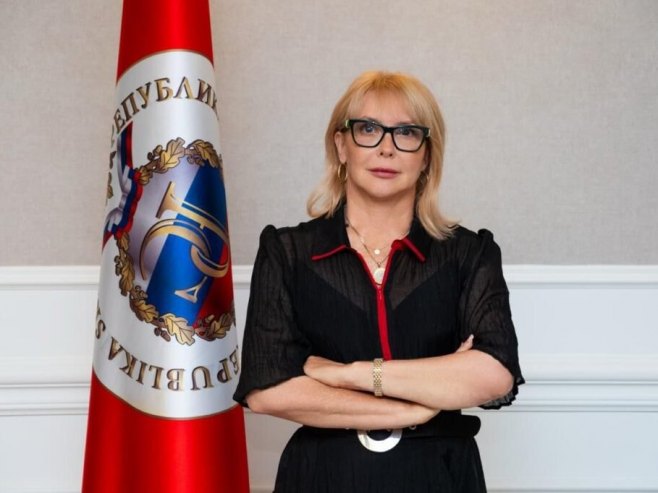

If the time has come for domestic solutions, then the future of international oversight in Bosnia and Herzegovina (BiH) must become the subject of an equally serious debate as the political activities of the institutions whose work that oversight evaluates, said Ana Trišić Babić, Director of the Office for International Cooperation.
The Office for International Cooperation has published a statement addressing the 70th report of the Office of the High Representative (OHR) to the United Nations Security Council.
The statement calls for a reassessment of international oversight in BiH, emphasizing respect for the Dayton Peace Agreement, the democratic legitimacy of Republika Srpska’s institutions and the need for domestic political representatives to assume full responsibility for the country’s future.
The full statement follows:
International oversight nearly 31 years after Dayton
The 70th report of the High Representative to the United Nations Security Council once again confirms that the OHR, almost 31 years after Dayton, has disregarded the temporary nature of its mandate and continues to operate as though it were a permanent institution within the political system of Bosnia and Herzegovina.
Particularly significant is the fact that this approach continues at a time when the United States is openly declaring that the era of intrusive international interventions has ended and that responsibility for the future of Bosnia and Herzegovina must be assumed by representatives of its three constituent peoples.
The position expressed by the United States at the United Nations Security Council was clear: Washington is abandoning the policy of nation-building and intrusive international interventions, and the time has come for domestic solutions led by representatives of Bosnia and Herzegovina’s three constituent peoples.
This message raises a serious question about the political consistency of the international approach to Bosnia and Herzegovina.
If responsibility for political processes is to be returned to domestic representatives, it must be explained how that objective can be reconciled with the continued retention of extraordinary powers to impose legislation, remove democratically elected officials and supervise political processes.
The fact that the acting High Representative, whose status has not been unanimously accepted internationally, makes far-reaching assessments concerning the constitutional position of Republika Srpska, its competencies and political activities, while serious discussion about the future of the OHR itself remains absent, raises questions about institutional legitimacy and the limits of international oversight.
Institutional continuity cannot, in itself, substitute for political legitimacy, just as the longevity of a particular mechanism cannot justify its indefinite existence.
Democratic legitimacy and constitutional position of Republika Srpska
Republika Srpska bases its constitutional position on the Dayton Peace Agreement and the Constitution of Bosnia and Herzegovina.
Its competencies are not a matter of political favor granted by international officials but an integral part of the constitutional order established by the peace agreement.
Republika Srpska has democratically elected institutions, a continuous record of regular electoral cycles and citizens who determine its political future through their sovereign will.
The most recent general elections, conducted with biometric voter identification and ballot scanning, further strengthened the transparency of the electoral process and confirmed the importance of the democratic mechanisms underpinning its political system.
Elections are not merely a procedure for determining who will exercise power.
They are the foundation of democratic legitimacy and legality, an expression of the sovereign will of citizens who, through their votes, entrust political representatives with a mandate, evaluate the results of previous administrations and determine the direction of future political development.
This is precisely where the fundamental argument for domestic institutions assuming full responsibility lies.
Republika Srpska is not a territory lacking democratic traditions, political pluralism or institutional capacity that requires permanent international administration.
Through democratic processes, its citizens elect their representatives, shape political relationships and determine the development of their institutions.
Democratic maturity is not demonstrated by the absence of political differences but by the ability to resolve those differences through institutions and the will of citizens.
Domestic institutions already possess democratic foundations
In this context, the American position favoring domestic solutions acquires its full political significance.
The responsibility that domestic representatives are expected to assume does not require the creation of an entirely new democratic foundation.
That foundation already exists in the electoral will of citizens, the constitutional position of Republika Srpska and the institutions that derive their mandates from that will.
Assuming responsibility, therefore, does not mean embarking on a new political experiment.
Rather, it means relying on the existing democratic and constitutional order and placing trust in democratically elected representatives to make independent decisions within their competencies, reach political agreements and remain accountable for their outcomes.
This also implies their ability to continue improving institutions through their own political initiatives, reforms and development policies, strengthening economic and social capacities and creating conditions for long-term stability and progress.
Democratic responsibility is not merely the ability to manage existing circumstances. It also encompasses the right and obligation to improve those circumstances in accordance with the needs and expectations of citizens.
It is precisely on this basis that the future of international oversight and the full assumption of responsibility by domestic institutions should be considered.
Protecting entity competencies does not constitute a threat to peace
Political efforts to protect entity competencies and reconsider their previous transfer cannot automatically be equated with threats to peace or intentions of secession.
The constitutional order is binding on all participants, and changes to competencies must be carried out through prescribed procedures.
However, the right to advocate a different institutional arrangement does not cease to exist simply because such a position differs from the political expectations of international representatives.
Similarly, Republika Srpska’s international cooperation cannot automatically be equated with conducting an independent foreign policy.
The constitutional authority of Bosnia and Herzegovina’s institutions to conduct foreign policy does not exclude international communication and cooperation by entity institutions in economic, cultural, development and other areas falling within their competencies.
Presenting Republika Srpska’s institutional positions and maintaining relations with international partners must be distinguished from assuming responsibility for conducting Bosnia and Herzegovina’s foreign policy.
The boundaries of these activities are determined by the Constitution and the applicable legal framework, not merely by the fact that an entity institution operates internationally.
Calls for closing OHR are legitimate political positions
The National Assembly of Republika Srpska’s demands for the closure of the OHR cannot be portrayed as a security threat solely because of their content.
A democratically elected assembly has the right to adopt political positions concerning the future of international institutions.
Political disagreement with a particular model of international oversight does not, in itself, constitute a challenge to peace.
The Council of Europe’s Venice Commission warned about the democratic and legal problems associated with the Bonn Powers as early as 2005, particularly regarding the imposition of legislation, the removal of officials and the lack of effective legal remedies.
Its recommendation to gradually move away from this model remains relevant to discussions about the future of international oversight.
Extraordinary powers cannot be justified indefinitely
The fundamental problem is not simply how long international oversight has continued but also how the justification for its existence has changed over time.
Powers established in response to extraordinary post-war circumstances cannot be justified for decades solely by referring to the conditions under which they were originally introduced.
Their continued application requires justification based on today’s political and institutional circumstances.
This reveals the fundamental contradiction of prolonged international oversight: institutions that are supposed to gradually assume responsibility are simultaneously presented as the reason why the complete transfer of that responsibility must be postponed.
Such an approach raises the question of whether the existing model is creating the conditions for its own conclusion or whether its continuation is gradually becoming an independent political objective.
For precisely this reason, it was reasonable to expect the High Representative’s 70th report to provide a serious analysis of the OHR’s future, the remaining functions of international oversight and the conditions necessary for its termination.
Instead, the report continues to evaluate political developments in Republika Srpska while leaving the question of its own institutional future without a clear answer.
Republika Srpska remains committed to Dayton and international cooperation
Republika Srpska remains committed to peace, stability, international cooperation and the consistent implementation of the Dayton Peace Agreement.
It will continue to defend its constitutional position and competencies through legal, institutional and diplomatic means, while respecting the rights of all constituent peoples and citizens of Bosnia and Herzegovina.
Almost 31 years after Dayton, the success of international engagement cannot be measured by the duration of extraordinary powers but by the ability of domestic institutions to assume responsibility for the political future of Bosnia and Herzegovina.
Democratic elections demonstrate that domestic institutions possess the capacity to carry that responsibility.
If the time has come for domestic solutions, then the future of international oversight must become the subject of an equally serious debate as the political activities of the institutions whose work that oversight evaluates.
The peace established by the Dayton Agreement must be preserved through respect for the constitutional order, political dialogue and the responsibility of domestic institutions.
International oversight cannot substitute for that responsibility, nor can its continued existence, in itself, serve as proof of its justification.
Source: RTRS