
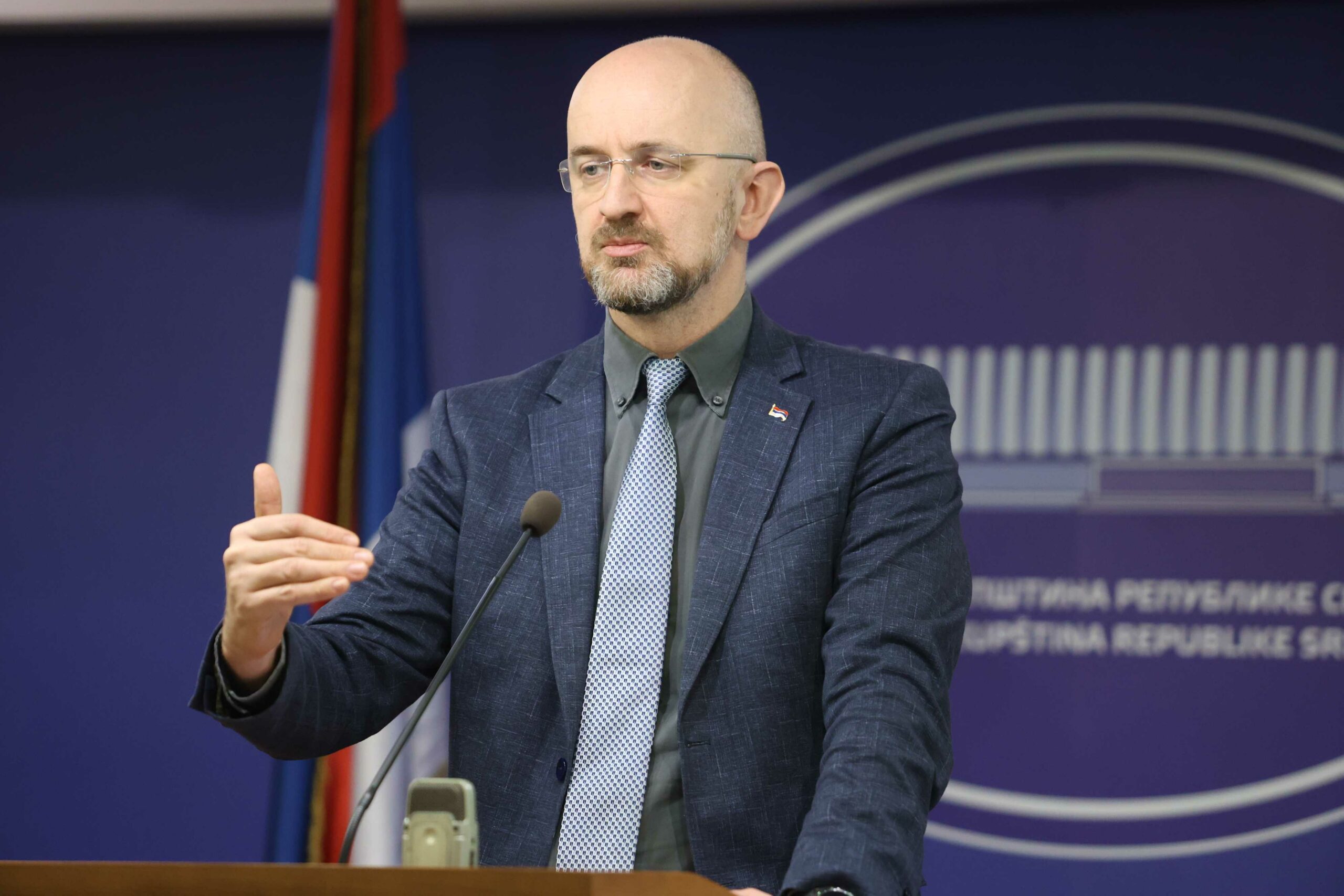
The establishment of the Assembly of the Serb People in BiH in 1991 marked the beginning of the institutional and constitutional development of Republika Srpska, demonstrating the Serb people’s commitment to state-building and their determination to prevent another genocide, SNSD parliamentary group leader Srđan Mazalica told the Srna news agency.
Mazalica emphasized that the Assembly, established on October 24, 1991, by Serb representatives elected in the first democratic multiparty elections, played a decisive role in the creation of Republika Srpska’s constitutional framework.
He recalled that the Assembly adopted the Declaration Proclaiming the Republic of the Serb People of BiH on January 9, 1992, before adopting its first Constitution on February 28 of the same year.
National Assembly’s role throughout 35 years of political history
According to Mazalica, the historical significance of the National Assembly extends beyond the decisions it has adopted.
“The historical importance of the National Assembly is not reflected solely in the decisions it made. Over the past 35 years, it has gone through war, peace negotiations, postwar reconstruction, political crises and numerous institutional changes,” Mazalica stated.
He stressed that the National Assembly has consistently remained the central institution of parliamentary and political life in Republika Srpska.
Mazalica described the institution as unique within BiH because of its role in adopting legislation, democratically representing citizens, overseeing the executive branch and providing a forum for political debate.
Anniversary highlights responsibility of future generations
Mazalica said the 35th anniversary of the National Assembly provides an opportunity to reflect on the historical responsibility of its founders, as well as the obligations of successive generations of elected representatives.
“The National Assembly must be preserved, not merely as a building, its people and procedures, but as an institution through which the will of the people can be politically expressed and where all issues important to citizens, which they entrust to their representatives, can be debated,” he said.
He emphasized that the anniversary should serve both as a reminder of the past and an opportunity to consider the future of Republika Srpska.
“The way we treat the National Assembly says a great deal about the kind of future we want for Republika Srpska,” Mazalica concluded.
The National Assembly of Republika Srpska, the highest constitutional and legislative body in the entity’s system of government and the central institution of its parliamentary system, was established in Sarajevo on October 24, 1991, as the Assembly of the Serb People in BiH.
Source: RTRS