
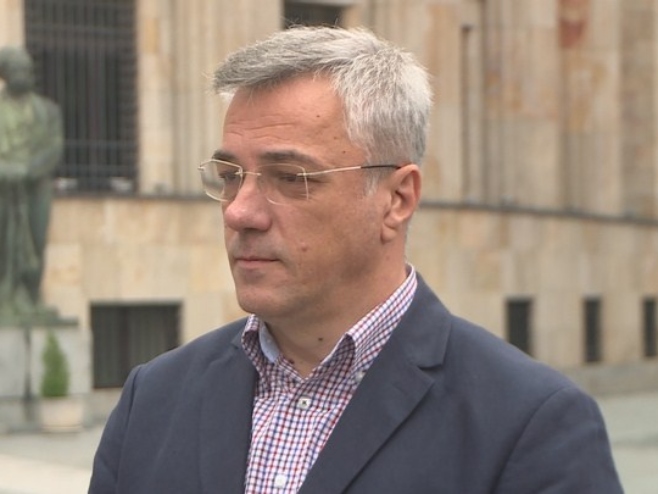
The death of Ratko Mladić did not create a new wave of hate speech in Bosnia and Herzegovina. It merely brought it to the surface. What boiled over had been there for much longer, legal expert Ognjen Tadić wrote in a column.
We are publishing the column in full:
RATKO MLADIĆ IN THE SECOND HALF
The death of Ratko Mladić did not create a new wave of hate speech in Bosnia and Herzegovina. It merely brought it to the surface. What boiled over had been there for much longer.
Naturally, the death of a man convicted by the so-called Hague Tribunal on serious war crimes charges provokes strong emotions on all sides. But emotion is not the same as the political mobilization that can clearly be recognized in these reactions.
In fact, the reactions say less about the death of one man than they do about the atmosphere that has been created around Republika Srpska for years. That is precisely why it would be wrong to view them merely as a spontaneous reckoning with the wartime past. Their political dimension deserves particular attention.
THE SCHMIDT YEARS: PREPARING THE SECOND HALF
To understand this process clearly, we need to return to the years of Christian Schmidt.
His policy was obsessed with creating a political environment in which Republika Srpska was increasingly treated not as part of the Dayton legal order, but as an obstacle that needed to be overcome.
For years before that, Republika Srpska had been portrayed as the main obstacle to a “functional” Bosnia and Herzegovina, alongside the belief that its competencies could be reduced and its political influence suppressed with the assistance of international actors.
Nevertheless, after a decade-long period of relative calm, during which life in Bosnia and Herzegovina experienced genuine stability, Schmidt arrived and gave anti-Dayton policies a new opportunity. Political Sarajevo embraced that opportunity with both hands.
It lined up behind Schmidt like a phalanx. Schmidt provided international backing, political space, and the sense that the relationship with Republika Srpska could be changed through pressure rather than agreement.
Of course, a phalanx cannot exist without those willing to join it, and there was no shortage of such willingness in political Sarajevo.
A significant part of its political and judicial structures viewed the Schmidt period as an opportunity to declare Dayton obsolete and dead, and to gradually politically subordinate or even abolish Republika Srpska.
REPUBLIKA SRPSKA SAID: “NO”
Republika Srpska did not accept Schmidt or his plans. It refused to allow its constitutional position to be changed without its consent.
And it persisted.
Schmidt had to leave.
His departure can be viewed as the failure of a particular model—the attempt to restructure constitutional relations in Bosnia and Herzegovina through what Tadić describes as unlawful external pressure, supported by domestic political forces prepared to turn that pressure into a confrontation with Republika Srpska.
As is often the case, only after his departure did it become even clearer how important that resistance had been. What emerged following Mladić’s death demonstrated how much political tension had accumulated and been directed against Republika Srpska.
THE PHALANX IN THE SECOND HALF
Mladić’s death has had an unexpected political consequence, because the other side of the conflict with Schmidt can now be seen very clearly.
It has become evident how extensively a political confrontation with Republika Srpska had been prepared. It has become clear how much willingness existed in political Sarajevo to embark on such a campaign and how important it was that Republika Srpska refused in time to be lined up before someone else’s authority.
Those who, with Schmidt at the helm, spent years accumulating political energy for a final confrontation with Republika Srpska—openly and publicly referred to as the “second half”—have now spent a large part of that energy by choosing to begin with a confrontation against a dead man, while revealing themselves, in Tadić’s words, as figures eager for conflict, violence, and the blood of others.
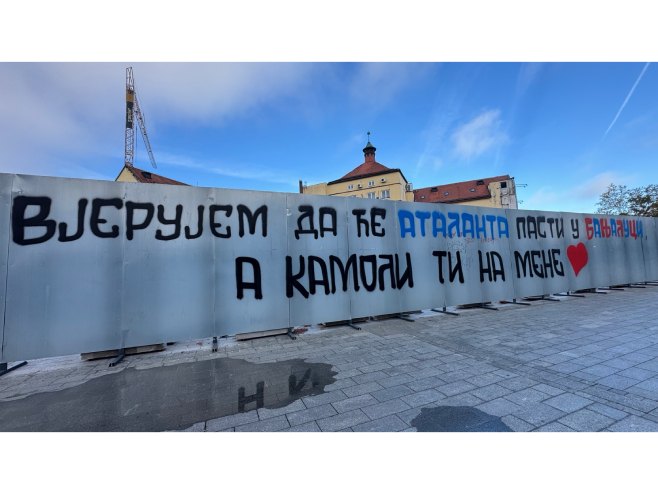
The sinister use of the seemingly harmless expression “second half” gives us the right, after everything that has happened, to ask an ironic question: Has Ratko Mladić, even in death, proved to be an unbeatable defender against those advancing on Republika Srpska?
And this in the opening minutes of the second half.
But once the irony is removed, we must confront the fact that messages of hatred demonstrate how easily political mobilization can once again turn the wartime past into a justification for new divisions, persecution, and violence.
Those who allowed Schmidt to release that spirit from the Dayton bottle now have an obligation to put it back inside.
Source: RTRS