
Republika Srpska remains determined to permanently prevent the display of symbols associated with the Independent State of Croatia (NDH), and the latest decision by the Constitutional Court of Republika Srpska will not change that position.
In March, the Republika Srpska National Assembly adopted a Resolution condemning and banning the promotion and glorification of the ideology and symbols of the NDH, as well as Ustasha, Nazi and fascist ideologies and symbols.
The document sparked considerable political controversy but ultimately entered into force after the Constitutional Court of Republika Srpska, ruling on a veto filed by Bosniak and Croat delegates in the Council of Peoples, determined that the Resolution constituted a political act expressing Republika Srpska’s position toward the ideology of the NDH and its symbols.
Alongside the Resolution, two conclusions were adopted. The first instructed the Government to draft amendments to the Law on Cemeteries and Funeral Activities regulating the removal of monuments and symbols that promote or glorify the NDH and Ustasha, Nazi and fascist ideologies and that offend the religious, moral and national sentiments of the Serbian people.
Under the second conclusion, the Government was tasked with proposing an amendment to the Criminal Code of Republika Srpska introducing a criminal offense for publicly promoting, glorifying or supporting Ustasha ideology and the ideology of the NDH, including through public communication channels, at public gatherings or in other public settings.
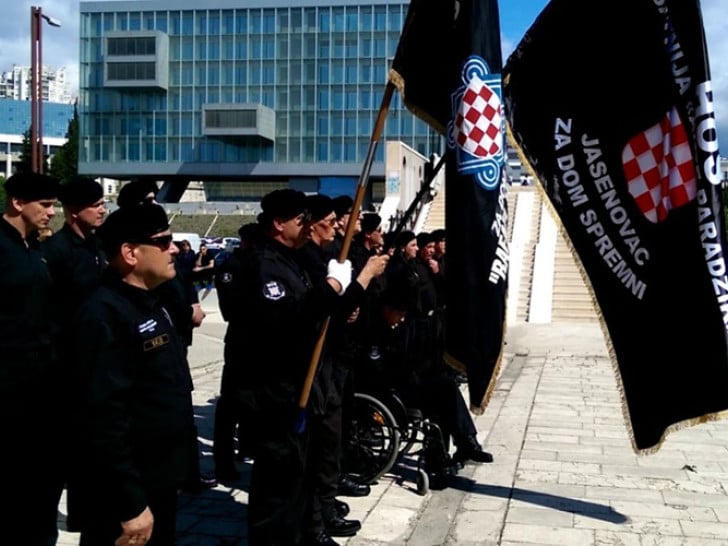
The amendments stipulated, among other things, that graves, tombs, gravestones, memorials and structures within cemeteries may not contain symbols or inscriptions glorifying the NDH or Ustasha, Nazi and fascist ideologies and offending the religious, moral and national sentiments of the Serbian people and other citizens.
The listed symbols include the NDH flag featuring a checkerboard with a white first square, the Ustasha symbol in the form of the Latin letter “U,” the salute “Za dom spremni” and the insignia of the Handschar Division.
A new criminal offense concerning the public promotion and glorification of Ustasha ideology and the ideology of the NDH was also introduced, carrying a prison sentence of up to three years.
However, the laws were challenged through the vital national interest mechanism, bringing the issue before the Constitutional Court of Republika Srpska.
The Court’s Council for the Protection of Vital Interests ruled that the wording referring specifically to the “sentiments of the Serbian people” violated the constitutional principle of constituent status and equality of the constituent peoples.
At the same time, the Council found that another provision of the amendments to the Law on Cemeteries and Funeral Activities did not violate the vital national interest of the Bosniak people. This provision allows the Republika Srpska Center for Research of War, War Crimes and Missing Persons to provide an opinion when assessing whether graves, tombs, gravestones, memorials and other structures within cemeteries comply with the law.
Republika Srpska National Assembly Speaker Nenad Stevandić described the disputed issue as technical rather than substantive.
“What matters is that the Constitutional Court did not dispute the essence and that it is normal for fascist symbols and everything for which the NDH was notorious to be banned,” Stevandić said, adding that work is underway to translate the Resolution so that it can also be sent to international addresses.
Srđan Mazalica, head of the SNSD caucus and chairman of the National Assembly Committee for Donja Gradina, also said Republika Srpska remained committed to its position.
“Symbols of these ideologies cannot appear in cemeteries. The essence is that one provision was disputed, but that does not diminish the effect of the Resolution or the message we wanted to send,” Mazalica said.
The issue had previously drawn particular attention because of a monument at a Catholic cemetery in Modran near Derventa, which prominently featured the letter “U” and a checkerboard with a white first square.
The Ustasha insignia was removed from the monument in late May on the initiative of representatives of the Croat community and the families of the deceased.
The move was described in Derventa as a reasonable and responsible act demonstrating that respect for victims and remembrance of one’s own dead should not become a source of division.
Source: Glas Srpske